Application of X-rays in Beverage Level Detection: Principles, Technologies, and Future Trends
Introduction
In modern beverage production lines, precise liquid level detection is a critical step to ensure product quality, improve production efficiency, and reduce waste. From early mechanical detection methods to modern non-contact high-precision detection technologies, liquid level detection has undergone significant evolution. Among these, X-ray detection technology has gained increasingly widespread application in the beverage industry due to its unique penetration capabilities, high precision, and non-contact characteristics. This article will delve into the application principles, technological implementation, advantages, and future trends of X-ray technology in beverage liquid level detection.
Part 1: Basic Principles of X-ray Liquid Level Detection
1.1 Physical Properties of X-rays
X-rays are electromagnetic waves with wavelengths between ultraviolet and gamma rays, possessing strong penetrating power. They can penetrate many materials opaque to visible light, such as metals, plastics, and glass. When X-rays penetrate matter, they interact with atoms, resulting in absorption, scattering, and other phenomena. Their intensity decays exponentially with increasing thickness and density of the material, following the Beer-Lambert Law:
I = I₀ * e^(-μρd)
Where:
I is the X-ray intensity after penetrating the material
I₀ is the initial X-ray intensity
μ is the mass attenuation coefficient of the material
ρ is the material density
d is the material thickness
This physical property forms the fundamental principle for applying X-rays in liquid level detection.
1.2 Basic Workflow of Liquid Level Detection
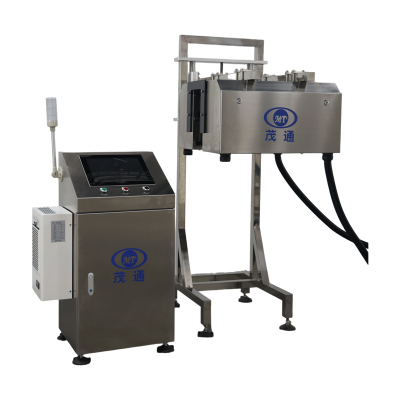
In a beverage liquid level detection system, an X-ray source emits a conical or fan-shaped X-ray beam that penetrates the beverage container. A receiver (typically a linear detector array) detects the intensity of the transmitted X-rays. Since beverages (liquids) and air (or the headspace in the container) attenuate X-rays to different degrees, the liquid height can be precisely determined by analyzing the distribution of the received X-ray intensity.
Specifically:
The top of the container (air region) causes minimal X-ray attenuation, resulting in the strongest signal at the detector
The container wall region (glass/plastic) causes moderate attenuation
The liquid region causes the greatest attenuation, producing the weakest detector signal
By analyzing the signal intensity variation curve, the liquid-gas interface position can be accurately determined
Part 2: Components of an X-ray Beverage Liquid Level Detection System
2.1 Main System Components
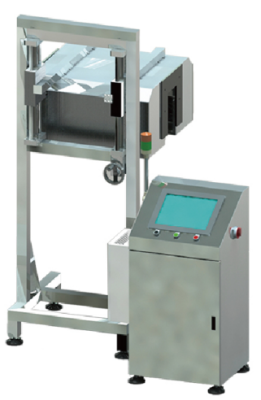
A typical X-ray beverage liquid level detection system consists of the following core components:
2.1.1 X-ray Source
Utilizes low-energy X-ray tubes (typically operating in the 20-80kV range)
Features stable output power and energy characteristics
Equipped with precise collimators to form fan-shaped or conical beams
Some systems use micro-focus X-ray sources to improve spatial resolution
2.1.2 Detector System
Linear array detectors: Composed of hundreds of independent detection units that simultaneously measure X-ray intensity at multiple positions
Scintillator + photodiode combinations: Convert X-ray photons to visible light, then to electrical signals
Digital signal processing circuits: Amplify, filter, and digitize detection signals
Modern systems often use direct digital detectors to improve detection speed and accuracy
2.1.3 Mechanical Conveyor System
Precision conveyor belts ensuring containers pass through the detection zone at constant speed
Synchronized encoders ensuring precise correlation between detection position and conveyor position
Container positioning devices ensuring each container is correctly positioned during detection
2.1.4 Data Processing and Analysis Unit
High-speed data acquisition cards for real-time detector signal collection
Dedicated algorithm processing units for real-time liquid level analysis
User interface displaying detection results and system status
Data storage and traceability system
2.1.5 Safety Protection System
Lead shielding layers ensuring radiation safety in operational areas
Interlock devices preventing X-ray emission when protective doors are open
Radiation monitors continuously measuring ambient radiation levels
2.2 Detection System Workflow
Containers enter the detection zone, triggering photoelectric sensors
The system activates the X-ray source, emitting a stable X-ray beam
Containers pass through the X-ray beam at constant speed while the detector array continuously collects transmission signals
The data processing unit analyzes signal intensity curves in real-time to identify liquid level positions
Results are compared with preset standards to determine if liquid levels are acceptable
Non-conforming products are marked or removed from the production line by rejection devices
Detection data is recorded in a database for quality analysis and process control
Part 3: Key Technologies and Algorithms in X-ray Liquid Level Detection
3.1 Liquid Level Boundary Recognition Algorithms
Accurately identifying liquid level boundaries is the core of the system. Common algorithms include:
3.1.1 Threshold Method
Sets intensity thresholds to distinguish liquid and air regions
Suitable for simple scenarios with obvious contrast
Fast computation, ideal for high-speed production lines
3.1.2 Edge Detection Method
Uses operators like Sobel or Canny to detect edges in signal intensity curves
Precisely locates liquid level boundary positions
Sensitive to noise, requiring filtering
3.1.3 Derivative Analysis Method
Calculates first or second derivatives of signal intensity curves
Derivative extremum points correspond to liquid level boundaries
High precision but relatively computationally intensive
3.1.4 Pattern Matching Method
Performs correlation analysis with standard liquid level curves
Suitable for complex container shapes and liquid properties
Strong anti-interference capability but requires extensive standard samples
3.2 Compensation Techniques for Influencing Factors
Various factors in production environments can affect detection accuracy, requiring compensation techniques:
3.2.1 Container Wall Thickness Variation Compensation
Different container batches may have varying wall thicknesses
Dynamic threshold adjustment based on signal intensity from empty container regions
Ensures liquid level detection is unaffected by container variations
3.2.2 Liquid Composition Variation Compensation
Different beverage densities and compositions affect X-ray attenuation
Establishes attenuation model libraries for different beverage types
Automatically selects appropriate parameters based on product type
3.2.3 Temperature Effect Compensation
Liquid density changes with temperature
Integrated temperature sensors for real-time density parameter adjustment
Improves detection accuracy for hot-fill products
3.2.4 Bubble and Foam Compensation
Bubbles in beverages and top foam affect liquid level determination
Uses multiple scan averaging or multi-point analysis techniques
Distinguishes between actual liquid levels and foam interfaces
3.3 Real-Time Data Processing and Optimization
High-speed production lines require real-time processing capabilities:
Uses FPGAs or dedicated DSPs for real-time signal processing
Parallel processing architecture handles multiple detection points simultaneously
Optimized data pipeline minimizes processing delays
Typical system speeds can exceed 1000 bottles per minute
Part 4: Advantages and Challenges of X-ray Liquid Level Detection
4.1 Technical Advantages
Compared to traditional liquid level detection technologies, X-ray detection offers significant advantages:
4.1.1 Non-Contact Detection
No direct contact with products, avoiding contamination
Does not interfere with normal production line flow
Suitable for aseptic filling environments
4.1.2 High Precision and Reliability
Liquid level detection accuracy up to ±0.5mm
Unaffected by container color, transparency, or surface characteristics
Can detect liquid levels in opaque containers
4.1.3 Multi-Function Integration
Simultaneously detects liquid levels, seal integrity, and foreign objects
One system achieves multiple quality control functions
Improves equipment utilization and return on investment
4.1.4 Strong Adaptability
Detects containers of various materials: glass, plastic, metal, cartons
Suitable for various liquids: water, juice, carbonated beverages, dairy products
Handles different capacities from milliliters to liters
4.1.5 Data Richness
Provides detailed detection data supporting Statistical Process Control (SPC)
Enables production quality traceability
Offers data support for process improvement
4.2 Technical Challenges and Responses
4.2.1 Radiation Safety
Challenge: Potential radiation risks to operators
Response: Strict shielding design complying with international safety standards; multiple interlock protections; regular radiation monitoring; operator training and protection
4.2.2 System Cost
Challenge: Higher initial investment than traditional methods
Response: High long-term returns through reduced waste and improved product quality; multi-function integration lowers overall equipment costs
4.2.3 Complex Product Adaptation
Challenge: Detection of complex products with pulp, bubbles, or multiple liquid layers
Response: Advanced algorithm development, such as deep learning; multi-energy X-ray technology to distinguish different components
4.2.4 Maintenance Specialization
Challenge: System maintenance requires specialized knowledge
Response: Modular design reduces maintenance difficulty; remote diagnostic support; regular maintenance personnel training
Part 5: Practical Application Case Studies
5.1 Carbonated Beverage Liquid Level Detection
Carbonated beverage production lines operate at high speeds (up to 2000 cans per minute) with liquids containing CO₂ bubbles, posing high demands on detection systems. An international beverage company successfully implemented an X-ray detection system achieving:
Liquid level detection accuracy of ±0.3mm
Detection speed compatible with 1800 cans/minute production lines
Simultaneous detection of fill volume, seal integrity, and can deformation
100% automatic rejection rate for non-conforming products
Annual cost savings of approximately $1.2 million (from reduced overfilling and customer complaints)
5.2 Premium Juice Product Liquid Level Detection
Premium juice products use opaque carton packaging where traditional optical methods fail. X-ray systems enable:
Penetration of opaque packaging for precise liquid level detection
Detection accuracy of ±0.5mm, ensuring consistent filling per carton
Simultaneous detection of straw insertion position and packaging seal integrity
Adaptation to density variations of different juice types
Enhanced premium brand image and reduced consumer complaints
5.3 Beer Bottle Liquid Level Detection
Dark bottle colors and uneven glass thickness challenge detection systems. Specialized X-ray systems feature:
High-power X-rays penetrating dark glass
Automatic compensation for glass thickness variations
Precise liquid level detection ensuring foam height meets standards
Detection of cap seal integrity and internal foreign objects
Quick adaptation to different bottle types and sizes
Part 6: Technological Trends and Future Outlook
6.1 Multi-Energy X-ray Technology
Traditional single-energy X-rays struggle to distinguish materials with similar densities. Multi-energy X-ray technology:
Uses different X-ray energies to scan the same object
Distinguishes materials through attenuation differences
Simultaneously analyzes liquid composition during level detection
Improves detection capability for beverages containing pulp or sediment
6.2 Deep Learning and Artificial Intelligence
AI technologies are transforming X-ray detection:
Convolutional Neural Networks (CNNs) automatically recognize liquid level patterns
Reduce dependency on preset parameters, improving adaptability
Self-learning systems continuously improve accuracy with production data accumulation
Predictive maintenance identifies potential equipment issues in advance
6.3 Miniaturization and Integration
Future X-ray detection systems will become more compact:
Miniaturized X-ray sources reducing equipment footprint
Highly integrated detectors improving spatial resolution
Modular design facilitating integration into existing production lines
Lower energy consumption improving energy efficiency
6.4 High-Speed 4D Detection
4D detection technology incorporating the time dimension:
High-speed scanning capturing liquid dynamic characteristics
Analysis of liquid surface fluctuations during filling
Detection of bubble formation in carbonated beverages
Real-time feedback for filling process optimization
6.5 Spectral CT Technology
Industrial application of Computed Tomography (CT) technology:
Obtains 3D images of containers and liquids
Precisely calculates actual fill volume, not just liquid level height
Detects internal defects and microscopic foreign objects
Although slower, suitable for premium products and sampling inspection
Part 7: Industry Standards and Regulatory Requirements
X-ray liquid level detection systems must comply with stringent international standards and regulations:
7.1 Radiation Safety Standards
IEC 60529: Equipment protection levels
21 CFR 1020.40: U.S. FDA requirements for X-ray equipment
ISO 13485: Quality management systems for medical devices
National radiation protection regulations (e.g., China's "Radioactive Pollution Prevention and Control Law")
7.2 Food Industry Standards
FDA regulations on food contact materials
EU 10/2011: EU regulations on plastic food contact materials
HACCP system integration
GMP (Good Manufacturing Practice) requirements
7.3 Detection Performance Standards
ISO 2859: Sampling inspection procedures
ISO 11607: Packaging for terminally sterilized medical devices
Industry-specific standards (e.g., beverage industry association standards)
Conclusion
The application of X-ray technology in beverage liquid level detection represents the development direction of modern quality control technologies in the food and beverage industry. With its non-contact, high-precision, and strong adaptability characteristics, X-ray detection systems have become indispensable quality control tools in premium beverage production lines. As technologies like multi-energy X-rays, artificial intelligence, miniaturization, and high-speed scanning continue to develop, the performance of X-ray liquid level detection systems will further improve, and their application scope will expand.
Meanwhile, safe use of X-ray systems must be emphasized, strictly adhering to radiation protection regulations to ensure operator and environmental safety. Amid rapid technological advancement, beverage manufacturers must comprehensively consider detection requirements, production line characteristics, return on investment, and regulatory requirements to select the most suitable liquid level detection solution.
Looking ahead, as consumer demands for product quality continue to increase and production efficiency remains a priority, X-ray liquid level detection technology will undoubtedly play an increasingly important role in the beverage industry, driving the entire sector toward higher quality, greater efficiency, and smarter operations.