A Comprehensive Analysis of Ink-Jet Code Inspection Technology for Glass Bottle Caps
I. Industry Background and Inspection Requirements
In the fast-moving consumer goods (FMCG) sectors—including beverages, alcoholic spirits, and condiments—glass bottle containers remain a primary choice for premium product packaging due to their high chemical stability and recyclability. As a critical component for sealing, the bottle cap bears essential data within its ink-jet printed codes, such as production dates, batch numbers, and traceability codes. With the implementation of the *Food Safety Law* and the growing consumer awareness regarding rights protection, the quality inspection of these ink-jet codes has become an indispensable requirement for quality control on production lines.
II. Principles of Ink-Jet Code Inspection Technology
2.1 Composition of the Vision System
Modern ink-jet code inspection systems typically employ industrial-grade line-scan or area-scan CCD cameras, paired with highly uniform ring lights or coaxial light sources. To address the unique reflective surfaces of glass bottle caps, customized polarizing filters are utilized to eliminate interference caused by specular reflection. Jinan Maotong Vision Inspection Equipment employs a multi-angle compound lighting scheme in this field: a primary light source illuminates the surface at a low angle of 30° to highlight the raised or recessed textures of the ink-jet code; this is supplemented by diffuse top lighting to eliminate shadows, while lateral structured light assists in detecting the precise position of the bottle cap's edges.
2.2 Image Processing Workflow
1. Image Acquisition Phase: The camera's acquisition resolution typically exceeds 2 megapixels, capturing the entire bottle cap area in a single shot. At a production line speed of 1,500 bottles per minute, the exposure time must be controlled to within 0.1 milliseconds, utilizing a global shutter to prevent motion blur.
2. Preprocessing Algorithms: To mitigate common interference factors associated with glass bottle caps—such as reflections and scratches—Adaptive Histogram Equalization (CLAHE) is applied to enhance contrast, combined with median filtering to remove "salt-and-pepper" noise. Bottle caps made of specialized materials (e.g., frosted glass or metal) require the application of distinct preprocessing parameter templates.
3. Character Segmentation and Recognition: Connected component analysis is combined with projection-based segmentation to isolate the ink-jet code area into individual character units. A deep learning-based OCR engine is capable of recognizing various formats—including printed text and dot-matrix codes—and achieves a fault-tolerant recognition rate of over 99.5% even for damaged or incomplete characters. The system also supports the simultaneous reading of multiple code types, such as standard alphanumeric codes, QR codes, and DataMatrix codes. 4. Defect Classification Model: A machine-learning-based defect classifier is established to categorize coding issues into four major groups:
• Integrity Defects: Missing characters, broken lines/segments, insufficient ink coverage
• Clarity Defects: Blurriness, ink diffusion/blooming, ghosting/double imaging
• Positional Accuracy: Offset deviation > 0.3 mm, rotation angle > 2°
• Content Errors: Batch code mismatch with database records, date logic errors
III. Production Line Integration Solution
3.1 Hardware Deployment Architecture
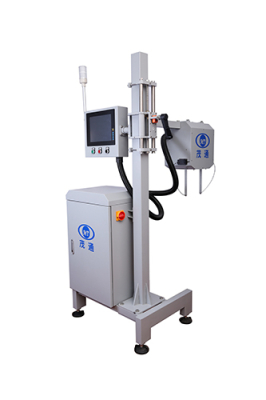
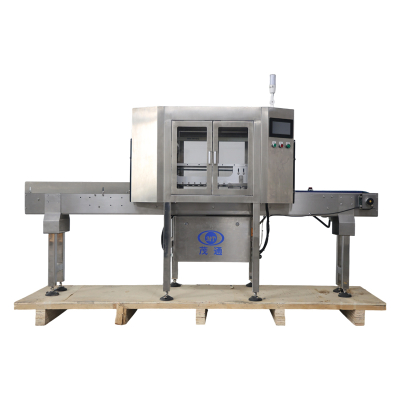
On a typical beverage filling line, the inspection station is usually positioned downstream of the capping machine and upstream of the labeling machine. The Jinan Maotong MT-VS3000 series equipment utilizes a gantry-style mounting structure to ensure an optimal working distance of 80 mm between the camera and the bottle cap. Photoelectric sensors are installed on both sides of the conveyor belt; when a bottle triggers a sensor, a rotary encoder simultaneously triggers the camera to capture an image, ensuring that the deviation between the image center and the bottle cap center remains less than 0.1 mm.
3.2 Motion Synchronization Control
The greatest challenge in high-speed production lines is image blur caused by bottle vibration. The solution involves:
• Employing a servo-motor-driven focus-tracking mechanism to fine-tune the camera height in real-time based on encoder signals
• Installing a vibration-damping air-cushion platform to isolate the main inspection unit from mechanical vibrations originating from the production line
• Developing a motion prediction algorithm that forecasts the precise position of the fourth bottle based on the motion trajectories of the preceding three bottles
3.3 Tiered Processing Mechanism
The inspection system communicates in real-time with the production line PLC via PROFINET or EtherCAT protocols, executing a three-tiered processing response based on the inspection results:
• Tier 1 (Pass): Green light signal for release; data is uploaded to the MES system
• Tier 2 (Suspicious): Yellow light alarm; triggers a secondary verification process at a dedicated re-inspection station
• Tier 3 (Fail): Red light alarm; a pneumatic pusher ejects the defective bottle into a designated rework lane within 0.2 seconds
IV. Key Technological Breakthroughs
4.1 High-Reflectance Surface Imaging Technology
To address highly reflective materials—such as gold-colored aluminum caps and electroplated caps—Jinan Maotong has developed a multi-spectral fusion imaging technology. This technology utilizes a beam-splitting prism to separate incoming light into distinct RGB channels; images are captured for each channel using different polarization angles, and subsequently reconstructed via image fusion algorithms to produce a clear, glare-free image devoid of high-light interference. Experimental data indicates that this method improves the recognition accuracy for highly reflective regions from 78% to 99.2%.
4.2 Dynamic Optimization via Deep Learning
The device's embedded MT-AI engine features an online learning capability: whenever a novel defect pattern is detected, the system automatically captures over 100 sample images. These images are then processed by an edge computing unit to train and generate a supplementary feature model, allowing the new defect type to be incorporated into the detection library within 48 hours—without the need for remote software upgrades from the manufacturer.
4.3 Robust Detection in Complex Backgrounds
Beverage production lines operate in complex environments frequently subject to interference from water stains, foam, and label glare. By utilizing Generative Adversarial Networks (GANs) to create a dataset of 100,000 annotated synthetic images, a detection model was trained that demonstrated a 40% improvement in interference immunity compared to traditional algorithms during real-world production line testing.
V. Quality Data Analysis System
5.1 Real-time Monitoring Dashboard
The system provides a web-based monitoring interface that displays the following information in real time:
• Production line OEE (Overall Equipment Effectiveness) curves
• Coding pass rate trend charts (aggregated by hour or shift)
• Pareto analysis of defect types
• Comprehensive equipment utilization rates and MTBF (Mean Time Between Failures)
5.2 Traceability and Early Warning Functions
Each image of a bottle cap's printed code is stored in association with its corresponding inspection result, with a retention period of at least three years. Should quality fluctuations be detected within a specific product batch, the system can:
• Trace the temporal distribution of all bottles exhibiting similar defects within the preceding 24 hours
• Conduct correlational analyses involving 32 key process parameters, such as ambient temperature and humidity, ink viscosity, and printhead voltage
• Automatically push early warning notifications to maintenance personnel whenever five consecutive bottles are found to exhibit the same type of defect
5.3 SPC (Statistical Process Control)
The system incorporates built-in Shewhart control charts to perform real-time SPC analysis on Critical-to-Quality (CTQ) characteristics—such as coding position offset, character height, and ink density. If data points fall outside the Upper/Lower Control Limits (UCL/LCL) or if a rising trend is observed across seven consecutive data points, the system automatically notifies process engineers to adjust the coding machine's parameters. VI. Real-World Application Cases
6.1 Beer Production Line Upgrade Project
In 2025, a major beer conglomerate implemented the Jinan Maotong inspection system at its Qingdao facility, applying it to a 330ml glass bottle beer production line. A comparison of data before and after the upgrade reveals the following improvements:
• The missed detection rate for date codes dropped from 1.2% (under manual spot-checking) to 0.0015%.
• Customer complaints attributed to date code issues saw a 92% year-over-year quarterly reduction.
• Production line speed increased from 1,200 bottles per minute to 1,500 bottles per minute.
• Quality control staffing was reduced from two personnel per shift to 0.5 personnel (assigned to cross-line roving inspections).
6.2 Customized Solution for a Juice Manufacturer
To address the challenge posed by the diverse range of bottle cap colors (transparent, amber, and green) used for NFC juice products, Jinan Maotong developed an adaptive color engine. When the equipment encounters a bottle cap of an unknown color for the first time, it automatically executes the following process:
1. Captures images of five sample bottle caps.
2. Analyzes the HSV spatial distribution of the dominant color tone.
3. Matches the optimal lighting combination from a pre-established light source library.
4. Generates a dedicated set of inspection parameters specifically for that color.
This entire adaptive process is completed within 30 seconds, enabling seamless switching between different product lines.
VII. Future Technology Outlook
7.1 Integration of 5G and Edge Computing
The next generation of inspection equipment will incorporate industrial-grade 5G modules to transmit high-resolution images (20MB per image) in real-time to a cluster of edge servers for processing; the device itself will retain only a lightweight inference engine. Testing has demonstrated that this architecture can reduce the analysis time for complex defects from 50ms to 8ms, thereby laying the foundation for increasing production line speeds to 2,000 bottles per minute.
7.2 Digital Twin-Based Quality Prediction
By leveraging real-time production line data, a digital twin model is constructed to simulate the impact of factors—such as print nozzle wear and variations in ink characteristics—on date code print quality. Should the model predict that the date code pass rate is likely to drop below 99% within the next four hours, it automatically generates a preventive maintenance work order, thereby achieving a transformative shift from merely "detecting defects" to "preventing defects." 7.3 Cross-Modal Quality Correlation
The intelligent quality management system currently under development correlates and analyzes visual inspection data alongside data from other workstations—such as filling precision, capping torque, and liquid fill levels. Through big data mining, the system uncovers latent quality correlations; for instance, it may detect that when ambient humidity exceeds 75%, the defect rate for inkjet code diffusion triples, prompting the system to automatically recommend activating dehumidification equipment.
Conclusion
The inspection of inkjet codes on glass bottle caps has evolved from a simple "presence/absence" check into an intelligent quality perception system that integrates optical imaging, artificial intelligence, and big data analytics. Through continuous innovation, domestic manufacturers—such as Jinan Maotong—have not only achieved world-leading levels of inspection precision (with a defect detection rate exceeding 99.99%) but have also established unique advantages in terms of production line adaptability, ease of use, and overall intelligence. As the Industrial 4.0 era continues to advance, visual inspection technology is poised to become a core pillar of quality assurance systems within the food and beverage industry, safeguarding the safety and traceability of every bottle—from the production line all the way to the consumer.