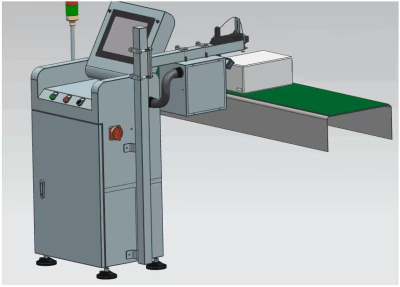
Keep Carton Lines Audit Ready With Tetra Pak Straw Pipette Detection
In high-speed paper beverage carton production, two small issues can quickly turn into costly complaints: an unreadable inkjet code and a missing straw. Tetra Pak Straw Pipette Detection is designed to run inline and verify both points on every passing package—without contact and without slowing the conveyor. It combines top-view imaging, encoder-based tracking, real-time HMI status, and automatic rejection so defects can be removed before they move further downstream.

Installation location on the conveyor
For Tetra Pak Straw Pipette Detection to be effective, it must be positioned where the straw has already been applied and the pack is stable for imaging. The specified installation point is on the conveyor line approximately 0.5–1.0 meters downstream from the tube applicator. At this location, Tetra Pak Straw Pipette Detection can check both inkjet printing quality and straw placement as part of one continuous inspection step.
A typical inline layout follows a simple sequence:
Placing the unit at this distance supports continuous inspection while maintaining normal production flow, helping the rejection mechanism act on the correct package at the correct time.
Detection principle in real time
Tetra Pak Straw Pipette Detection integrates a positioning sensor, a Gigabit Ethernet digital camera, an image processor, an HMI for status display, and a control unit that drives rejection. The workflow is designed to keep tracking stable—even when line speed changes or the conveyor stops briefly.

1) Positioning sensor detects the package
As each package passes the positioning sensor, Tetra Pak Straw Pipette Detection detects the arrival, logs the package ID, and records the real-time encoder signal. This creates the basis for consistent tracking and correctly timed rejection.
2) Encoder-based tracking keeps rejection accurate
The encoder is mounted on the conveyor’s synchronous motor. In Tetra Pak Straw Pipette Detection, the encoder counting system helps ensure the rejection accuracy is not affected by production line stoppages or changes in conveyor speed—a practical requirement on fast beverage carton lines.
3) Camera captures top-view images for analysis
The positioning sensor triggers the Gigabit Ethernet digital camera to capture top-view images of each package. In Tetra Pak Straw Pipette Detection, these images are transmitted over the network to the image processor for digital analysis.
4) Image processor evaluates inkjet codes and straw presence
Based on the configured inspection requirements, Tetra Pak Straw Pipette Detection supports multiple inspection categories for inkjet code quality and straw verification, including:
When defects are detected, Tetra Pak Straw Pipette Detection provides a clear pass/fail outcome per package.
5) HMI displays inspection status with access control
Inspection results are also sent to the HMI for real-time display. Tetra Pak Straw Pipette Detection includes a user-friendly interface with configurable multi-level access permissions, supporting daily operation and management.
6) Control unit triggers the rejector automatically
If the control unit receives a defect signal, it instructs the rejector mechanism to automatically remove the identified defective package(s) without interrupting production. This inline approach is core to Tetra Pak Straw Pipette Detection, especially where manual checks are impractical at high throughput.
Deep learning support for product changeovers
In practical production, different carton models can have different printing layouts or visual characteristics. Tetra Pak Straw Pipette Detection uses a deep learning approach intended to reduce manual intervention during model changeovers. When switching product models on-site, about 300 product images are collected for data collection, and the corresponding data model is constructed. Once models are established for the required product types, Tetra Pak Straw Pipette Detection can apply the appropriate detection logic to support error-proof inspection across product variants.
For lines focused specifically on straw placement checks, a related option is Tetra Pak Straw Position Detection.
Technical specifications and inspection performance
The inspection system model for Tetra Pak Straw Pipette Detection is Tetra Pak Straw Pipette Detection, designed for non-contact, inline inspection on paper packaging production lines.
Core specifications
| Tetra Pak Straw Pipette Detection (as specified) | |
|---|---|
| Inspection mode | Non-contact, inline inspection |
| Maximum throughput | Up to 24,000 packages per hour |
| Imaging | Gigabit Ethernet digital camera (top-view) |
| Protection rating | IP65 |
| Traceability | Daily automatic storage of defective product images (storage duration adjustable) |
| Line adaptability | Encoder-based counting system supports stable rejection timing through speed changes/stops |
Accuracy figures provided for testing conditions
| Inspection item | Rejection rate | False kick / false reject |
|---|---|---|
| Missing inkjet printing (no coding) | ≥99.99% | — |
| Straw presence (no straw) | ≥99.99% | ≤0.01% |
| Inkjet inspection (overall) | — | ≤0.03% |
These figures are presented as theoretical experimental data under the stated testing conditions.
Where it fits in a procurement discussion
Buyers evaluating Tetra Pak Straw Pipette Detection typically focus on three operational outcomes: stable inline checks at production speed, rejection accuracy that stays consistent during normal line disturbances, and traceability that supports investigation when defects occur. Features such as unique lighting design (intended to avoid impact from natural light), industrial-grade cooling and air conditioning, and 24/7 remote monitoring/operation are commonly reviewed as part of site integration planning.
Product page details are available at Tetra Pak Straw Pipette Detection, and a related application description is shown on Juice Box Quality Inspection.