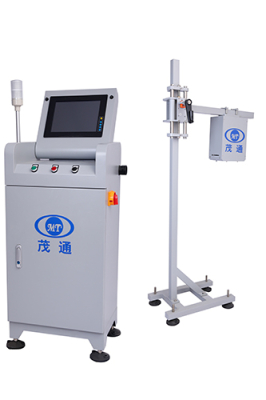
Verify Operating Conditions Before Buying Best Bottle Inspection Machine
Selecting a Best Bottle Inspection Machine is not only a question of speed or detection accuracy. For PET and PE bottle lines, stable performance also depends on whether the workshop environment, power supply, compressed air, grounding, and conveyor integration match the system requirements. On a 48,000 bottles-per-hour line, small mismatches can influence image quality, rejection timing, and long-term equipment reliability.

Operating Environment Buyers Should Confirm First
A Best Bottle Inspection Machine should be installed in a controlled industrial environment where optical imaging and electronic components can operate consistently. For the MT-PK021 bottle finish inspection system, the recommended operating altitude is 5–3000 m, the ambient temperature range is 5°C–40°C, and the relative humidity range is 50%–65% RH.
The workshop floor should meet requirements for flatness and load-bearing capacity. Storage areas for equipment and spare parts should also follow proper storage conditions, with lubrication and preventive maintenance during idle periods to reduce the risk of surface damage, corrosion, or deformation before commissioning.
Utility Conditions That Affect Inspection Stability
For buyers comparing a Best Bottle Inspection Machine, utility readiness is a practical checkpoint. The machine’s operating conditions include a noise level of ≤85 dB, although actual sound levels may vary with container type, equipment power, and building acoustics.
| Requirement | |
|---|---|
| Main power | 3 × 380V AC ±10%, 50 Hz, 3PH + N + PE |
| Lighting power | 220V AC, 50 Hz, single-phase |
| Control voltage | 24 VDC |
| Total installed power | Approx. 1.0 kW |
| Compressed air | 4–6 bar |
| Noise level | ≤85 dB |
Power should be connected from the customer’s main electrical cabinet to the equipment cabinet. If special voltage is required, it should be confirmed in advance because it may affect equipment specifications, delivery arrangements, and integration planning.
How Machine Vision Supports Bottle Finish Control
A bottle mouth inspection machine uses machine vision to inspect the bottle finish without contact. As bottles move along the conveyor, a positioning sensor detects each bottle and records its ID and encoder position through the control unit. The camera then captures the bottle mouth image, and the image processor analyzes the result for real-time display on the HMI and for rejection tracking.
This inspection process is especially important before filling, because the bottle finish is directly related to sealing quality. If the system identifies a defective finish, the control unit sends a rejection command so the rejector removes the corresponding bottle without interrupting normal production flow.
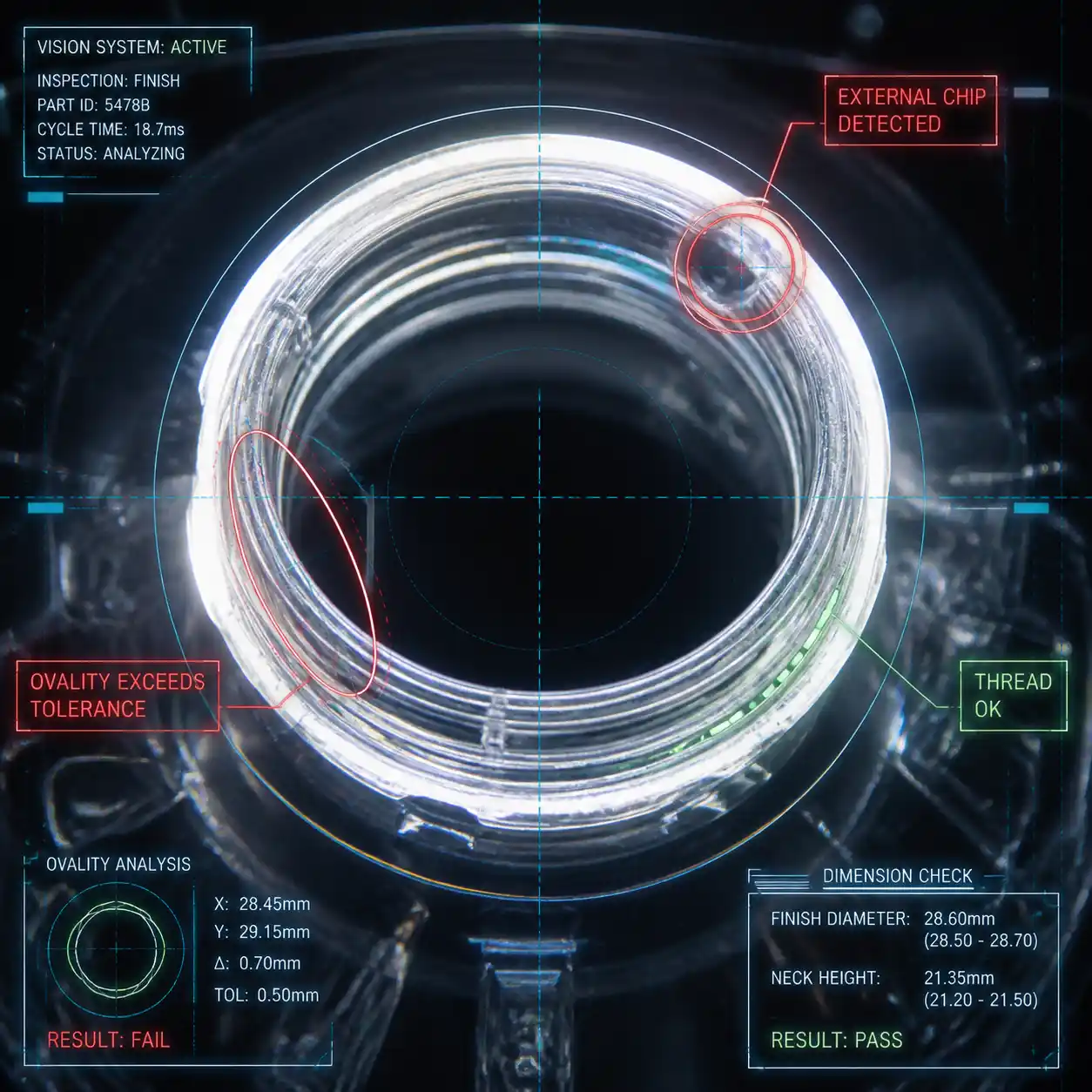
Defects and Accuracy Buyers Should Review
A Best Bottle Inspection Machine should be evaluated by the specific defects it is designed to detect. The MT-PK021 system is used for PET and PE bottles and focuses on finish defects such as through-holes, internal chipping, external chipping, point defects, and oval-shaped neck deformation.
| Inspection item | Reference dimension | Detection accuracy | False rejection rate |
|---|---|---|---|
| Penetration | Vertical section width 0.8 mm, depth 0.25 mm | ≥99.99% | ≤0.03% |
| Internal defects | Vertical section width 0.8 mm, depth 0.25 mm | ≥99.95% | |
| External defects | Vertical section width 0.8 mm, depth 0.25 mm | ≥99.95% | |
| Point defects | Diameter 0.8 mm, depth 0.25 mm | ≥99.99% | |
| Neck deformation | Diameter difference 2 mm | ≥99.95% |
These figures help buyers link machine selection with real production risk. A bottle finish inspection machine should not be judged by throughput alone; the defect scope, rejection logic, lighting design, and installation conditions should be reviewed together.
Imaging Components Behind High-Speed Performance
The inspection system uses an LED area light source with a service life of up to 30,000 hours. Front illumination helps present the bottle mouth as a continuous bright ring in the captured image, making finish features easier to evaluate. A fixed-focus lens with manual aperture adjustment is used to tune clarity and brightness.
The camera is an area-array CCD analog camera with 640 × 480 pixel resolution and an image acquisition rate of up to 60 frames per second. These components support stable inspection on PET/PE packaging lines rated at 48,000 bottles per hour.
Installation Checklist for Production Teams
Before installing a Best Bottle Inspection Machine, production and engineering teams should confirm that the site is ready for mechanical, electrical, pneumatic, and conveyor integration.
FAQs
What makes a Best Bottle Inspection Machine suitable for PET and PE lines?
It should match the line speed, inspection scope, environmental conditions, power supply, compressed air, and installation position required by the production line.
Why is compressed air important?
Compressed air at 4–6 bar supports the rejection device, allowing defective bottles to be removed according to tracking data.
Can the system inspect PET and PE bottles?
Yes. The MT-PK021 bottle finish inspection system is designed for PET/PE bottles on a 48,000 bottles-per-hour packaging line.
Why should special voltage be confirmed early?
Special voltage requirements may affect equipment specifications, delivery planning, and integration arrangements.
Where can the system be installed?
It can be positioned inside the blow molding machine at the bottle discharge section or along the conveyor chain.