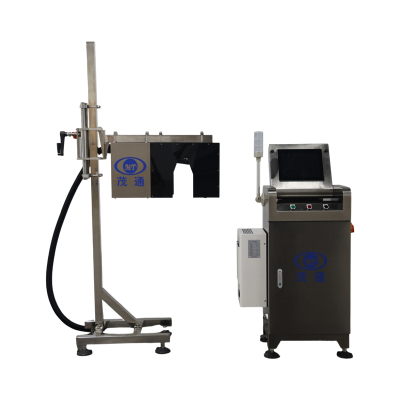
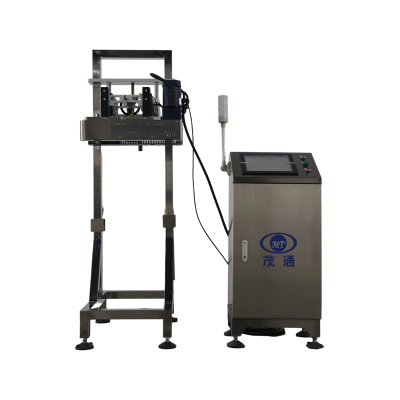
Best Bottle Inspection Machine Finds Finish Defects Early
In PET and PE bottle production, bottle finish quality affects sealing stability, capping reliability, and downstream filling performance. The Best Bottle Inspection Machine is designed for inline, non-contact inspection of bottle mouth deformation and surface damage. By combining sensor positioning, encoder tracking, CCD image acquisition, HMI monitoring, and automatic rejection, it helps keep defective bottles from moving further into the packaging line.

How Inline Tracking Works
The operating principle of the Best Bottle Inspection Machine begins when each bottle passes a positioning sensor. The sensor detects the bottle and, through the control unit, records the bottle ID together with the current encoder value. This tracking step is important because inspection and rejection happen at different points on a moving conveyor.
After detection, the sensor triggers the camera to capture an image of the bottle mouth. The image processor analyzes the captured finish image and sends the result to the human–machine interface for real-time display. At the same time, the result is transmitted to the control unit, which prepares the reject instruction if the bottle finish is judged defective.
When the control unit receives a rejection signal, it activates the rejector to remove the bottle with the corresponding recorded ID. This sequence allows the Best Bottle Inspection Machine to inspect inline without stopping normal bottle transport.
Image Acquisition That Makes Defects Visible
Stable imaging is central to any reliable bottle finish inspection machine. This system uses an LED area light source with a service life of up to 30,000 hours. With front illumination, the bottle mouth appears as a continuous bright ring, making finish defects easier to identify.
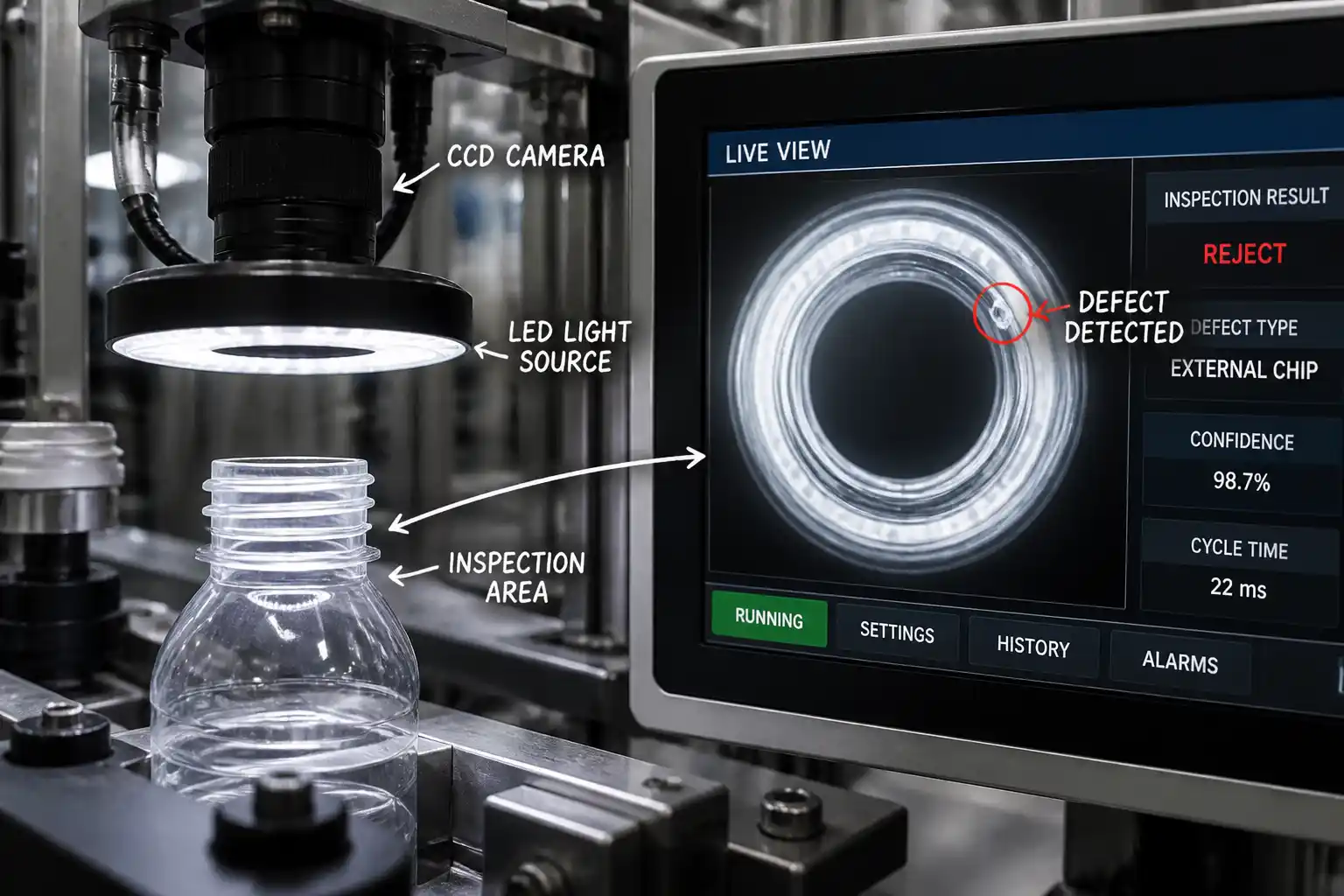
A fixed-focus lens with manual aperture adjustment is used to optimize clarity and brightness on the CCD sensor. The camera is an area-array CCD analog camera with a resolution of 640 × 480 pixels and an image acquisition rate of up to 60 frames per second. Together, these components support consistent image capture on high-speed PET/PE bottle lines.
Defects the System Is Designed to Detect
The Best Bottle Inspection Machine focuses on bottle finish conditions that can influence sealing quality and line stability. The inspection module covers through-hole defects, internal chips, external chips, point chips, and deformed bottle necks. These defect categories are directly related to whether a bottle can be capped and sealed properly.
| Inspection content | Defect dimension | Detection accuracy | False rejection rate |
|---|---|---|---|
| Penetration | Vertical section width 0.8 mm, depth 0.25 mm | ≥99.99% | ≤0.03% |
| Internal defects | Vertical section width 0.8 mm, depth 0.25 mm | ≥99.95% | |
| External defects | Vertical section width 0.8 mm, depth 0.25 mm | ≥99.95% | |
| Point defects | Diameter 0.8 mm, depth 0.25 mm | ≥99.99% | |
| Neck deformation | Diameter difference 2 mm | ≥99.95% |
For production teams that also need inspection before bottle blowing, a Preform Mouth Defect Detection Machine can be evaluated as an earlier-stage quality control option.
Line Integration and Operating Conditions
The Best Bottle Inspection Machine model MT-PK021 is configured for PET/PE bottles and a production capacity of 48,000 bottles per hour. It can be installed inside the blow molding machine at the bottle discharge point or on the conveyor chain, depending on line layout.
Its control architecture includes a PLC, HMI interface, image processor, LED light source, industrial CCD camera, sensor, and rejection device. The PLC coordinates encoder tracking and reject timing, while the HMI displays inspection data, defect images, and system status for operators. For fuller downstream coverage, manufacturers may also review a Cap and Liquid Level Inspection Machine after filling and capping.
Why This Workflow Matters
A bottle finish defect may be small, but its effect can appear later as leakage, unstable capping, or packaging interruption. The Best Bottle Inspection Machine addresses that risk by linking every bottle image to a recorded ID and encoder position. This creates a practical inspection chain: detect, capture, analyze, display, and reject.
For PET/PE lines running at high speed, this structured process helps manufacturers keep inspection consistent while reducing dependence on manual checking. The result is a more controlled flow of qualified bottles toward filling and packaging.
FAQs
1.What does the Best Bottle Inspection Machine inspect?
It inspects PET/PE bottle finish defects, including penetration, internal chips, external chips, point defects, and neck deformation.
2. How does the system know which bottle to reject?
When a bottle is detected, the control unit records its ID and encoder value. If a defect is found, the rejector removes the bottle matching that recorded ID.
3. What camera does the system use?
It uses an area-array CCD analog camera with 640 × 480 pixel resolution and up to 60 frames per second image acquisition.
4. Where can the machine be installed?
It can be installed at the blow molding machine discharge point or along the conveyor chain.
5. What is the rated production capacity?
The system is rated for 48,000 bottles per hour on PET/PE bottle production lines.