Get Conveyor Setup Right for PE Bottle Squeeze Leak Testing
Installing a PE Bottle Squeeze Leak Detection Machine is less about “getting it to run” and more about making results repeatable—minute after minute, shift after shift. Because this inspection method relies on controlled mechanical contact and pressure signal sampling, small issues like conveyor vibration, belt non-parallelism, or temperature variation can show up as unstable rejection behavior.
This article consolidates the installation specifications, working principle, operating conditions, and performance parameters published for the PE Bottle Squeeze Leak Detection Machine, so buyers and line engineers can plan utilities and placement with fewer surprises.

Installing a PE Bottle Squeeze Leak Detection Machine is less about “getting it to run” and more about making results repeatable—minute after minute, shift after shift. Because this inspection method relies on controlled mechanical contact and pressure signal sampling, small issues like conveyor vibration, belt non-parallelism, or temperature variation can show up as unstable rejection behavior.
This article consolidates the installation specifications, working principle, operating conditions, and performance parameters published for the PE Bottle Squeeze Leak Detection Machine, so buyers and line engineers can plan utilities and placement with fewer surprises.
How the PE Bottle Squeeze Leak Detection Machine evaluates leaks
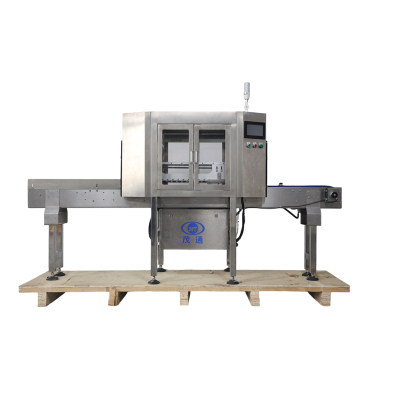
The PE Bottle Squeeze Leak Detection Machine is described as a contact-type online detection solution that directly reflects internal pressure characteristics through stable sampling. During conveying, a flexible clamping belt applies controlled extrusion, and side-mounted sensors collect pressure-related signals for analysis.

Belt squeeze process with two pressure readings
The published extrusion schematic and principle describe a guided pre-squeeze at the front to build a defined internal pressure condition. If a container leaks, pressure releases. Two readings are captured:
The controller compares these values to determine leakage, and results are delivered to the human-machine interface and control unit. When the rejection condition is met, the rejector removes the non-conforming product.
Installation requirements that keep results stable
The PE Bottle Squeeze Leak Detection Machine installation sequence is typically handled in three layers: mechanical placement, electrical checks, and pneumatic connection. The requirements below are stated as installation specifications.
Mechanical placement and conveyor alignment
Position the equipment horizontally, ensuring the clamping conveyor belt is parallel to the product conveyor belt. This is a core condition for consistent extrusion contact and comparable pressure sampling.
For line layout, installation is recommended on a straight conveyor section of 1.5–2 meters, which helps reduce irregular motion effects during sensing.
Pre-power checks and grounding
Before connecting power:
These steps are part of the specified pre-power inspection routine for the PE Bottle Squeeze Leak Detection Machine.
Power supply connection
Connect to a single-phase AC 220V, 50Hz supply. The published total equipment power is 250W.
Compressed air connection
Connect compressed air at 4–8 bar, with air quality meeting industry standards. This compressed air requirement applies to the PE Bottle Squeeze Leak Detection Machine as part of its production-line operation and rejection functionality.
Environmental conditions
The specified environmental range is:
For more consistent inspection behavior, inspection after cooling is recommended, and a single-row conveyor is recommended where product temperature is uniform.
Performance parameters published for the PE Bottle Squeeze Leak Detection Machine
Procurement teams often evaluate the PE Bottle Squeeze Leak Detection Machine on speed, detection range, and false reject behavior. The published parameters include:
| Item | Published parameter |
|---|---|
| Detection range | 0.08–0.5 MPa |
| Accuracy | Better than 0.02 MPa |
| Maximum inspection speed | Exceeds 600 bottles/minute |
| Rejection rate | ≥99.99% |
| False reject rate | ≤0.03% |
Operating conditions that influence accuracy and false rejects
Three factors are explicitly noted as influencing inspection results for the PE Bottle Squeeze Leak Detection Machine:
In practice, this means the PE Bottle Squeeze Leak Detection Machine performs best when conveyor motion is stable, product temperature is consistent, and containers are within normal manufacturing variation.
Inline functions buyers typically look for
Beyond leak decisions, the PE Bottle Squeeze Leak Detection Machine is described with functions aimed at continuous line integration:
Applicable inspection objects
The PE Bottle Squeeze Leak Detection Machine is positioned for pressure and leak inspection of specified gas-containing containers, including:
Where this fits in a broader inspection lineup
On packaging lines where multiple checks are deployed, buyers may pair leak and pressure inspection with other stations. For example, a line may also evaluate can pressure using a Can Pressure Tester depending on the container and process.
Next step for specification and integration
For detailed product information and the full specification set, review the manufacturer’s product page and align utilities (power and compressed air) before line downtime is scheduled.
View PE Bottle Squeeze Leak Detection Machine details