Make Air Leakage Detection Of Bagged Products Stable at Line Speed
Air Leakage Detection Of Bagged Products is commonly evaluated by manufacturers who need an inline way to identify leaking bags, poor seals, and abnormal bag pressure without slowing production. One representative approach is belt squeeze pressure inspection: packages are guided, pre-extruded, measured, and then either accepted or automatically rejected based on pressure response.
For buyers comparing options for Air Leakage Detection Of Bagged Products, the most practical questions tend to be simple: how the pre-extrusion step creates a measurable difference, how stable the pressure judgment is at high throughput, and what installation conditions are required to keep rejection performance consistent.

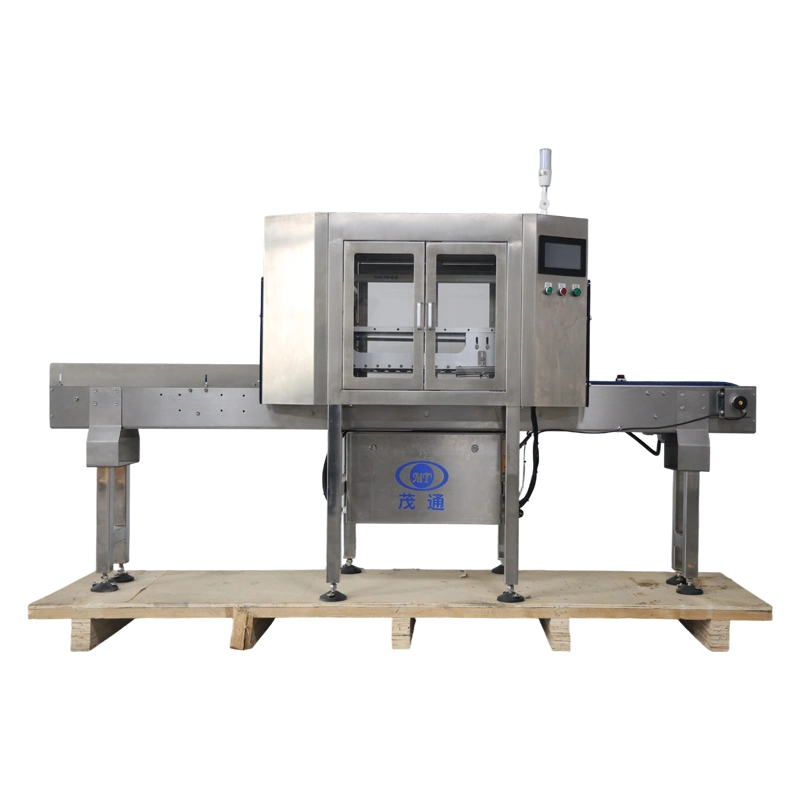
A fast spec snapshot buyers check first
When procurement teams shortlist Air Leakage Detection Of Bagged Products equipment, they typically start with throughput, accuracy, and reject reliability. The Air Leakage Detection Of Bagged Products is specified as a fully automated functional testing system for high-speed quality control of bagged products.
| Item | Specification |
|---|---|
| Equipment model | Air Leakage Detection Of Bagged Products |
| Inspection throughput | Up to 300 packs per minute |
| Maximum detection speed (extrusion method + force analysis algorithms) | Up to 400 bags/min (configuration-dependent) |
| Pressure detection accuracy | ±0.02 MPa |
| Bag leakage rejection rate | ≥99.98% |
| False rejection rate | ≤0.05% |
| Bag pressure rejection rate | ≥99.93% |
In practical terms, these parameters define whether Air Leakage Detection Of Bagged Products can be placed directly after sealing and still keep up with the line while maintaining meaningful decision thresholds.
Why pre-extrusion makes leakage differences easier to see
A defining characteristic of this Air Leakage Detection Of Bagged Products approach is the front-end guide mechanism that applies a pre-extrusion force to the product to maintain a certain level of pressure.
The inspection sequence is typically described as:
Bag entry → front-end pre-extrusion → pressure release → rear-end measurement → pressure evaluation
The underlying logic is straightforward:
This is why Air Leakage Detection Of Bagged Products based on controlled squeezing is positioned as a functional test rather than an appearance-only check.
How DSP-based analysis supports real-time decisions
In Air Leakage Detection Of Bagged Products, mechanical repeatability is only half the story; signal handling determines whether borderline packs are judged consistently. The Air Leakage Detection Of Bagged Products specifies Maotong’s proprietary DSP digital signal processing algorithm and a human–machine interface (HMI) for operation and display.
The detection principle is described as an inline workflow:

DSP-based inline workflow from sensing to rejection.
In procurement terms, this structure is often considered a baseline requirement for Air Leakage Detection Of Bagged Products on continuous conveyors, because it supports per-pack traceability through the inspection station and targeted rejection at speed.
Installation conditions that keep performance stable
Even high-performing Air Leakage Detection Of Bagged Products systems can underdeliver if conveyor alignment and utilities are not set correctly. The installation guidance specifies:
Utility and environment requirements are also specified:
| Parameter | Requirement |
|---|---|
| Power supply | Single-phase AC 220V |
| Frequency | 50 Hz |
| Total power | 250 W |
| Compressed air | 4–8 bar |
| Operating temperature | 0–50°C |
| Relative humidity | 10–80% |
| Frame material | 304 stainless steel |
| Equipment weight | Approx. 100 kg |
For many projects, these details become the practical checklist for commissioning Air Leakage Detection Of Bagged Products and achieving stable rejection behavior day-to-day.
Safety and line-control functions buyers ask about
High-speed Air Leakage Detection Of Bagged Products is closely tied to operational safety. The MT-DZ-XL-S2-01 specifies that the machine can automatically synchronize with production-line speed and stop when the line stops, helping prevent product bursting due to idling and bag jams.
Additional specified functions include:
These points are frequently used by buyers as a risk-control lens when placing Air Leakage Detection Of Bagged Products equipment on critical lines.
Typical products evaluated for this inspection method
The specified applicable inspection objects include:
In these use cases, Air Leakage Detection Of Bagged Products focuses on two inspection functions: leakage caused by defective seals and identification of low internal pressure or bag bulging.
For readers who want a single place to review the product positioning and specs, see Air Leakage Detection Of Bagged Products, and the broader product family page for the Bag Product Leakage Detection Machine.