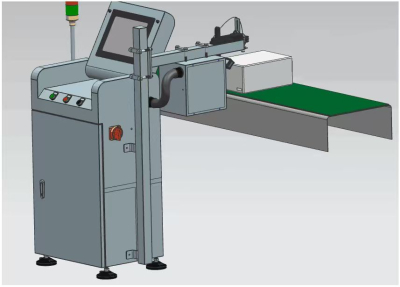
Keep Glass Bottle Lines Stable With Bottle Fill Level Detection
Bottle Fill Level Detection is a critical inspection step for high-speed glass bottle packaging lines, especially when underfilled products must be identified before they move into downstream packaging. Jinan Maotong Inspection’s glass bottle liquid level online inspection system is designed for automated, non-contact inspection of glass bottles from 100 mL to 1,000 mL, with a standard rated capacity of 1,000 bottles per minute. Installed immediately after the filler on a single-lane conveyor, the system helps detect low liquid level defects and reject non-compliant bottles in real time.

What Bottle Fill Level Detection Does on the Line
Our Bottle Fill Level Detection system applies machine vision technology to inspect liquid level defects in glass bottles during production. Its core role is straightforward: confirm whether each bottle meets the configured liquid level requirement and remove bottles with low liquid level before they continue downstream.
The equipment is suitable for glass bottle packaging lines and is installed on a single-lane conveyor immediately after the filling machine. Because the inspection is non-contact, it does not touch the container or interrupt normal conveying. The system also uses a soft ray design without a radioisotope source, supporting safe and reliable ray protection in the production environment.
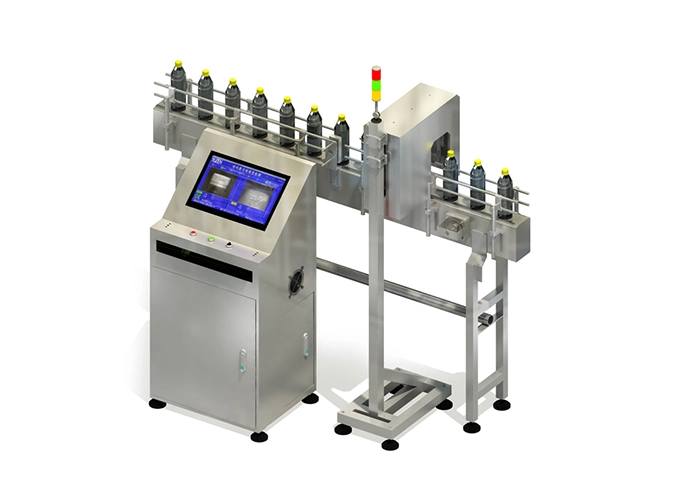
How the Inspection Workflow Operates
Bottle Fill Level Detection follows a controlled sequence so that inspection and rejection remain synchronized with conveyor movement:

1.A positioning sensor detects the arrival of each glass bottle.
2.The system records the bottle ID and encoder value.
3.The sensor triggers the camera to capture the liquid level image.
4.The image processor analyzes the captured frame and displays results on the HMI.
5.The control unit determines whether the liquid level is acceptable.
6.If a low liquid level defect is detected, the PLC activates the rejector at the correct position.
This workflow links sensing, image capture, processing, decision-making, and rejection into one online inspection process. For production teams, the encoder-based position reference is especially important because it helps the rejector remove the correct bottle even when line conditions change.
Operating Parameters Plant Teams Should Confirm
Stable Bottle Fill Level Detection depends on correct electrical supply, suitable site conditions, and reliable conveyor layout. The main operating parameters are summarized below.
| Parameter | Specification |
|---|---|
Rated capacity | 1,000 bottles/minute, standard configuration |
| Noise level | ≤85 dB, with actual levels influenced by container type, machine power, and plant acoustics |
| Main supply | 3 × 380V AC ±10%, 50 Hz, 3PH+N+PE |
| Lighting supply | 220V AC, 50 Hz, single-phase |
| Total power consumption | Approximately 1.0 kW |
| Control voltage | 24 VDC |
| Operating temperature | 5°C–40°C |
| Operating humidity | 50–65% RH |
| Applicable altitude | 5–3,000 m above sea level |
The power connection runs between the customer’s main power cabinet and the equipment’s control cabinet. If a project requires non-standard voltage, this should be communicated in advance because it may affect equipment specifications, delivery time, and cost.
Installation Conditions for Reliable Detection
For Bottle Fill Level Detection to perform consistently, the inspection point must allow stable bottle movement and a clear view of the liquid boundary. The system requires a single-lane conveyor, a straight conveyor section of at least 2 meters, and a minimum bottle spacing of 2 cm.
The liquid level should show clear stratification at the inspection point. Foaming or turbulence should be minimized whenever possible because a visible boundary between the liquid and headspace supports accurate image analysis. A rigid collection container is recommended at the rejection point to receive defective bottles, and the conveyor guard may require an opening so rejected bottles can exit smoothly.
Detection Accuracy and Quality Value
The specified inspection target is low liquid level detection. For this item, the system provides ±2 mm accuracy, a rejection rate of ≥99.9%, and a false rejection rate of ≤0.05%.
| Test item | Detection target | Accuracy | Rejection rate | False rejection rate |
|---|---|---|---|---|
| Liquid level | Low liquid level defects | ±2 mm | ≥99.9% | ≤0.05% |
For beverage and liquid product manufacturers, Bottle Fill Level Detection helps reduce the risk of underfilled products reaching the market. It also supports more consistent product appearance and smoother downstream packaging by removing defective bottles early in the process.
FAQs
What containers is this Bottle Fill Level Detection system designed for?
It is designed for glass bottles with a filling volume range of 100 mL to 1,000 mL.
Where should the equipment be installed?
The system is installed on a single-lane conveyor immediately after the filler, where each bottle can be inspected before entering downstream packaging.
What is the standard rated capacity?
The standard configuration is rated for 1,000 bottles per minute on suitable glass bottle packaging lines.
What defect does the system mainly detect?
The main inspection target is low liquid level defects in glass bottles.
What accuracy is specified for liquid level inspection?
The specified accuracy for low liquid level detection is ±2 mm, with a rejection rate of ≥99.9% and a false rejection rate of ≤0.05%.
What should be confirmed before installation?
Teams should confirm conveyor straight length, bottle spacing, liquid boundary visibility, power supply, environmental conditions, and whether any non-standard voltage is required.