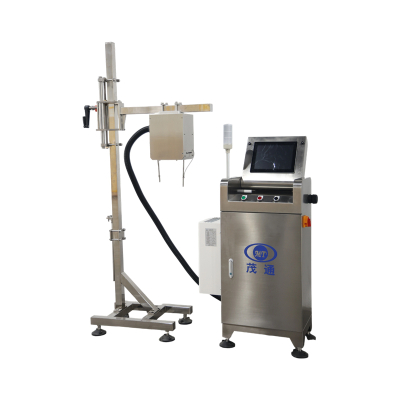
PET Label Inspection Machine Makes Defects Easier to Reject
A PET Label Inspection Machine is most valuable when it turns label quality from a manual judgment into a clear inline decision. For PET bottle lines, the key inspection concerns are straightforward: missing labels, labels applied too high or too low, wrong label orientation, and connection labels during label changes. By combining controlled lighting, CCD image capture, bottle tracking, HMI display, and automatic rejection, the PET Label Inspection Machine helps operators identify defective bottles before they continue downstream.

How the Inspection Workflow Tracks Each Bottle
The operating sequence of a PET Label Inspection Machine begins when a bottle passes the positioning sensor. The sensor detects the bottle, while the control unit records the bottle ID and the corresponding encoder value. This tracking step matters because the inspection system must reject the correct bottle, not simply react to a defect signal somewhere on the line.
After detection, the positioning sensor triggers the camera to capture an image of the current bottle label. The image processor analyzes the image and sends the inspection result to two places: the human-machine interface for real-time display and the control unit for defect handling. If the result indicates a nonconforming bottle, the control unit sends a command to the rejector, which removes the bottle associated with the recorded ID.
Image Acquisition Components That Support Stable Inspection
The PET Label Inspection Machine uses an LED area light source with a service life of up to 50,000 hours. Front illumination is applied to present the measured area clearly. In the captured image, the bottle opening appears as a continuous bright circular ring, which supports a stable visual reference during inspection.

The optical setup of the PET Label Inspection Machine includes a fixed-focus manual aperture lens. During setup, the focus ring is adjusted to obtain the sharpest image on the CCD sensor plane, while the aperture ring is fine-tuned to optimize image brightness. This practical adjustment process is important because image clarity and brightness directly affect whether label position and presence can be evaluated consistently.
The camera system uses an area-array CCD analog camera with a resolution of 640 × 480 pixels and an image acquisition speed of up to 60 frames per second. For procurement teams evaluating a PET Label Inspection Machine, these details define the imaging foundation behind the inspection process rather than relying only on general claims about automation.
Inspection Scope and Stated Accuracy
A PET Label Inspection Machine focuses on common label application defects that are easy to miss during manual spot checks but costly once packed or shipped. The inspection scope includes:
| Test Content | Testing Accuracy | Rejection Rate | False Rejection Rate | |
|---|---|---|---|---|
| 1 | No label | — | 100% | ≤0.03% |
| 2 | High label | Deviation ≥ 2 mm | ≥99.9% | — |
| 3 | Low label | Deviation ≥ 2 mm | ≥99.9% | — |
| 4 | Connection label | Requires significant color difference between tape and label | ≥99.9% | — |
This table is especially useful for procurement teams because it separates inspection content from measurable rejection performance. A PET Label Inspection Machine should be assessed by what it detects, the deviation threshold it supports, and how the reject decision is executed on the production line.
Control Platform and Operator Visibility
The PET Label Inspection Machine is composed of multiple inspection modules and an HMI, making it suitable for label inspection on high-speed production lines. Each inspection module is driven by a reliable industrial-grade control computer, which processes inspection data and communicates with the control system for real-time information transfer.
The electronic control system integrates programmable logic controllers, program memory, photoelectric and inductive sensors, a control program, and the HMI. Operating conditions and fault diagnostics are displayed visually through the HMI in a graphical format. For daily operation, this helps operators see inspection results and machine status without relying only on manual observation.
A rejection verification module ensures that defective products are detected and removed from the line. The power distribution cabinet is equipped with industrial air conditioning to maintain an appropriate internal operating temperature and support system service life. The compact design of the testing cabinet also helps reduce equipment footprint where line space is limited.
Practical Buyer Checklist
Before specifying a PET Label Inspection Machine, buyers should confirm the inspection target, label defect categories, line integration point, rejector arrangement, HMI display requirements, and lighting conditions. It is also worth checking how lens focus and aperture are adjusted during commissioning, since stable imaging is the basis for reliable label detection.
For PET bottle packaging lines, the strongest value of a PET Label Inspection Machine is not simply that it captures images. Its value lies in connecting bottle ID tracking, front-illuminated imaging, CCD acquisition, real-time HMI feedback, and reject control into one inline inspection process.
FAQs
What defects can a PET Label Inspection Machine detect?
A PET Label Inspection Machine detects no label, high label, low label, wrong label orientation, and connection labels when the tape and label have a significant color difference.
What camera is used in the system?
The PET Label Inspection Machine uses an area-array CCD analog camera with 640 × 480 pixel resolution and image acquisition up to 60 frames per second.
Why is front illumination used?
Front illumination helps clearly display the measured area. In the captured image, the bottle opening appears as a continuous bright circular ring, supporting stable detection.
How are defective bottles removed?
The control unit of the PET Label Inspection Machine records bottle ID and encoder value, receives the defect result, and instructs the rejector to remove the corresponding bottle from the line.
What false rejection rate is stated for no-label detection?
For no-label detection, the stated rejection rate is 100%, with a false rejection rate of ≤0.03%.