Specify PET Label Inspection Machine Controls Before Line Integration
For PET bottle producers, label control is not only an appearance issue. A missing label, a label placed too high or too low, or a wrong orientation can interrupt downstream packaging quality and weaken shelf presentation. Our PET Label Inspection Machine is designed to make these problems visible on the line through automatic, non-contact machine vision inspection and reliable rejection.

Why Control Architecture Matters
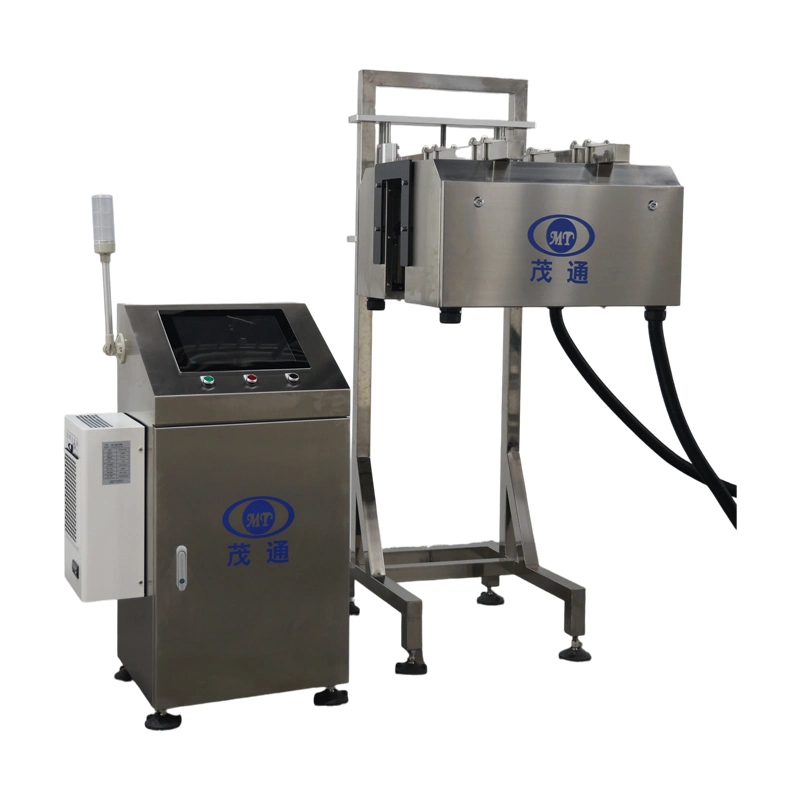
Our PET Label Inspection Machine is composed of multiple inspection modules and a human–machine interface (HMI), making it suitable for label inspection on high-speed production lines. Each inspection module inside the PET Label Inspection Machine uses a reliable industrial-grade control computer to process inspection data and communicate with the control system for real-time information transfer.
This structure matters because label inspection is a timing-sensitive task. When a bottle passes the positioning sensor, the control unit in the PET Label Inspection Machine records the bottle ID and encoder value. The sensor then triggers the camera to capture the current label image. After image processing, results are displayed on the HMI and sent to the control unit for defective bottle removal.
With this coordinated architecture, the PET Label Inspection Machine links sensing, imaging, analysis, and rejection into one continuous control loop, which is crucial on fast PET bottle lines.
PLC HMI Integration For Stable Inspection
The electronic control system integrates imported programmable logic controllers, program memory, photoelectric switches, inductive switches, and an HMI interface. Together, these elements form an automatic control platform for the PET Label Inspection Machine. The HMI displays operating status and fault information graphically, giving operators a clearer view of inspection and rejection conditions directly on the PET Label Inspection Machine.

A rejection confirmation unit is also configured to support accurate removal of defective products. For buyers comparing automated inspection systems, this closed-loop step is important: the PET Label Inspection Machine does not only detect a defect; it also confirms that the rejected bottle is handled correctly.
By combining PLC logic, HMI visualization, and rejection confirmation, the PET Label Inspection Machine maintains more stable inspection performance over long production runs.
Image Acquisition Defines Detection Quality
The PET Label Inspection Machine uses an LED area light source with a service life of up to 50,000 hours. Foreground illumination helps present object details clearly, while a manual iris fixed-focus lens supports sharp imaging and brightness adjustment. The camera in the PET Label Inspection Machine is an area scan CCD analog camera with 640 × 480 pixel resolution and image capture speed of up to 60 frames per second.
For wider label coverage, the related 360° Label Inspection Machine highlights 360-degree inspection, multi-view stitching, and color recognition technology. These inspection concepts are especially relevant where PET bottle labels must be checked from multiple viewing angles, and they complement what a standard PET Label Inspection Machine offers on a single inspection station.
The combination of lighting, optics, and camera specifications in the PET Label Inspection Machine directly influences the reliability of defect detection and the consistency of inspection results.
Inspection Items And Listed Accuracy
The PET Label Inspection Machine focuses on practical label defects that frequently affect PET bottle lines. Its inspection content includes no label, high label, low label, and positive or negative label orientation. These typical failure modes are addressed through the PET Label Inspection Machine’s image algorithms and rejection logic.
| Inspection Item | Inspection Basis | Rejection Rate | False Rejection Rate |
|---|---|---|---|
| No label | Listed item | 100% | ≤0.03% |
| High label | Deviation ≥ 2 mm | ≥99.9% | — |
| Low label | Deviation ≥ 2 mm | ≥99.9% | — |
| Connection label | Requires significant color difference | ≥99.9% | — |
The project specification also lists PET bottle application, installation on the single-row straight conveyor line behind the labeling machine, rated output of 60,000 units per hour, and a maximum inspection speed of up to 36,000 BPH in the product feature description. Operating conditions for the PET Label Inspection Machine include 220V, 50Hz, single-phase power, approximately 1.0kW total power, 24VDC control voltage, and 0.5MPa compressed air.
By matching these parameters, the PET Label Inspection Machine can integrate with existing bottling equipment and support the required production capacity.
Practical Value For High Speed PET Lines
A PET Label Inspection Machine is often evaluated not only by its camera but by how well the full system fits the production line. The compact inspection cabinet helps reduce footprint. The power distribution cabinet in the PET Label Inspection Machine is equipped with industrial air conditioning to maintain a suitable internal temperature and support service life. Custom programs for different bottle types can be built in, enabling one-click bottle type switching on the PET Label Inspection Machine.
For purchasing teams, the key question is whether the PET Label Inspection Machine can match the line layout, bottle type, label defect standards, available utilities, and rejection method. Reviewing these points before installation helps reduce commissioning uncertainty and supports more consistent label quality control with the PET Label Inspection Machine.
In day-to-day use, a well-configured PET Label Inspection Machine gives operators immediate feedback on label quality, helps protect downstream packaging, and supports a more stable appearance on the shelf for PET bottle brands.
FAQs
What does a PET Label Inspection Machine inspect?
A PET Label Inspection Machine inspects PET bottle labels for no label, high label, low label, and wrong positive or negative orientation. These core defect types are defined in the inspection program of the PET Label Inspection Machine and linked to the rejection device.
Where is the machine installed?
The PET Label Inspection Machine is installed on the single-row straight conveyor line positioned behind the labeling machine, so every bottle passes the inspection window before entering downstream equipment.
What role does the HMI play?
The HMI on the PET Label Inspection Machine displays operating status and fault conditions in graphical form, helping operators monitor the inspection process, understand rejection statistics, and adjust settings where needed.
What happens when a defective bottle is detected?
When the PET Label Inspection Machine detects a defective bottle, the control unit sends a signal to the rejector, which removes the bottle corresponding to the recorded ID. The rejection confirmation unit on the PET Label Inspection Machine then verifies that the defective bottle has actually been cleared from the line.
What should buyers check before integration?
Before integrating a PET Label Inspection Machine, buyers should review conveyor position, bottle type, power supply, compressed air, inspection standards, and rejection requirements. Aligning these points with the PET Label Inspection Machine specification helps ensure smoother commissioning and more reliable label control.