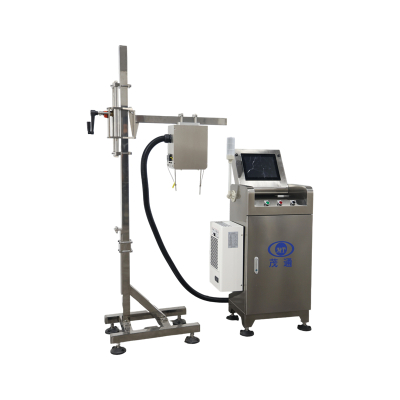
Stabilize Bottles Mouth Inspection Machine Imaging at Speed
In high-speed PET and PE bottle production, a Bottles Mouth Inspection Machine depends on more than processing speed. The decisive factor is consistent image acquisition: stable lighting, clear focus, controlled brightness, and synchronized capture. When the bottle mouth appears as a clean, continuous bright ring, defects such as chipping, penetration, localized point damage, and oval neck deformation become easier to evaluate before bottles move further downstream.

Equipment Role in PET and PE Bottle Lines
The Bottle Finish Inspection Machine, model MT-PK021, is designed for PET and PE bottles on a 48,000 bottles/hour packaging line. It can be installed inside the blow molding machine, either at the bottle discharge position from the mold or on the conveyor chain. Its stated function is to detect and reject PET/PE bottles with deformation or damage on the top surface of the bottle finish.
| Item | Specification |
|---|---|
| Equipment name | Bottle Finish Inspection Machine |
| Model | MT-PK021 |
| Compatible containers | PET/PE bottles |
| Production capacity | 48,000 bottles/hour |
| Installation point | Blow molding machine discharge position or conveyor chain |
| Function | Detects and rejects bottle finish deformation or surface damage |
How the Inspection Sequence Works
A Bottles Mouth Inspection Machine must keep the inspection result aligned with the exact bottle moving through the line. The workflow begins when a bottle passes the positioning sensor. The control unit records the bottle ID and current encoder value, then the sensor triggers the camera to capture the bottle mouth image. After acquisition, the image processor analyzes the image and sends the result to the human–machine interface for real-time display and to the control unit for rejection preparation.
When a defect signal is received, the control unit instructs the rejector to remove the bottle with the corresponding recorded ID. This sequence supports inline inspection because image capture, processing, display, and rejection are coordinated around bottle tracking.
Image Acquisition Components That Determine Stability
LED Area Light Forms the Bright Ring
The light source used in the Bottles Mouth Inspection Machine is an LED area light with a service life of up to 30,000 hours. With front illumination, the inspected features are made clearly visible. In the captured image, the bottle mouth appears as a continuous bright ring, giving the system a stable visual basis for evaluating the finish.

A complete and uniform ring is important because interruptions or irregularities can correspond to visible finish problems. In machine vision practice, lighting is treated as a core part of inspection reliability because it determines whether the camera receives a repeatable image rather than a fluctuating one.
Fixed-Focus Lens Controls Sharpness and Brightness
The system uses a fixed-focus lens with manual aperture adjustment. The focus ring is adjusted to achieve maximum image clarity on the CCD sensor surface, while the aperture ring is fine-tuned to optimize brightness. This matters because the bottle mouth edge must remain sharp enough for the image processor to evaluate the finish accurately.
If focus is soft, the bright ring may look wider or less defined than it should. If brightness is not balanced, details may become too weak or too bright for stable evaluation. Proper lens adjustment helps the Bottles Mouth Inspection Machine maintain a repeatable image under production conditions.
CCD Camera Captures Images at Line Speed
The camera is an area-array CCD analog camera with a resolution of 640 × 480 pixels and an image acquisition speed of up to 60 frames per second. This configuration supports high-speed capture and processing for the bottle mouth detection module.
For this type of inspection, the camera, light source, and lens work as one imaging chain. The light creates the bright ring, the lens sharpens and balances it, and the CCD camera captures the image for processing. Stable capture is essential because the system evaluates defects from the image itself.
Inspection Items and Accuracy
The Bottles Mouth Inspection Machine covers the following inspection items: through-holes, internal chipping, external chipping, localized point chipping, and neck deformation in an oval shape. The listed inspection thresholds and accuracy values are tied to defined defect dimensions.
| Inspection content | Dimension reference | Detection accuracy | False rejection rate |
|---|---|---|---|
| Penetration | Vertical section width 0.8 mm, depth 0.25 mm | ≥99.99% | ≤0.03% |
| Internal defects | Vertical section width 0.8 mm, depth 0.25 mm | ≥99.95% | — |
| External defects | Vertical section width 0.8 mm, depth 0.25 mm | ≥99.95% | — |
| Point defects | Diameter 0.8 mm, depth 0.25 mm | ≥99.99% | — |
| Neck deformation | Diameter difference 2 mm | ≥99.95% | — |
These values show why image quality cannot be treated as a minor setup detail. Small defects require a stable image, and stable images depend on controlled illumination, accurate focus, suitable brightness, and synchronized capture.
Practical Setup Priorities for Clearer Images
For operators and production engineers, setup should begin with the image rather than the software result. First, adjust the focus ring until the bottle mouth edge is as clear as possible on the CCD sensor surface. Next, adjust the aperture ring so the ring is bright but not visually washed out. Then confirm that the bottle mouth appears as a continuous bright ring during normal line operation.
A Bottles Mouth Inspection Machine performs best when the inspection area is consistently presented to the camera. Before relying on rejection statistics, the imaging chain should be checked under actual production speed so that the sensor trigger, encoder tracking, camera capture, and rejector response remain coordinated.
FAQs
Why does the bottle mouth appear as a bright ring?
Front illumination from the LED area light makes the bottle mouth features clearly visible, so the captured image presents the mouth as a continuous bright ring for evaluation.
What camera is used in this inspection system?
The system uses an area-array CCD analog camera with 640 × 480 pixel resolution and an acquisition speed of up to 60 frames per second.
What defects can the system inspect?
It inspects through-holes, internal chipping, external chipping, localized point chipping, and oval-shaped neck deformation.
Where can the machine be installed?
It can be installed inside the blow molding machine at the bottle discharge position from the mold or on the conveyor chain.
Why is manual aperture adjustment important?
Manual aperture adjustment fine-tunes image brightness, helping the captured bottle mouth image remain clear and suitable for processing.