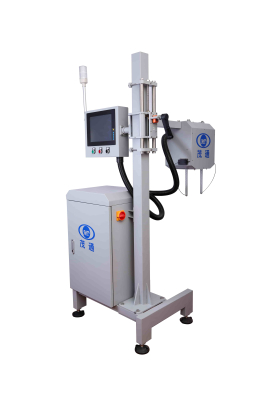
Stop Wrong Can Codes Before They Leave the Line
In beverage can production, a printed bottom code is more than a small mark. It supports traceability, production control, and final product quality. A Can Code Inspection Machine is designed to inspect inkjet printing on can bottoms online, identify unqualified cans, and reject them without stopping normal production flow. Its value comes from a tightly synchronized process: sensing, image capture, digital analysis, result output, and precise rejection.
In high-speed lines, this kind of automated inspection becomes a core part of quality control, linking each can’s code to production data and downstream logistics.

Why Inline Can Code Inspection Matters
High-speed can lines leave little room for delayed quality checks. If a missing date, blurred character, wrong factory code, or duplicate print is discovered too late, defective products may already have moved far downstream. A Can Code Inspection Machine is installed closely after the inkjet printer so each freshly printed code can be checked at the right point in the process.
Unlike manual sampling, the Can Code Inspection Machine performs real-time inspection on each can. The system is suitable for beverage can production lines and is built for online, non-contact inspection, so it does not damage the can body while checking the inkjet printing quality.
Detection Principle of a Can Code Inspection Machine
The working principle is direct but highly coordinated. A Gigabit Ethernet digital camera takes photos from above, and the captured images are digitally analyzed. If the code does not meet the set requirements, the unqualified can is rejected online.
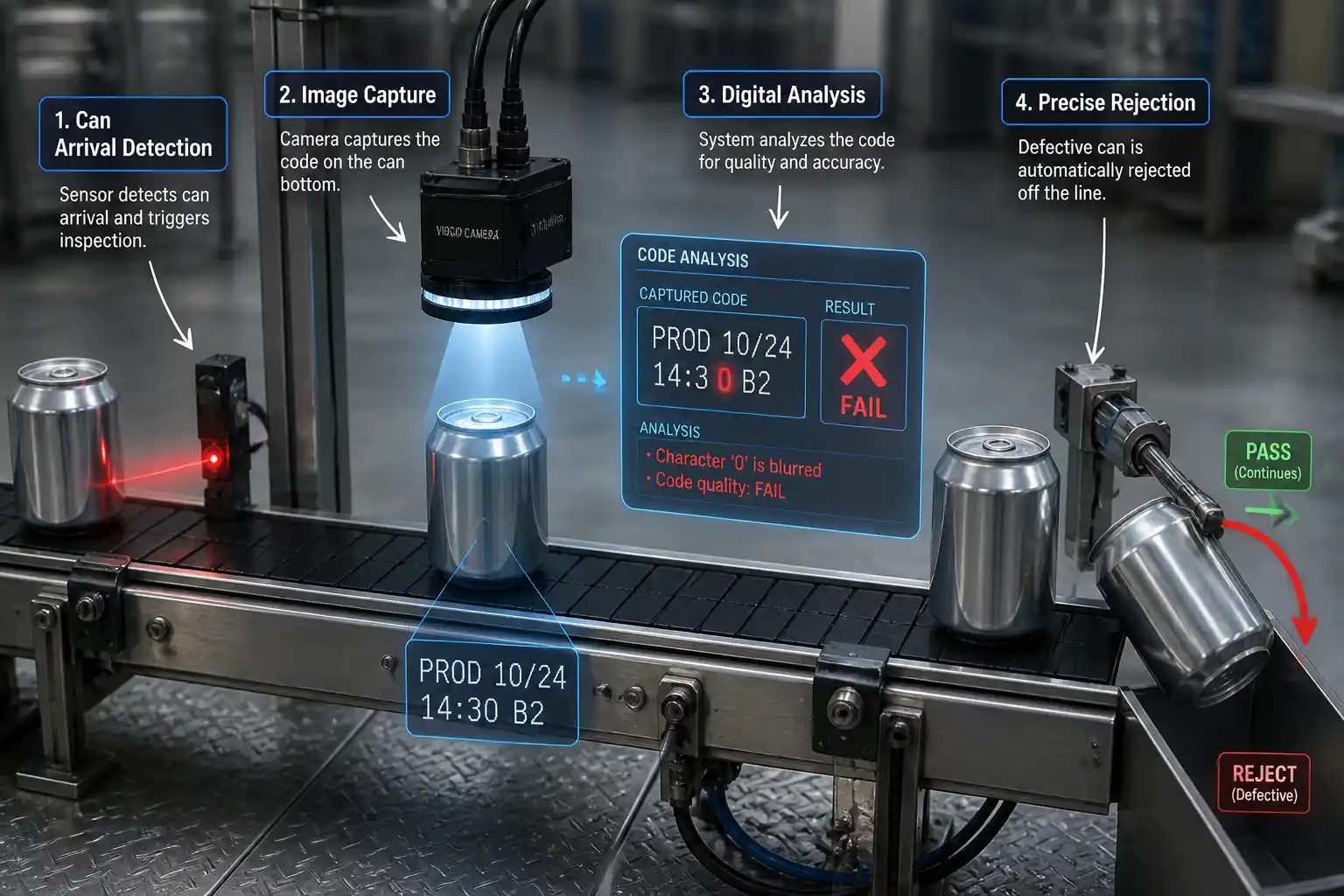
The full detection sequence works as follows:
1.Can arrival detection: The can passes a positioning sensor, which detects its arrival at the inspection point.
2.Encoder signal recording: The control unit records the can identification number and the current encoder signal.
3.Image capture: The positioning sensor triggers the Gigabit Ethernet digital camera to capture the current bottom code image.
4.Network transmission: The image is sent to the image processor through the network.
5.Image analysis: The image processor analyzes the code and sends results to the human-machine interface (HMI) and the control unit.
6.Online rejection: When an unqualified signal is received, the control unit notifies the rejector to remove the corresponding can.
This encoder-based counting method is important because rejection accuracy is not affected by line stops or speed changes after the defective can number has been recorded. For buyers evaluating a Can Code Inspection Machine, this synchronization is one of the most practical details to confirm.
What Defects Can Be Detected
A Can Code Inspection Machine supports several key inspection functions from the same captured image. It can detect missing prints, covered prints, and inverted cans. It also identifies fuzzy inkjet printing when characters cannot be recognized by the human eye.
The system can flag incorrect inkjet printing, including wrong dates, wrong factory codes, wrong security codes, and deformation. It can also recognize missing inkjet printing when a single character is missing by more than 20%, detect position offset beyond the set range, and identify duplicate codes printed within the code area. Character recognition is also used to read and interpret inkjet printing information.
For production teams, this means the Can Code Inspection Machine does not only check whether a code exists. It checks whether the code is readable, correctly positioned, complete, and consistent with the required content.
Key Configuration and Performance Data
The official configuration lists the system as an inkjet printing inspection system, model Can Code Inspection Machine, with a maximum production speed of 72,000 bottles per hour. The inspection scope is inkjet print quality, and the rejection method is high-precision online rejection of defective cans. The safety protection rating is IP65.
| Inspection item | Condition | Rejection rate | False kick rate |
|---|---|---|---|
| No inkjet printing | Cover print, missing print, inverted can | >99.99% | ≤0.03% |
| Missing inkjet printing | Single character >20% | >99.8% | ≤0.03% |
| Fuzzy inkjet printing | Human eye cannot recognize characters | >99.93% | ≤0.03% |
| Incorrect inkjet printing | Wrong date, factory code, security code, deformation | >99.99% | ≤0.03% |
| Position offset | Beyond the expansion zone | >99.99% | ≤0.03% |
| Duplicate inkjet printing | Multiple codes in the area | >99.99% | ≤0.03% |
These figures help explain why a Can Code Inspection Machine is useful for high-speed production environments. It reduces reliance on manual inspection, supports production efficiency, and helps maintain product quality by removing non-conforming cans during the line process.
Practical Advantages for Production Lines
A modern Can Code Inspection Machine combines non-contact online inspection, image processing, encoder synchronization, and automatic rejection. It also supports a flexible HMI with multi-level user access, fast character training, automatic storage of defective product photos by date, customizable storage time, continuous rejection and shutdown functions, 24-hour remote control, 360° coding inspection, and zero-delay inkjet printing detection.
The system is designed to filter interference from can-bottom logos or scratches, helping reduce false rejection. Functions can also be customized according to actual production conditions, which is useful when can formats, code styles, or production requirements vary.
Conclusion
A Can Code Inspection Machine protects can coding quality by linking every inspection decision to a specific can identification number and encoder position. From the moment a can reaches the positioning sensor to the instant a rejector removes an unqualified product, the process is built around timing accuracy and image-based judgment.
For buyers comparing can bottom code inspection options, the most important points are clear: install the system closely after the inkjet printer, confirm the supported defect types, review rejection and false kick data, and understand how the encoder, camera, image processor, HMI, and rejector work together.
FAQs
How does a Can Code Inspection Machine detect code defects?
It uses a Gigabit Ethernet digital camera to capture the can bottom code from above. The image is transmitted to an image processor, analyzed digitally, and the result is sent to the HMI and control unit. If the code does not meet preset standards, the corresponding can is rejected online.
Where should the Can Code Inspection Machine be installed?
It should be installed closely after the inkjet printer so freshly printed can bottom codes can be inspected online before products move farther downstream.
What defects can the system identify?
It can detect missing codes, covered prints, inverted cans, fuzzy printing, wrong dates, wrong factory codes, wrong security codes, missing characters, position offset, and duplicate printing.
Why is the encoder important?
The encoder helps the control unit track each can’s position. Once a defective can number is recorded, rejection accuracy is maintained even if the line stops or speed changes.
What is the maximum listed production speed?
The listed maximum production speed is 72,000 bottles per hour for the MT-YLG-OCR-03 inkjet printing inspection system.