Beer Bottle Cap QR Code and Character Pattern Detection: An Integrated High-Precision Solution
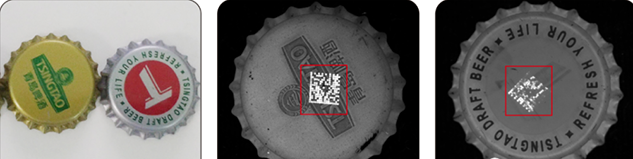
The QR code (typically used for traceability, anti-counterfeiting, and marketing) and character patterns (brand logo, country of origin letters, production batch number, etc.) on beer bottle caps together constitute the product's "digital ID card" and "brand face." The detection of both must be synchronized, high-speed, and 100% accurate; failure in either could prevent the product from reaching the market or trigger a brand crisis.
I. Characteristics of the Detection Object and Core Challenges
1. Materials and Processes:
Metal Materials: Extremely strong specular reflection poses the biggest challenge to imaging.
Diverse Printing Methods: QR codes and characters may be printed using inkjet printing, laser marking, embossing, or a combination of multiple processes. Different processes produce drastically different imaging characteristics.
2. The Special Characteristics of QR Code Detection:
Decoding is Paramount: The final output of the detection is the decoded string. Even if there are cosmetic defects, as long as it can be correctly read by a standard barcode scanner, it may be acceptable.
International Standard Evaluation: Adhering to standards such as ISO/IEC 15415 (for surface mount QR codes), the evaluation includes multiple dimensions such as contrast ratio, modulation ratio, axial inconsistency, and lack of error correction levels, going beyond just "aesthetics."
Extreme Requirements for Resolution and Uniform Illumination: Blurred imaging or uneven lighting in even one module (small black and white squares) will directly lead to decoding failure.
3. Special Characteristics of Character and Pattern Detection:
Emphasis on Appearance Consistency and Readability: Logos and characters must be clear, complete, and undistorted, conforming to brand standards.
Potential Color Judgment: Accuracy of brand colors.
High Pattern Complexity: Logos may contain fine lines, gradients, and complex graphics.
4. Shared Production Line Challenges:
High Speed: Extremely fast production line speed.
Variable Posture: Bottle caps may rotate or tilt during transport.
Compact Space: QR codes and patterns may be distributed within a limited area on the cap, requiring high-resolution single-shot imaging.
II. Core Detection Technology Path
A mature system typically adopts a "one machine, multiple tasks" architecture, meaning one imaging hardware unit, coupled with different software algorithm modules, processes two detections in parallel.
(I) Imaging and Illumination System: Overcoming Metal Reflection
This is the foundation of the entire system's success. Optimal and uniform illumination must be provided for the QR codes and character patterns.
• Preferred Illumination Solution: High-Uniformity Dome Integral Light Source
This is the most effective way to solve the specular reflection problem on curved metal surfaces. It uses a diffuser to reflect light multiple times, creating a shadowless, uniform light field, similar to a cloudy day. This completely eliminates the glaring highlights caused by the uneven structure of the bottle cap crown and curved surfaces, resulting in a stable and consistent contrast between the dark modules of the QR code and the light background, and between the characters and the substrate.
• Auxiliary/Alternative Solutions:
Low-Angle Ring Light: For embossed characters or QR codes, low-angle light can create shadows to highlight the three-dimensional shape, serving as supplementary illumination or an option for specific processes.
• Coaxial Light Source: Provides shadow-free frontal lighting for very flat local areas (such as the center of the cap), but may not be suitable for the entire curved cap surface.
• Imaging Unit:
• High-Resolution Industrial Camera: Ensures that the smallest module of the QR code occupies a sufficient number of pixels in the image (typically requiring each module to be ≥4-5 pixels wide) to ensure decoding reliability. A 2-5 megapixel area scan camera is typically used.
• Telecentric Lens: Ensures that even with slight vertical movement of the bottle cap, the image size remains unchanged. This is crucial for stable measurement of the QR code module size and stable character positioning.
(II) QR Code Detection Algorithm Flow
1. Positioning and Image Preprocessing:
• Quickly locate the bottle cap and QR code area (ROI).
• Perform filtering, sharpening, and other processing to enhance module edges.
2. Decoding and Core Quality Assessment:
Call standard decoding libraries: such as ZBar, Zxing, or QR/DM code decoders from commercial vision libraries, and attempt decoding. This is the first hurdle to overcome (pass/fail).
Symbol Rating: After successful decoding, the system further analyzes the image, calculates various quality parameters in the ISO standard, and gives a rating from A (best) to F (failure). This provides quantitative data for process improvement (e.g., a continuous decrease in contrast may indicate insufficient ink in the inkjet printer).
3. Appearance Defect Detection:
Check the QR code area for obvious stains, scratches, missing modules, ink splatter, etc. These defects may affect long-term readability or consumer perception.
(III) Character Pattern Detection Algorithm Flow
1. Location and Segmentation:
Locate the ROI at fixed positions such as the brand logo and character sequences.
2. Detection and Recognition:
For fixed patterns (logos): Use template matching or more robust feature matching (such as SIFT, ORB). By comparing with a standard template, the system determines whether the pattern exists, its position is accurate, and whether it is deformed or incomplete. Deep learning-based image classification or object detection models are also very powerful here, tolerating certain changes in lighting and angle.
For variable characters (batch number, date): Optical Character Recognition (OCR) is used. For high-quality printing with fixed fonts, traditional OCR is sufficient; for complex backgrounds or slight deformations, deep learning-based OCR (such as CRNN) is a better choice, ensuring 100% accuracy.
3. Appearance Quality Assessment:
Evaluate the clarity, contrast, color saturation (if color), presence of fuzzy edges, ghosting, ink spots, etc., of the character pattern.
III. Integrated System Workflow
On the production line, the system's workflow is highly collaborative:
1. Synchronous Trigger: When the bottle cap arrives at the workstation, the sensor triggers the same set of cameras and light sources to capture a high-quality image.
2. Parallel Processing: The industrial control computer simultaneously sends images to two processing threads:
Thread A (QR Code): Positioning -> Decoding -> Quality Rating -> Appearance Inspection.
Thread B (Character Pattern): Positioning -> Logo Comparison/OCR -> Appearance Inspection.
3. Comprehensive Judgment: The central processing unit summarizes the results of the two threads. Only when the QR code is decodeable and meets quality standards, and the character pattern is correct and the appearance is acceptable, is the bottle cap judged as "OK".
4. Execution and Traceability: NG products are immediately rejected. All inspection data (original image, decoded content, quality grade, defect type) are linked to the bottle cap's production time and batch, stored in a database, and achieve full-process traceability.
IV. Core Values and Trends
• Value:
Zero-Defect Shipment: Prevents products with incorrect information or untraceable defects from entering the market.
Brand Protection: Ensures that the appearance of every bottle cap conforms to a high-end brand image.
Process Optimization: Real-time quality data provides direct basis for adjusting inkjet printer parameters, laser power, and printing pressure. • Digital Foundation: Provides accurate data entry points for supply chain management, anti-counterfeiting and anti-diversion, and consumer interactive marketing.
Trends:
• Deep AI Integration: Utilizes a multi-task deep learning network to simultaneously output QR code decoding results, character recognition results, and various defect segmentation maps, simplifying processes and improving accuracy.
• 3D Vision Assistance: For laser-marked embossed QR codes, 3D cameras can directly read their depth information, completely unaffected by ink or substrate color, offering stronger resistance to staining.
• Cloud-based Quality Monitoring: Inspection data from all production lines is uploaded to the cloud for big data analysis, enabling cross-factory and cross-production line process quality benchmarking and predictive maintenance.
In summary, QR code and character pattern detection on beer bottle caps is a comprehensive project integrating high-difficulty optical imaging, high-speed image processing, standard decoding algorithms, and intelligent recognition technology. Its successful implementation marks a crucial step for packaging production lines from "automation" to "intelligence" and "digitalization."