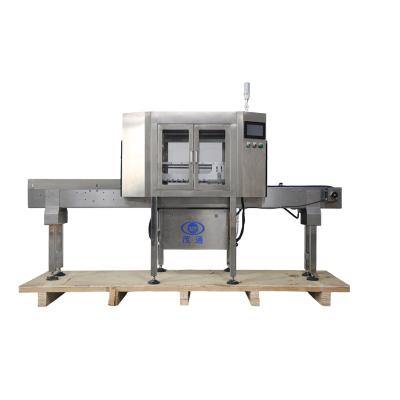
Inspect PET Bottles Faster With One Vision Station
For PET bottle producers, small defects can quickly become expensive problems. A missing cap, tilted cap, broken anti-theft ring, inaccurate liquid level, or unreadable inkjet code may lead to rework, returns, or unnecessary production interruptions. At Maotong Inspection, our Liquid Level Capping Detection Machine is built as an in-line visual inspection solution for full PET bottles, bringing multiple quality checks into one inspection station for products from 200 ml to 2 L and project output of up to 60,000 bottles per hour.

Project Equipment Overview
The project is defined as the PET Bottle Capping, Anti-theft Ring, Liquid Level, and Inkjet Printing Inspection Project. Its purpose is clear: inspect PET bottles online and automatically reject bottles with defects in cap status, anti-theft ring integrity, liquid level, or inkjet printing quality.
| Specification | |
|---|---|
| Project name | PET Bottle Capping, Anti-theft Ring, Liquid Level, and Inkjet Printing Project |
| Project scope | Inspect and reject cap, anti-theft ring, liquid level, and inkjet printing defects |
| Maximum output | 60,000 bottles/hour |
| Bottle type | PET bottle |
| Product capacity | 200 ml–2 L |
For buyers planning a Liquid Level Capping Detection Machine for PET bottle lines, this integrated configuration is especially useful when one inspection point must handle several quality risks without separating cap, fill-level, and code checks into multiple stations.
What the Machine Inspects
The Liquid Level Capping Detection Machine focuses on three critical inspection zones: the closure area, the liquid level area, and the coding area. The cap inspection module uses three CCD cameras positioned at different angles to reduce blind spots around the cap and anti-theft ring. It checks for missing caps, high caps, crooked caps, fully disconnected safety rings, partially broken rings, and missing safety rings.

The liquid level module uses a CCD camera to capture a frontal image of the bottle. Image processing separates the filled area from the empty area, allowing the system to judge whether the liquid level is above or below the preset standard. The specified liquid level detection condition is 3 mm below or above the standard, with detection accuracy of ≥99.92%.
The inkjet printing module checks whether the code is present and readable. It supports inspection of yellow caps with black ink and black caps with white ink, identifying missing print, partially missing print, excessive print, and blurred print where characters are unreadable.
Detection Performance Highlights
The detection table for the Liquid Level Capping Detection Machine gives practical reference values for key defects:
| Inspection item | Defect condition | Detection accuracy or rejection rate |
|---|---|---|
| No cap | — | ≥99.99% rejection rate |
| High cap | >0.8 mm | ≥99.98% detection accuracy |
| Crooked cap | >0.8 mm | ≥99.5% detection accuracy |
| Safety ring 100% disconnected | >1 mm gap | ≥99.99% detection accuracy |
| Safety ring >70% broken | >1 mm gap | ≥98.32% detection accuracy |
| Safety ring >50% broken | >1 mm gap | ≥95.78% detection accuracy |
| Liquid level high or low | 3 mm below or above standard | ≥99.92% detection accuracy |
| No inkjet print | — | ≥99.99% rejection rate |
| Overall inkjet print 50% missing | — | ≥99.95% rejection rate |
| Blurred inkjet print with lost characters | — | ≥99.99% rejection rate |
These figures make the machine a strong fit for high-speed PET bottle quality control where closure integrity, liquid level consistency, and code readability all need to be checked before products leave the line.
Working Principle and Signal Flow
The inspection sequence is synchronized by a positioning sensor and incremental encoder. When a PET bottle reaches the sensor, the control unit records the bottle identification number and encoder signal. The sensor then triggers the cameras to capture images of the cap, anti-theft ring, liquid level, and inkjet print area.
The embedded imaging industrial computer processes the images and sends results to the touchscreen HMI and PLC. If a bottle is judged unacceptable, the PLC uses the encoder position to activate the single-stage air-push rejector at the correct moment, removing the defective bottle from the conveyor.
Process flow: bottle entry → sensor detection → camera trigger → image processing → HMI display and PLC judgment → timed rejection.
Main Assemblies and Utilities
The Liquid Level Capping Detection Machine for PET bottle inspection line includes three main mechanical assemblies: a distribution cabinet, a detection module, and a rejection device. The distribution cabinet houses the image processor, interface processor, strobe controller, and PLC. The detection module integrates LED light sources, industrial CCD cameras, and sensors. The rejection device uses solenoid valves and mechanical components to remove nonconforming bottles.
Key electrical and control components include an embedded imaging industrial computer, four DAHUA high-speed gigabit digital cameras, COMPUTAR 6 MP 12 mm lenses, a Maotong PLC, a 15-inch touchscreen display, a light source controller, customized photo light sources, a 304 stainless-steel power distribution cabinet, an incremental encoder, and a single-stage air-push rejector with a Norgren cylinder and MAC solenoid valve.
Utility requirements include 220 V, 50 Hz, single-phase power, approximately 2.4 kW total power consumption, 24 VDC control voltage, and compressed air in the specified 4–12 Pa range, with the air pipeline supplied from the main plant air source to the equipment.
Installation Conditions for PET Bottle Lines
The recommended installation position is after the filling machine, either before or after the inkjet printer. A single-row conveyor is required, with at least 2 meters of straight conveyor length at the inspection and rejection section. At the reject outlet, the guardrail gap should be ≤15 cm, and a rigid container should be prepared to collect rejected bottles.
Operating conditions include an altitude range of 5–3,000 m, ambient temperature of 5°C–40°C, and relative humidity of 50%–65% RH. Factory floor levelness, load-bearing capacity, and storage conditions should support proper installation, commissioning, and long-term operation.
FAQs
What defects can the Liquid Level Capping Detection Machine detect?
It can detect missing caps, high caps, crooked caps, broken or missing anti-theft rings, high or low liquid levels, missing inkjet print, partially missing print, excessive print, and blurred unreadable codes.
What PET bottle sizes are supported?
The defined product capacity range is 200 ml to 2 L PET bottles.
Where should the machine be installed?
It is installed after the filling machine, either before or after the inkjet printer, depending on the line layout and code inspection requirement.
How does the rejection system stay accurate at high speed?
A positioning sensor and incremental encoder track each bottle. When the inspection system identifies a defect, the PLC triggers the rejector at the correct encoder position.
What conveyor layout is required?
The system requires a single-row conveyor, at least 2 meters of straight conveyor length, and a reject outlet guardrail gap of no more than 15 cm.