Industrial Visual Defect Detection Technology: Principles, Methods, and Future Trends
On a modern production line, as parts pass through an inspection system at speeds of several meters per second, minute defects imperceptible to the human eye are identified and sorted in real time. Behind this seemingly simple process lies the deep integration of optical imaging, artificial intelligence, and automation technologies.
Defect detection, as a core component of industrial quality control, is crucial for ensuring product safety and reliability. Traditional defect detection relies primarily on manual visual inspection, but this method is inefficient and prone to misjudgments due to fatigue. With the development of machine vision technology, computer vision-based defect detection technology has gradually become an important part of industrial automation.
Modern industrial defect detection systems can achieve automatic identification and classification with micron-level precision, increasing detection speed by more than 90% compared to manual methods, providing key technological support for the high-quality and sustainable development of the manufacturing industry. This article will systematically introduce the technical principles, main methods, application practices, and development trends of defect detection, providing a reference for practitioners in related fields.
1. Technical Principles and System Composition of Defect Detection
The basic principle of defect detection is to use an optical system to acquire images of the product surface, and then use image processing and analysis algorithms to identify abnormal areas. A complete industrial vision defect detection system typically includes the following core components:
1.1 Optical Imaging System
The optical imaging system is the "eye" of defect detection, and its quality directly determines the accuracy of subsequent analysis. Industrial vision systems usually employ special light source combinations to enhance the defect features of different material surfaces: dark-field lighting is used to capture planar defects such as scratches and ink spots; bright-field lighting detects three-dimensional defects such as bumps and orange peel texture; and translucent lighting is suitable for contour positioning of translucent defects such as sand holes and chipped edges.
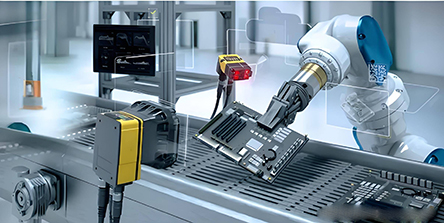
High-performance industrial cameras (area scan/line scan cameras) combined with adjustable optical lens groups constitute the core of image acquisition. Related patent technologies from 2024 show that advanced detection systems can achieve micron-level detection accuracy through line-by-line shooting with a line scan camera and programmed control of the stroboscopic light source. To meet the needs of complex workpiece inspection, multi-feature optical imaging systems employ collaborative robotic arms carrying multiple sets of vision imaging equipment, using area scan cameras, line scan cameras, and 3D laser sensors to work together to ensure comprehensive image acquisition of the workpiece without blind spots.
1.2 Signal Processing and Image Analysis
The signal processing system is responsible for converting the optical signals acquired by the optical hardware into digital signals and performing noise reduction, gain adjustment, and other processing to ensure the stability of the original data. The image processing module uses a series of algorithms to preprocess the image, including noise reduction, enhancement, and segmentation, to improve image quality and highlight defect features.
Key preprocessing technologies include adaptive illumination compensation, multi-scale feature fusion, and image sharpening. The CLAHE algorithm, designed for reflective metal surfaces, effectively addresses uneven illumination; multi-scale Gabor filter responses can enhance defect features of different sizes.
2. Mainstream Defect Detection Algorithms
Industrial defect detection algorithms have evolved from traditional image processing to machine learning, and then to deep learning. Different methods have their own advantages and disadvantages and are suitable for different scenarios.
2.1 Traditional Image Processing Algorithms
Traditional image processing methods mainly rely on feature engineering and template matching techniques. Feature engineering detects defects by analyzing image grayscale values, variance, mean, color, shape, contour, area, and other features, offering advantages such as high flexibility and fast development speed. Blob analysis analyzes connected components of identical pixels in an image to calculate relevant features and accurately locate defect regions.
Template matching, on the other hand, uses a pre-defined standard image template and compares it with the image to be tested to identify defects. This method is simple and effective in specific scenarios, but its adaptability and generalization ability are limited. While traditional algorithms perform well in certain specific scenarios, they often underperform in complex backgrounds or with diverse defect types.
2.2 Machine Learning Methods
Machine learning methods in defect detection mainly employ classification algorithms such as Support Vector Machines (SVM) and decision trees. These methods do not require massive amounts of training data, have good robustness, and are frequently used in defect detection for printed materials and food.
SVM-based detection methods can achieve an accuracy of over 95% in detecting surface defects in printed materials. However, these methods are typically only suitable for binary classification of defects and have limited effectiveness in complex scenarios where multiple defects coexist.
2.3 Deep Learning Methods
Deep learning technology performs exceptionally well in defect detection, automatically learning complex features in images and significantly improving detection accuracy and adaptability. Mainstream deep learning algorithms include:
• Image classification algorithms: Directly classify the entire image to determine the defect category. Commonly used networks include ResNet and MobileNet, but classification accuracy is affected when the image contains a large amount of irrelevant background.
• Object detection algorithms: Locate defects in an image and identify their category. The YOLO series of algorithms, with their high accuracy and fast inference capabilities, are the preferred choice in industry, especially suitable for real-time inspection scenarios.
• Instance segmentation algorithms: Provide finer pixel-level localization based on object detection, effectively handling complex situations where defects intersect or are contained within each other.
For the problem of scarce defect samples in industrial scenarios, semi-supervised and self-supervised learning provide effective solutions. Through a teacher-student network structure and a reverse distillation strategy, high-performance defect detection can be achieved with a small amount of labeled data.
3. Industrial Application Practices and Challenges
3.1 Typical Application Scenarios
Visual defect detection technology has been widely used in many industries:
In electronic product inspection, the system can identify solder residue and pin oxidation defects as small as 0.1 mm², using the OpenCV library for real-time image processing. LCD screen inspection utilizes differential deep learning and model training to achieve foreign object detection and Mura defect detection with an accuracy rate exceeding 99%.
In the automotive manufacturing industry, vision systems are used to inspect the surface quality of various components. Taking automotive wheel hub inspection as an example, leveraging its multi-curved, highly reflective characteristics, a multi-station collaborative inspection is employed. Inspection points are set on the front, back, and rim, with a robotic arm controlling their position for omnidirectional defect detection.
In battery inspection, the system can comprehensively inspect all surfaces of the battery, identifying defects such as slime, dents, damage, deformation, dirt, and scratches. It also inspects label appearance, welding quality, and coding quality.
3.2 Practical Challenges and Solutions
Industrial defect detection faces multiple challenges requiring targeted solutions:
Insufficient data samples are a common problem in industrial scenarios. Due to strict production process control, defect samples are scarce and labeling costs are high. Solutions include using data augmentation techniques to generate synthetic defect images and fine-tuning pre-trained models using transfer learning.
Complex backgrounds and minute defects also pose challenges to inspection. Defects often represent only a small area in a high-resolution image and have low contrast with the background. To address this issue, multi-scale feature fusion and attention mechanisms have proven effective, guiding the model to focus on key areas.
Model deployment cost is a crucial consideration for industrialization. Lightweight model techniques (such as pruning and quantization) and edge computing architectures can significantly reduce resource consumption, enabling efficient deployment on embedded devices.
4. Technological Development Trends and Prospects
With the continuous development of artificial intelligence technology, industrial visual defect detection is evolving towards greater intelligence and efficiency:
4.1 Deepening Technological Integration
Multimodal data joint analysis will become a trend, breaking through the limitations of single visual data. By combining information from multiple sources such as infrared and X-rays, the detection error challenges of special objects such as highly reflective and transparent materials can be overcome. Simultaneously, hybrid models combining traditional image processing and deep learning will continue to evolve, leveraging their respective advantages to form more powerful detection capabilities.
Generative AI technology will inject new vitality into defect detection. By generating synthetic defect samples, the problem of small-sample learning can be solved, improving the model's generalization ability. Furthermore, the widespread application of emerging architectures such as Transformer in vision tasks will further drive improvements in detection accuracy.
4.2 System Integration and Intelligence
Future defect detection systems will place greater emphasis on collaborative hardware and software design, forming integrated solutions. AI-powered optical quality inspection equipment will be deeply integrated into intelligent manufacturing production lines, seamlessly collaborating with industrial robots, AGVs, and other systems to form a closed-loop system of "detection-judgment-sorting."
The function of defect detection will also extend from "post-event identification" to "pre-event prediction." By linking with production systems such as MES, AI can analyze the correlation between production parameters and defects, enabling early warning of quality problems and process optimization.
4.3 Improved Automation and Usability
Lowering the technical barriers to use is key to promoting widespread application. Future defect detection systems will focus more on improving the toolchain, enabling ordinary engineers to train and deploy models without requiring extensive AI knowledge. Automated parameter tuning and adaptive learning capabilities will be further enhanced, allowing the system to quickly adapt to new products and scenarios.
With technological advancements, industrial visual defect detection is shifting from traditional "rule-driven" to "data-driven" approaches, and from an "auxiliary tool" to a "decision-making core." Future defect detection systems will be more intelligent, adaptive, and integrated, providing a solid guarantee for the high-quality and sustainable development of the manufacturing industry.
This transformation will not only improve product quality control but also redefine production processes and efficiency standards, laying a solid foundation for the era of intelligent manufacturing.