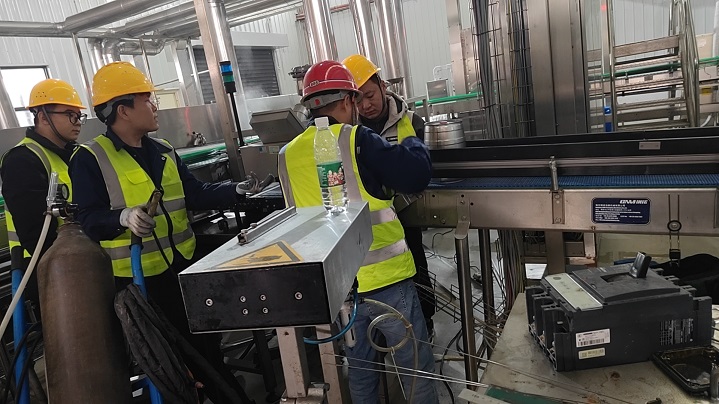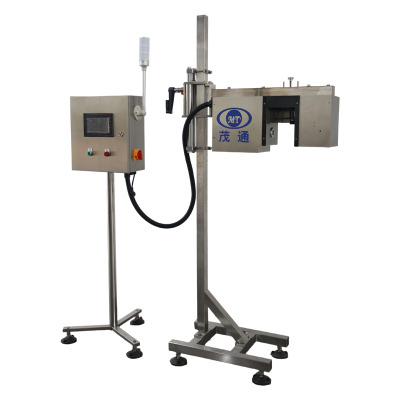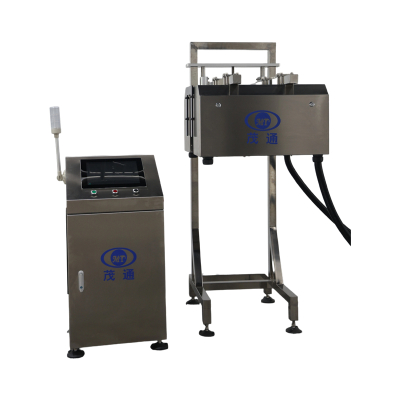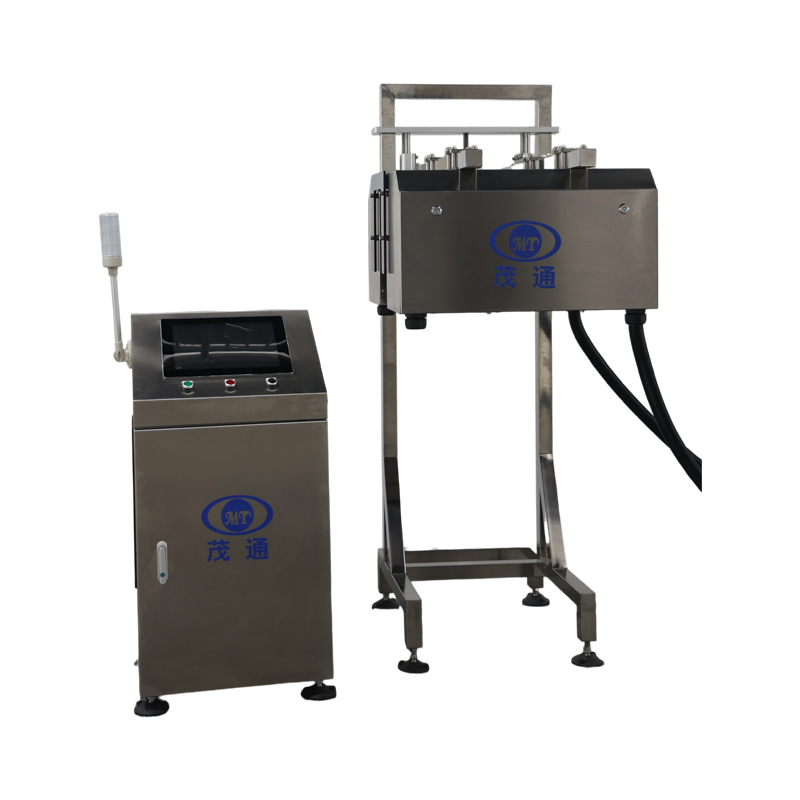
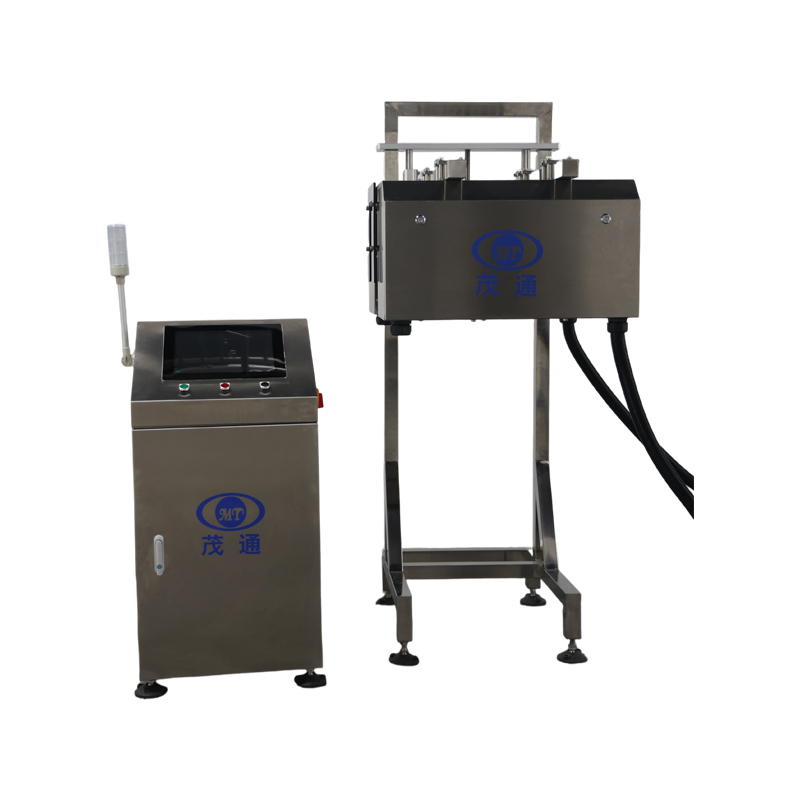
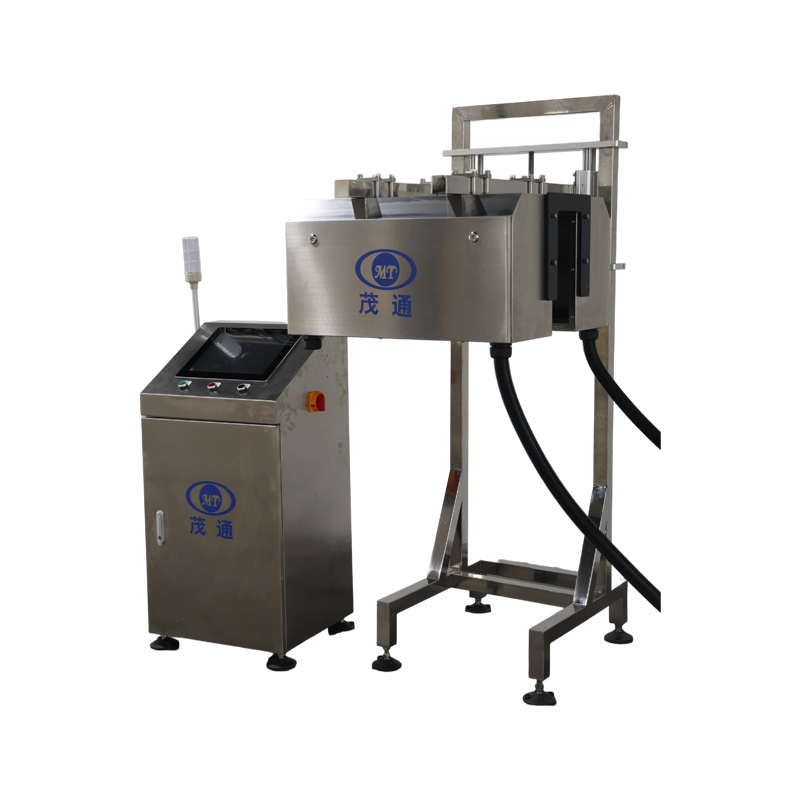
Cap and Liquid Level Inspection Machine
1.Using graphical man-machine interface , intuitive and concrete
2.The processing speed is fast, the inspection accuracy is high, the fastest speed can reach 50000 BPH
3.Simple operation, easy to production line staff
4.Multi angle inspection, no dead angle, less manual intervention, low false tick rate
5.Using high brightness LED light source, adjustable brightness, long lfe, energy saving,maintenance free
I. Project Equipment Overview
Project Title: PET Bottle Inspection System for Cap, Tamper-Evident Ring, Liquid Level, and Inkjet Code Quality
Project Description:
The system is designed to perform automated inspection of PET bottles, covering cap condition, tamper-evident ring integrity, liquid filling level, and inkjet code quality. Bottles that fail to meet the specified quality requirements are automatically identified and rejected from the production line.
Maximum Production Capacity:Up to 60,000 bottles per hour.
Applicable Bottle Type:PET bottles.
Applicable Filling Volume:200 mL to 2 L.
II. Environmental Requirements
Operating Altitude:
The equipment is designed for stable operation at altitudes ranging from 5 to 3,000 meters above sea level.
Ambient Operating Temperature:5°C to 40°C.
Relative Humidity:50% to 65% RH.
Factory Site Requirements:
The installation site shall meet applicable national standards with respect to floor flatness, structural load-bearing capacity, and other relevant facility conditions. The site must provide an environment suitable for the safe and reliable operation of the equipment.
Storage and Preservation Requirements:
Following delivery, all equipment and components shall be stored under environmental conditions compliant with applicable national standards. Appropriate lubrication, protection, and routine maintenance shall be carried out during storage to prevent corrosion, surface damage, deformation, or other conditions that may adversely affect subsequent installation, commissioning, or operation.
III. Equipment Operating Parameters
Power Supply:
220 VAC, 50 Hz, single-phase, supplied by the customer. Any special power supply requirements must be confirmed prior to equipment design and production, as deviations from the standard power supply may affect equipment configuration, lead time, and overall cost.
Rated Power Consumption:Approximately 2.4 kW.
Control Voltage:24 VDC.
Compressed Air Supply:
Required air pressure: 4–12 Pa. The customer shall be responsible for providing and connecting the compressed-air supply line to the main equipment unit.
IV. Equipment Overview
Installation Location:
The final installation position shall be determined based on the customer’s existing production line layout and site conditions.
Inspection Functions:
The inspection system is capable of detecting the following defects and quality conditions:
Missing cap
Cap positioned too high
Crooked or improperly aligned cap
Damaged or broken tamper-evident ring
Insufficient liquid level
Missing inkjet code
Excessive, incomplete, or abnormal inkjet printing
Inspection and Detection Principle:
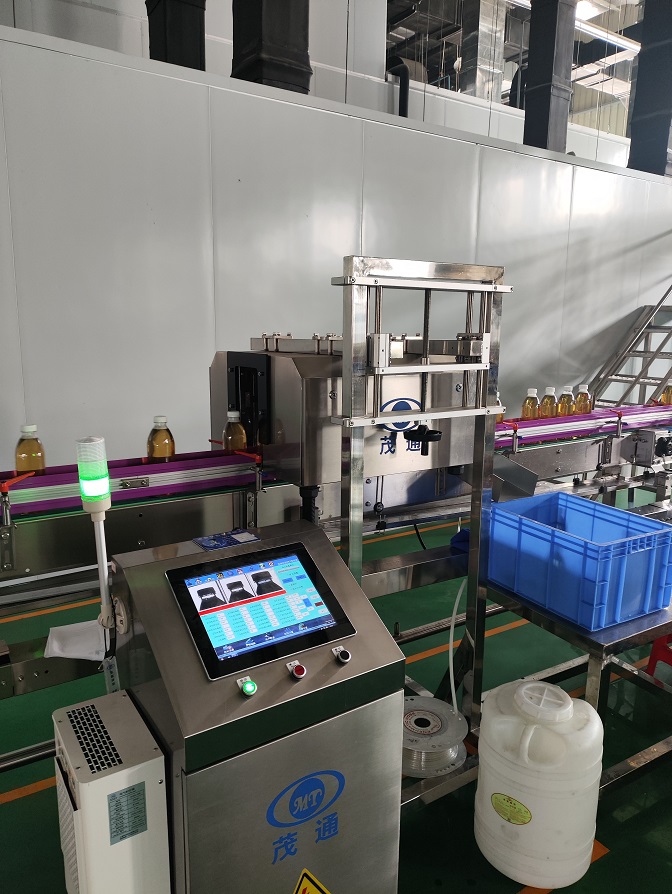
As each PET bottle passes through the positioning sensor, the control system assigns and records the corresponding bottle ID together with the current encoder position.
The positioning sensor then triggers the inspection cameras to capture images of the bottle cap, liquid level, and inkjet printing area. The image-processing system analyzes the captured images and determines whether the bottle meets the predefined quality criteria.
The inspection results are transmitted simultaneously to the HMI for real-time monitoring and to the PLC control system. Based on the inspection results and the corresponding encoder position, the PLC activates the rejection mechanism at the appropriate position to automatically remove defective bottles from the production line.
When the control unit receives a rejection signal, it instructs the rejector to remove the bottle corresponding to the recorded ID.
4. Equipment mechanical components
model
| Name | Components | Functional Description | Remark
|
1 | Distribution cabinet | Composed of an image processor, an interface processor, a strobe controller, and a PLC. | Provides power to the entire system, processes images, and controls the rejection of defective products. | |
2 | Detection module | LED light source, industrial CCD camera, and sensor. | Dynamically captures images of PET bottles. | |
3 | Rejection device | Main components include solenoid valves and mechanical components. | Receives signals and controls the rejection of defective products. |
5. Electrical composition of the equipment
model
| Name | Unit | Brand Notes | Quantity |
1 | Embedded imaging industrial computer (4 Ethernet ports) i5+4G+120G | Unit | Taiwan Chaoen, dust-proof, fast processing speed, and excellent stability | 1 |
2 | DAHUA high-speed gigabit digital camera | Unit | Resolution 680x480, imported from Canada, industry-leading brand | 4 |
3 | Camera I/O module | Set | Made-in-China | 4 |
4 | Lens | Piece | COMPUTAR 6MP, 12mm | 4 |
5 | Camera-50/30line cable | Piece | Made-in-China, 5m | 4 |
6 | MW.24v DC power supply 75/120W (DRP-75/120-24) | Piece | Taiwan Mean Well | 2 |
7 | PLC | Piece | Maotong independently developed | 1 |
8 | Touchscreen display | Piece | Taiwan IEI 15-inch | 1 |
9 | Light source controller | Unit | Customized in China, 4-way asynchronous triggering, screen flicker control technology, significantly extending light source life | 1 |
10 | Photo light source | Unit | Customized surface lighting, infrared, and blue | 4 |
11 | Power distribution cabinet | Piece | Made-in-China, 304 material, brushed, pickled, oxidized, and brushed finishes | 1 |
12 | Single-stage rejector Mono | Piece | Customized, air-push type, 304 material | 1 |
13 | Reject unit cylinder | Piece | Norgren high-speed cylinder, UK | 1 |
14 | Reject unit solenoid valve | Piece | MAC high-speed solenoid valve, US, 4.9ms response speed | 1 |
15 | Encoder | Piece | Made-in-China, Hode, incremental type | 1 |
16 | Low-voltage electrical components | Piece | Schneider, France | Several |
17 | Image processing system | Piece | Maotong independently developed, can develop V3.0 according to customer needs | 1 |
18 | Special equipment refrigeration unit - industrial air conditioner | Piece | Shanghai Highly Special, cooling capacity 320W | 1 |
19 | Terminal blocks | Piece | Honeywell, USA | Several |
20 | Photoelectric sensor | Piece | Leuze, Aurora PNP | 1 |
21 | Other electrical components | Piece | - | Several |
22 | Cabinet material and surface treatment | Piece | 304 material, igus® mechanical parts, brushed, pickled, oxidized, and brushed finishes. | 1 |
23 | Alarm light | - | Several | |
24 | Oil-water separator | - | Schneider tri-color tower light | Several |
25 | Relay | Piece | 1 | |
26 | Glass material | Piece | AirTac | 1 |
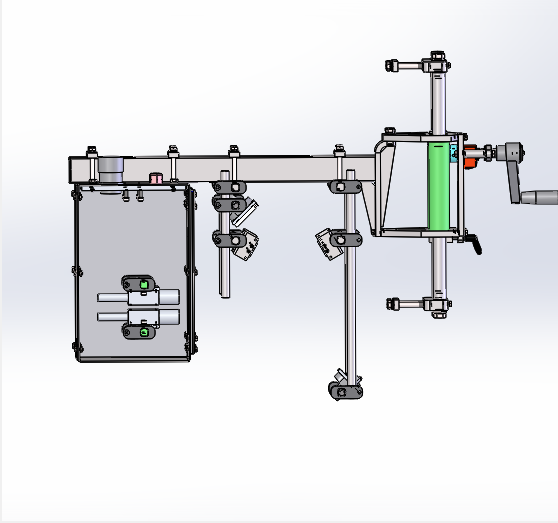
6. Testing cabinet structure diagram

Capping liquid level detection
Inkjet printing inspection
7. Cap Inspection
This module uses three CCD cameras to capture images of bottles from different angles, reducing blind spots. Special optical lenses filter light from all directions to ensure efficient image acquisition. Its primary function is to detect defective bottles such as missing caps, overhanging caps, crooked caps, and broken caps.
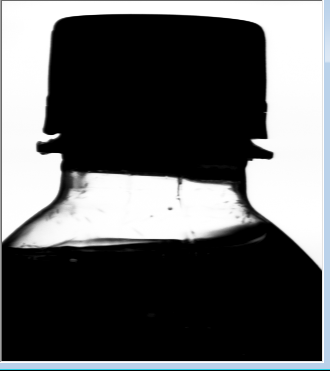
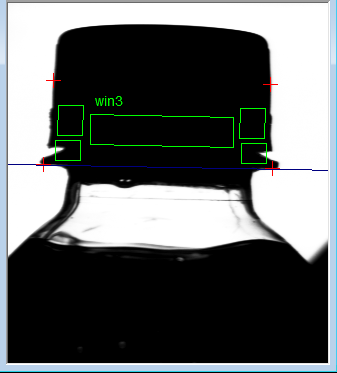 PET bottle capping images captured by CCD camera
8. Liquid Level Inspection
The liquid level inspection module uses a CCD camera to acquire front-view images of each bottle. When the bottle is properly positioned and stationary, the liquid surface is expected to maintain an approximately horizontal orientation.
The captured images are processed using dedicated image-processing algorithms. In the processed image, the area occupied by the liquid is represented in black, while the unfilled area above the liquid surface is represented in white. The system analyzes the position of the liquid-to-air boundary and determines whether the actual liquid level meets the predefined inspection standard.
9. Inkjet Printing Inspection
The inkjet printing inspection module employs a CCD camera to capture front-view images of the printed codes on both bottles and caps. The captured images are analyzed using digital image-processing algorithms to automatically verify the presence and quality of the inkjet printing.
The system can accurately detect missing, incomplete, or abnormal printing and automatically identify defective bottles for subsequent rejection. The inspection system supports various ink-and-background color combinations, including black ink printed on yellow caps and white ink printed on black caps.
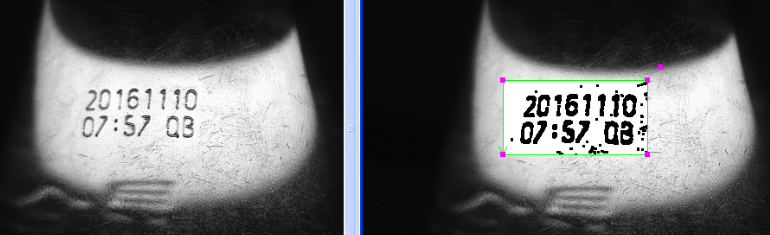
Sample image recognition processing effect
10. Detection accuracy
Inspection Items | Inspection Contents | Detection accuracy
| Rejection rate
|
Bottle Cap Inspection
| No cap | —— | ≥99.99% |
High cap | >0.8 mm | ≥99.98% | |
Crooked cap | >0.8 mm | ≥99.5% | |
Safety ring 100% disconnected | >1mm gap | ≥99.99% | |
Safety ring >70% broken | >1mm gap | ≥98.32% | |
Safety ring >50% broken | >1mm gap | ≥95.78% | |
Safety ring 100% missing | —— | ≥99.99% | |
Safety ring 70% missing | —— | ≥98.21% | |
Safety ring 50% missing | —— | ≥95.78% | |
Inspection Items | Liquid level detection (high and low) | 3mm below (or above) the standard
| ≥99.92% |
Bottle Cap Inspection | No inkjet print | ≥99.99% | |
Overall inkjet print 50% missing | ≥99.95% | ||
Overall inkjet print 30% missing | ≥99.9% | ||
Overall inkjet print 20% missing | ≥99.8% | ||
Inkjet print is blurred enough to remove the inkjet characters after processing | ≥99.99% |