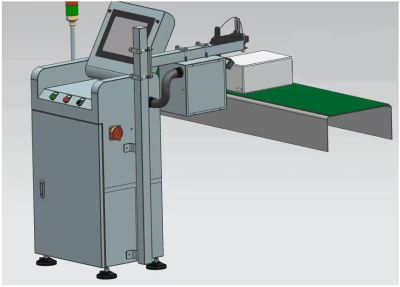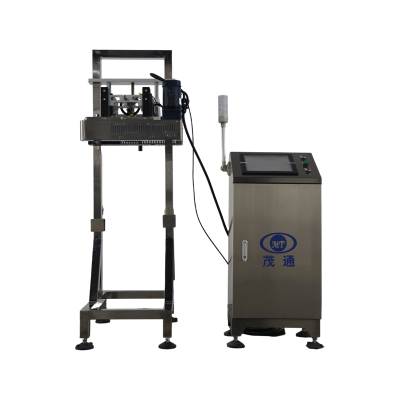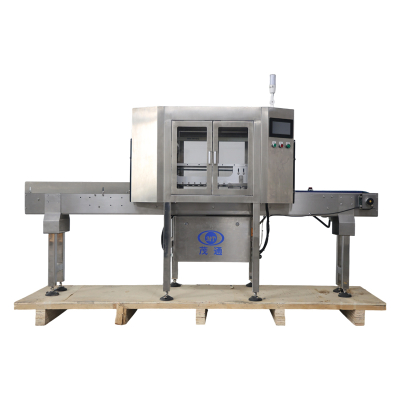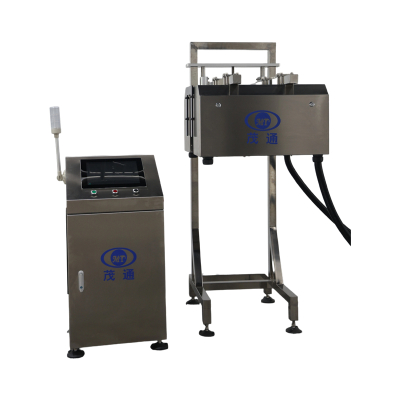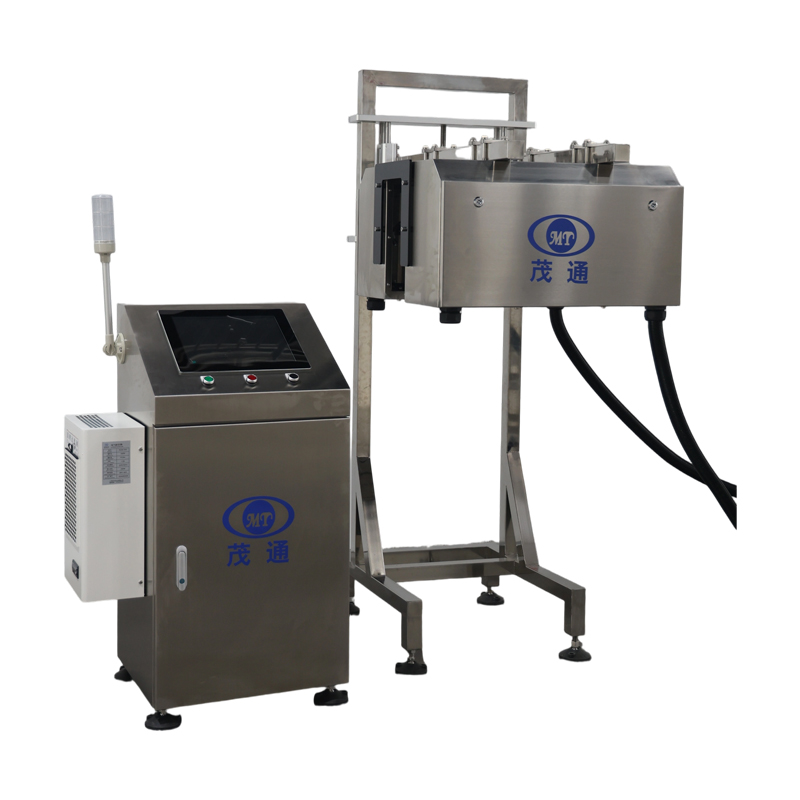
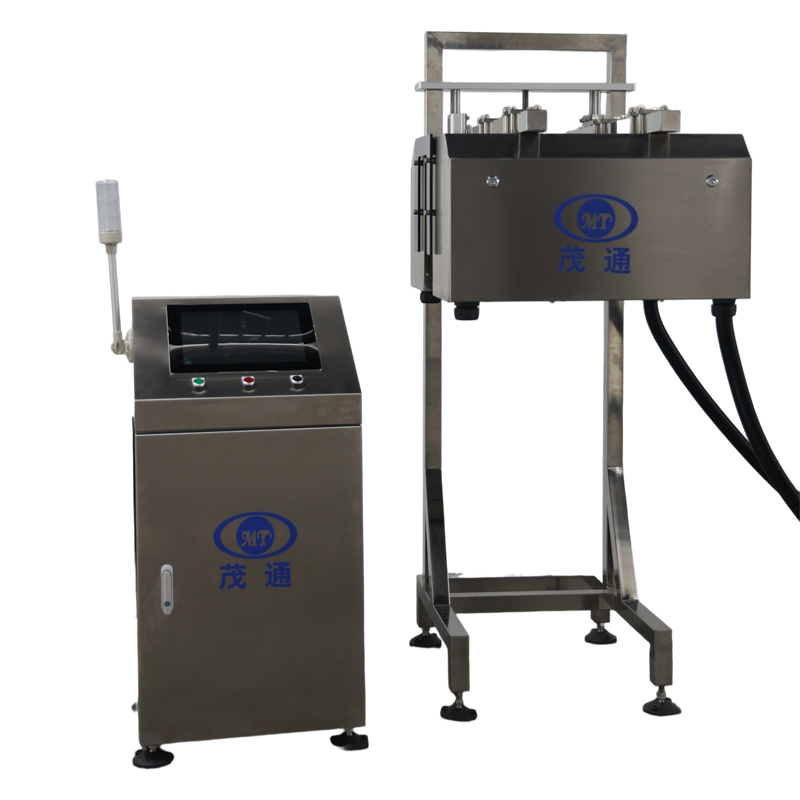
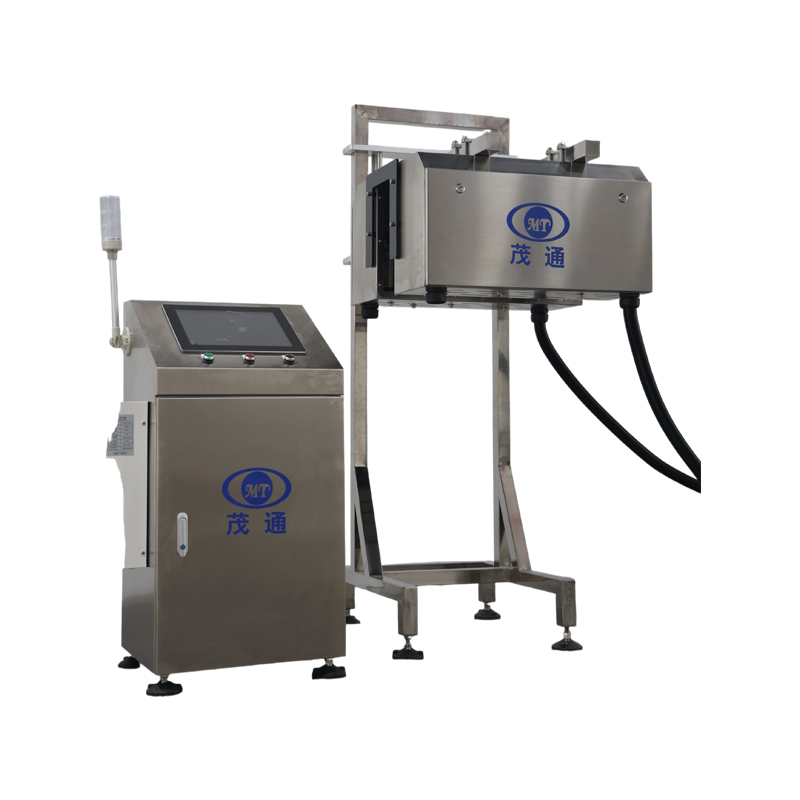
Code Inspection Machine
1.The advanced algorithm is stable and has high detection accuracy
2.Detect different positions of code
3.The maximum speed is up to 72000 BPH
I. General System Description
1. Project Name
Integrated PET Bottle Vision Inspection System for Cap, Tamper-Evident Ring, Liquid Level, and Inkjet Code Inspection
2. System Overview and Function
The inspection system is designed to provide continuous and fully automated quality control for PET bottles throughout the production process. It performs comprehensive inspection of cap installation, tamper-evident ring integrity, liquid filling level, and inkjet-printed information.
The system automatically analyzes each bottle against predefined quality standards. Any bottle identified as non-conforming is tracked and automatically removed from the production line, ensuring that only qualified products proceed to the next production stage.
3. Maximum Line Speed
Up to 60,000 bottles per hour
4. Applicable Container Type
PET bottles
5. Applicable Filling Range
200 mL to 2 L
II. Installation and Environmental Requirements
1. Applicable Installation Altitude
5 to 3,000 meters above sea level
2. Operating Temperature
5°C to 40°C
3. Recommended Relative Humidity
50% to 65% RH
4. Installation Site Requirements
The customer shall provide an installation area with a level, stable, and adequately load-bearing foundation. The site shall satisfy all applicable national standards and provide sufficient conditions for safe installation, commissioning, and continuous operation of the inspection system.
The installation environment shall also provide adequate space and accessibility for equipment operation, inspection, maintenance, and adjustment.
5. Equipment Storage Requirements
Prior to installation and commissioning, all equipment and components shall be stored in an environment that meets applicable national storage requirements.
For prolonged storage periods, appropriate protective measures shall be taken, including periodic inspection, lubrication, and environmental protection. These measures are intended to prevent corrosion, surface deterioration, component deformation, or other damage that may adversely affect subsequent installation, commissioning, or normal equipment operation.
III. Utilities and Operating Requirements
1. Electrical Power Supply
220 VAC, 50 Hz, single-phase
The required electrical power supply shall be provided by the customer.
Any special or non-standard electrical requirements must be confirmed prior to equipment design and manufacturing. Changes to the standard power supply may require modifications to the electrical system and equipment configuration and may consequently affect the manufacturing schedule, delivery time, and final quotation.
2. Total Installed Power
Approximately 2.4 kW
3. Control Voltage
24 VDC
4. Compressed-Air Requirement
Specified pressure: 4–12 Pa
The customer shall be responsible for providing the plant compressed-air source and connecting the air-supply pipeline to the designated pneumatic inlet of the inspection equipment.
Technical Note:
The pneumatic pressure unit should be confirmed before the final technical specification is released. A range of 4–12 Pa is unusually low for conventional industrial pneumatic systems. If the intended specification is 4–12 bar or 0.4–1.2 MPa, the corresponding value should be corrected in the final document.
IV. Equipment Configuration and Inspection Workflow
1. Installation and Integration
The inspection system is designed to be integrated into the customer's existing PET bottle conveying line downstream of the filling process.
The final installation position shall be determined based on the actual production-line arrangement, conveyor configuration, bottle pitch, conveying speed, available installation space, and required inspection distance. The equipment shall be positioned to ensure stable bottle presentation and reliable image acquisition.
2. Inspection Items
The system is capable of identifying the following quality defects and abnormalities:
Missing cap
Cap installed above the specified position
Cap tilted or incorrectly aligned
Damaged, incomplete, or broken tamper-evident ring
Liquid level below the specified limit
Missing inkjet code
Abnormal, excessive, incomplete, or otherwise non-conforming inkjet printing
3. Inspection and Control Procedure
3.1 Bottle Identification and Tracking
When a PET bottle enters the inspection zone, the photoelectric sensor detects its position and generates the corresponding trigger signal.
Upon receiving the trigger, the control system registers the bottle and assigns a unique tracking ID. The encoder simultaneously provides continuous position feedback, enabling the control system to accurately monitor the bottle's movement along the conveyor.
3.2 Image Acquisition and Vision Analysis
As the bottle reaches the designated inspection position, the relevant vision cameras are triggered to capture images of the required inspection areas, including:
Bottle cap and tamper-evident ring
Liquid filling level
Inkjet-printed information
The captured images are transmitted to the vision-processing system, where dedicated image-processing algorithms analyze the relevant characteristics and compare the inspection results with the predefined quality criteria.
The inspection results and current system status are displayed on the HMI in real time, allowing operators to monitor production and inspection conditions. At the same time, the inspection results are transmitted to the PLC for subsequent tracking and rejection control.
3.3 Automatic Rejection of Defective Bottles
When a bottle is identified as non-conforming, the system stores its inspection result and tracking ID. The bottle is then continuously monitored based on encoder position feedback as it travels toward the rejection station.
Once the defective bottle reaches the predetermined rejection position, the PLC sends a control signal to the rejection mechanism. The reject device operates at the appropriate timing to remove the non-conforming bottle from the main production flow.
Qualified bottles remain on the conveyor and continue through the production process without interruption.
Through the coordinated operation of vision inspection, bottle identification, encoder-based tracking, PLC control, and automatic rejection, the system provides stable and reliable quality inspection suitable for high-speed PET bottle production.
4. Equipment mechanical components
model
| Name | Components | Functional Description | Remark
|
1 | Distribution cabinet | Composed of an image processor, an interface processor, a strobe controller, and a PLC. | Provides power to the entire system, processes images, and controls the rejection of defective products. | |
2 | Detection module | LED light source, industrial CCD camera, and sensor. | Dynamically captures images of PET bottles. | |
3 | Rejection device | Main components include solenoid valves and mechanical components. | Receives signals and controls the rejection of defective products. |
5. Electrical composition of the equipment
model
| Name | Unit | Brand Notes | Quantity |
1 | Embedded imaging industrial computer (4 Ethernet ports) i5+4G+120G | Unit | Taiwan Chaoen, dust-proof, fast processing speed, and excellent stability | 1 |
2 | DAHUA high-speed gigabit digital camera | Unit | Resolution 680x480, imported from Canada, industry-leading brand | 4 |
3 | Camera I/O module | Set | Made-in-China | 4 |
4 | Lens | Piece | COMPUTAR 6MP, 12mm | 4 |
5 | Camera-50/30line cable | Piece | Made-in-China, 5m | 4 |
6 | MW.24v DC power supply 75/120W (DRP-75/120-24) | Piece | Taiwan Mean Well | 2 |
7 | PLC | Piece | Maotong independently developed | 1 |
8 | Touchscreen display | Piece | Taiwan IEI 15-inch | 1 |
9 | Light source controller | Unit | Customized in China, 4-way asynchronous triggering, screen flicker control technology, significantly extending light source life | 1 |
10 | Photo light source | Unit | Customized surface lighting, infrared, and blue | 4 |
11 | Power distribution cabinet | Piece | Made-in-China, 304 material, brushed, pickled, oxidized, and brushed finishes | 1 |
12 | Single-stage rejector Mono | Piece | Customized, air-push type, 304 material | 1 |
13 | Reject unit cylinder | Piece | Norgren high-speed cylinder, UK | 1 |
14 | Reject unit solenoid valve | Piece | MAC high-speed solenoid valve, US, 4.9ms response speed | 1 |
15 | Encoder | Piece | Made-in-China, Hode, incremental type | 1 |
16 | Low-voltage electrical components | Piece | Schneider, France | Several |
17 | Image processing system | Piece | Maotong independently developed, can develop V3.0 according to customer needs | 1 |
18 | Special equipment refrigeration unit - industrial air conditioner | Piece | Shanghai Highly Special, cooling capacity 320W | 1 |
19 | Terminal blocks | Piece | Honeywell, USA | Several |
20 | Photoelectric sensor | Piece | Leuze, Aurora PNP | 1 |
21 | Other electrical components | Piece | - | Several |
22 | Cabinet material and surface treatment | Piece | 304 material, igus® mechanical parts, brushed, pickled, oxidized, and brushed finishes. | 1 |
23 | Alarm light | - | Several | |
24 | Oil-water separator | - | Schneider tri-color tower light | Several |
25 | Relay | Piece | 1 | |
26 | Glass material | Piece | AirTac | 1 |
6. Testing cabinet structure diagram
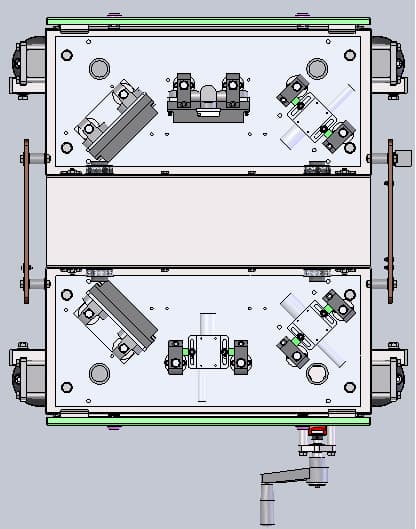
Capping liquid level detection
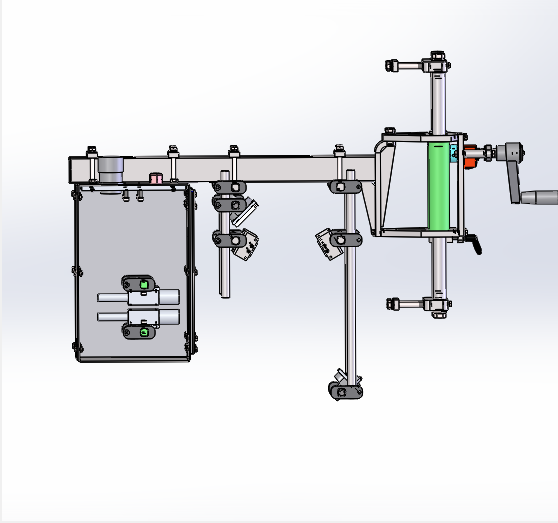
Capping liquid level detection
This inspection unit is equipped with three CCD cameras positioned at different viewing angles to obtain comprehensive images of each bottle and minimize potential inspection blind spots. Dedicated optical lenses are incorporated to control and filter incoming light, helping maintain consistent and high-quality image capture during operation. The module is primarily designed to identify cap-related abnormalities, including missing caps, excessively raised or improperly seated caps, tilted caps, and cracked or damaged caps.
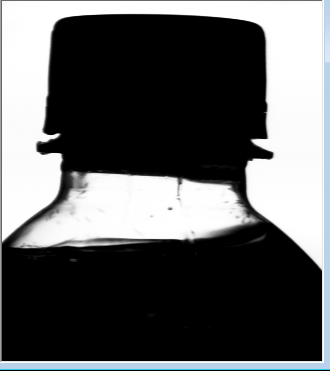
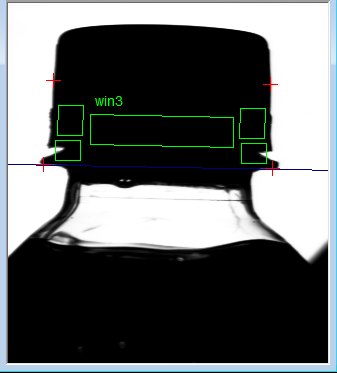
PET bottle capping images captured by CCD camera
8. Liquid Level Detection
The liquid level inspection unit employs a CCD camera to capture a front-view image of each bottle. During image acquisition, the bottle is temporarily stabilized to minimize liquid movement and ensure that the liquid surface remains substantially horizontal, thereby maintaining consistent inspection conditions.
The captured image is subjected to dedicated image-processing procedures to enhance the distinction between the filled and unfilled regions. The liquid-filled portion is displayed as a dark area, while the empty portion above the liquid surface is displayed as a light area.
A specialized vision algorithm identifies the liquid-to-air interface and determines its position relative to the preset reference level. The measured liquid level is then compared with the specified acceptance limit to determine whether the bottle meets the required filling standard.
9. Inkjet Printing Inspection
The inkjet inspection unit uses a CCD camera to acquire images of the printed markings on both the bottle body and the cap. The acquired images are analyzed by a dedicated vision-processing algorithm to assess the presence, location, legibility, consistency, and overall quality of the printed information.
The system can identify missing, misplaced, unclear, incomplete, or otherwise abnormal inkjet markings. When the detected printing does not comply with the predefined inspection parameters, the corresponding bottle is automatically identified as a defective product and subsequently removed from the production line by the rejection system.
The inspection system supports a variety of printing and background color combinations, including black ink applied to yellow caps and white ink applied to black caps, providing reliable inspection performance under different packaging configurations.
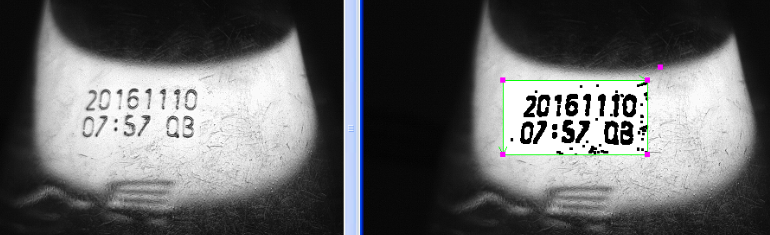
Sample image recognition processing effect
10. Detection accuracy
Inspection Items | Inspection Contents | Detection accuracy
| Rejection rate
|
| No cap | —— | ≥99.99% |
High cap | >0.8 mm | ≥99.98% | |
Crooked cap | >0.8 mm | ≥99.5% | |
Safety ring 100% disconnected | >1mm gap | ≥99.99% | |
Safety ring >70% broken | >1mm gap | ≥98.32% | |
Safety ring >50% broken | >1mm gap | ≥95.78% | |
Safety ring 100% missing | —— | ≥99.99% | |
Safety ring 70% missing | —— | ≥98.21% | |
Safety ring 50% missing | —— | ≥95.78% | |
Inspection Items | Liquid level detection (high and low) | 3mm below (or above) the standard
| ≥99.92% |
Bottle Cap Inspection | No inkjet print | ≥99.99% | |
Overall inkjet print 50% missing | ≥99.95% | ||
Overall inkjet print 30% missing | ≥99.9% | ||
Overall inkjet print 20% missing | ≥99.8% | ||
Inkjet print is blurred enough to remove the inkjet characters after processing | ≥99.99% |