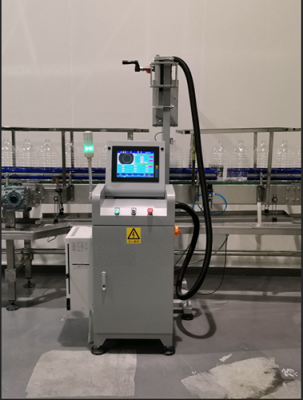
Automatic Visual Inspection Machine Secures BC Can Caps at Speed
For BC can packaging lines, maintaining impeccable cap quality requires precise quality control without impacting production speed or traceability. The Automatic Visual Inspection Machine Automatic Visual Inspection Machine offers fully automated, non-contact online inspection of BC can caps at an impressive rated capacity of 400 cans per minute. Utilizing four cameras for 360° image inspection, our machine diligently checks each cap after high-temperature sterilization and air drying. It then supports online rejection of defective products through a sophisticated sequence involving a sensor, encoder, image processor, Human-Machine Interface (HMI), PLC, and a dedicated rejector.

Why Precision Cap Inspection is Crucial
On a high-speed BC can line, a defective cap can travel a significant distance beyond the inspection station before reaching its designated removal point. This means tracking is as vital as the imaging itself. Our Automatic Visual Inspection Machine addresses this challenge by recording the can ID and encoder value precisely when the can passes the positioning sensor. This meticulous tracking ensures that the subsequent rejection command accurately matches the exact can identified during inspection, preventing costly mis-rejections or, worse, defective products reaching consumers. Undetected cap defects can lead to product spoilage, leakage, and significant brand damage, making robust inspection indispensable.
Our system is designed for cans and BC cans with a container volume range of 100 mL to 1000 mL. It is ideally suited for can and BC can packaging lines operating at no more than 400 cans/min, with the inspection unit installed on a single-lane conveyor downstream of the sterilizer and air dryer. This strategic placement ensures that caps are inspected at a critical post-treatment stage, guaranteeing the highest quality before sealing.
Four-Camera Workflow for 360° Cap Inspection
The Automatic Visual Inspection Machine employs synchronized vision capture and real-time image processing, a powerful combination for achieving comprehensive quality control. As each can enters the inspection zone, multiple high-resolution cameras work in unison to capture cap images from all directions. This 360-degree approach eliminates blind spots, ensuring no defect goes unnoticed, unlike systems with limited camera angles.
The vision processor then rapidly analyzes these images, extracting critical data points and comparing them against predefined quality standards. The processing results are instantly transmitted to the HMI for dynamic display, providing operators with real-time insights, and simultaneously sent to the control unit for efficient rejection handling. This integrated process makes our Automatic Visual Inspection Machine an essential online quality gate rather than a separate offline check. The inspection and rejection actions stay perfectly synchronized, even though they occur at different positions on the conveyor, ensuring continuous and reliable production flow.
Here’s a straightforward look at the operating sequence:

Defect Detection Capabilities of the Automatic Visual Inspection Machine
Our Automatic Visual Inspection Machine is specifically engineered to detect defined BC can cap defects, including critical issues such as missing covers, various types of broken bridges, and deformed covers. The precise inspection conditions and documented performance figures are crucial, as each defect type carries its own acceptance criteria and performance metric. This specificity ensures reliable and consistent quality control.
| Inspection item | Defined defect condition | Documented performance |
|---|---|---|
| Bottle cap detection | No cover | Rejection rate ≥99.99% |
| Broken bridge | Gap spacing >0.5 mm or disconnected at two points | Inspection accuracy ≥99.99% |
| Deformed cover | Thread twisting or cap edge lifting | Inspection accuracy ≥99.95% |
| Broken bridge | Disconnected at one point | Inspection accuracy ≥99.75% |
For manufacturers selecting a BC Can Cap Inspection Machine, these distinctions prevent vague acceptance standards. A one-point broken bridge, for example, is not documented the same way as a bridge with a gap greater than 0.5 mm or a two-point disconnection. This level of detail allows for a tailored approach to quality control. Therefore, our Automatic Visual Inspection Machine should be evaluated against the actual cap risks prevalent on your production line, ensuring it meets your specific quality assurance needs with documented precision.
Site and Power Requirements
Before commissioning our Automatic Visual Inspection Machine, your plant teams should verify the operating environment and electrical supply to ensure optimal performance and longevity. The specified altitude range is 5–3000 m, with a recommended ambient temperature of 5–40°C, and recommended relative humidity of 50–65% RH. Maintaining these conditions is vital for the machine's sensitive optical and electronic components, preventing environmental stress that could impact accuracy or lifespan. Furthermore, floor flatness and load-bearing capacity must meet applicable national standards to guarantee the stable and vibration-free operation essential for precise vision inspection.
Power requirements include 3 × 380 VAC ±10%, 50 Hz, 3 PH + N + PE for the main supply, 220 VAC, 50 Hz single-phase for lighting, and a 24 VDC control voltage. The total power consumption is approximately 1.0 kW. It is imperative that any special voltage requirements are confirmed in advance, as deviations may affect equipment specifications, delivery schedules, and pricing. Proper power infrastructure ensures the machine operates reliably without electrical inconsistencies that could disrupt production.
Pre-Installation Checklist
A successful integration of our Automatic Visual Inspection Machine begins with accurate line data and meticulous planning. We recommend confirming that your production speed is within 400 cans/min, the container volume is within 100–1000 mL, and the inspection position is available after high-temperature sterilization and air drying. This ensures the machine's capabilities align perfectly with your operational needs.
Equally important is defining the cap defects in practical terms. Conditions such as no cover, broken bridge, thread twisting, and cap-edge lifting should be reviewed against the documented conditions and your specific quality standards. When these specifics are established before startup, our Automatic Visual Inspection Machine can be integrated seamlessly, minimizing misunderstandings during acceptance and maximizing its effectiveness from day one. Collaborating closely with our technical team during this planning phase will ensure a smooth and efficient deployment, yielding optimal return on your investment.
Frequently Asked Questions
What is the rated speed of the Inspection Automatic Visual Inspection Machine?
The standard configuration is rated at 400 cans per minute, ensuring high-speed production line compatibility.
Which containers does it support?
It is suitable for cans and BC cans within a 100 mL to 1000 mL volume range, offering broad applicability for various products.
Where should the machine be installed?
The specified installation position is on a single-lane conveyor after the high-temperature sterilizer and air dryer, which is crucial for effective post-treatment inspection.
Does the system reject defective cans automatically?
Yes, absolutely. When an unqualified result is generated by our system, the PLC instructs the rejector to automatically remove the can with the corresponding recorded ID, ensuring only quality products proceed.
What cap defects are covered?
The documented targets include no cover, broken bridge, deformed cover, thread twisting, and cap-edge lifting, providing comprehensive defect detection capabilities.