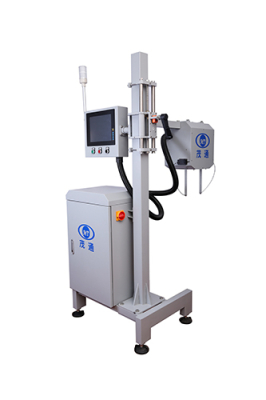
Track Every Bottle Finish Before Defects Move Downstream
For PET and PE packaging lines, the bottle finish is a small area with a large impact. A damaged sealing surface, chipped mouth, through-hole, or oval neck can affect downstream filling and sealing quality. The PET Bottle Mouth Inspection Machine is designed for fully automated, online, non-contact inspection of PET and PE bottle mouths, with rated operation at 48,000 bottles per hour. Its value comes from a synchronized process: each bottle is detected, identified, imaged, analyzed, displayed on the HMI, and rejected when the stored inspection result requires removal.

How the system follows each bottle
The working principle begins when a bottle passes the positioning sensor. The sensor detects its presence, and the control unit records the bottle ID together with the current encoder value. This pairing is essential because the bottle continues moving after inspection. Instead of treating inspection as a single camera event, the PET Bottle Mouth Inspection Machine keeps the bottle traceable from the detection point to the rejector.
Once the bottle reaches the inspection position, the positioning sensor signals the camera to capture an image of the bottle mouth. The process is non-contact, so the bottle is not touched during image acquisition. For high-speed production, this timing matters: the camera must capture the finish at the correct moment, while the encoder value keeps the control logic aligned with conveyor movement.
Image acquisition and processing logic
The PET Bottle Mouth Inspection Machine uses an LED area light source with front illumination. In the captured image, the bottle mouth appears as a continuous bright ring, making finish features easier to distinguish. The optical setup includes a fixed-focus lens with manual aperture adjustment, allowing focus and brightness to be tuned for clear imaging on the CCD sensor surface.

The camera is an area-array CCD analog camera with a resolution of 640 × 480 pixels and a capture capability of up to 60 frames per second. After the image is obtained, the image processor analyzes it for bottle mouth defects. The processed results are sent to the HMI for real-time display and simultaneously sent to the control unit, preparing the system for rejection when an unqualified finish is identified.
For buyers evaluating a Bottle Mouth Inspection Machine, this sequence is important because the decision and the reject action do not happen at the same physical location. The PET Bottle Mouth Inspection Machine stores the defect result with the tracked bottle ID, allowing the rejector to act only when the corresponding bottle reaches the rejection station.
Defects covered by the inspection module
The inspection scope focuses on finish problems that can directly affect sealing surface quality. The PET Bottle Mouth Inspection Machine is specified for PET and PE bottles and is used to inspect and reject bottles with deformation or damage on the sealing surface of the bottle finish.
| Inspection item | Specified defect condition | Detection accuracy | False rejection rate |
|---|---|---|---|
| Through-holes / penetration | Vertical section width 0.8 mm, depth 0.25 mm | ≥99.99% | ≤0.03% |
| Internal defects | Vertical section width 0.8 mm, depth 0.25 mm | ≥99.95% | |
| External defects | Vertical section width 0.8 mm, depth 0.25 mm | ≥99.95% | |
| Point defects | Diameter 0.8 mm, depth 0.25 mm | ≥99.99% | |
| Neck deformation / ovality | Diameter difference 2 mm | ≥99.95% |
Rejector timing and line integration
When the control unit receives a rejection signal, it activates the rejector to remove the specific bottle corresponding to the stored ID. This one-to-one relationship between bottle ID, encoder value, inspection result, and rejector action is the core of the PET Bottle Mouth Inspection Machine workflow.
The equipment can be installed inside the blow molding machine at the bottle discharge section or on the conveyor chain. Its operating conditions include an ambient temperature of 5°C–40°C, relative humidity of 50%–65% RH, 3 × 380V AC ±10% main power supply at 50 Hz, lighting power at 220V AC, total power consumption of approximately 1.0 kW, 24 VDC control voltage, and compressed air at 4–6 bar.
Why this process matters for production control
In modern machine vision inspection, reliable imaging is only part of the result. A practical production system must also know where each inspected container is after the image has been analyzed. The PET Bottle Mouth Inspection Machine combines sensor detection, encoder tracking, CCD imaging, HMI display, and rejector control into one continuous sequence. This helps production teams inspect every bottle finish online while reducing unnecessary interference with qualified bottles.
FAQs
How does the PET Bottle Mouth Inspection Machine identify each bottle?
As each bottle passes the positioning sensor, the control unit records the bottle ID and the current encoder value, allowing the system to track that bottle through inspection and rejection.
Is the inspection contact-based?
No. The PET Bottle Mouth Inspection Machine uses non-contact online machine vision inspection for PET and PE bottle mouths.
What defects can be inspected?
The system covers through-holes, internal chipping, external chipping, spot chipping, and deformed or oval-shaped bottle necks.
What is the rated capacity?
The rated capacity is 48,000 bottles per hour for compatible PET/PE bottle packaging lines.
Where can the machine be installed?
It can be installed inside the blow molding machine at the bottle discharge section or on the conveyor chain.