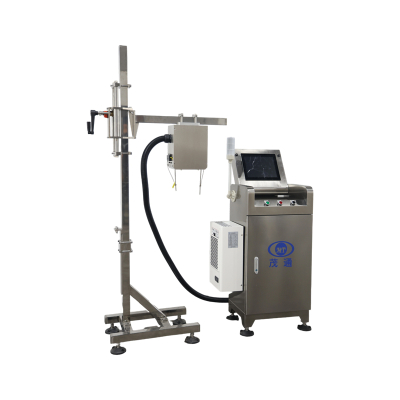
Bright Ring Imaging Makes Bottle Mouth Inspection More Stable
The PET Bottle Mouth Inspection Machine is designed for inline, non-contact inspection of PET and PE bottle finishes. Installed at the bottle discharge section of a blow molding machine or on a conveyor chain, the PET Bottle Mouth Inspection Machine helps identify deformation and damage on the top sealing surface before bottles move into downstream filling, capping, or packaging processes. For high-volume PET/PE production lines, this type of bottle finish control is especially important because small mouth defects can affect sealing reliability and line stability.

Why Inline Bottle Finish Inspection Matters
In PET and PE bottle production, the bottle finish is a small area with a large impact. Through-holes, chipping, localized point defects, and oval neck deformation may interfere with sealing performance. A Bottle Finish Inspection Machine reduces dependence on manual checking by inspecting each bottle as it passes through the line.
The PET Bottle Mouth Inspection Machine, model MT-PK021, is built for a rated speed of 48,000 bottles per hour and is suitable for PET / PE bottles. Its role is straightforward: the PET Bottle Mouth Inspection Machine inspects the bottle finish online, determines whether the mouth meets requirements, and rejects bottles with deformation or surface damage on the sealing area.
How the PET Bottle Mouth Inspection Machine Works
The inspection process follows a synchronized vision workflow. First, a positioning sensor detects each bottle and records the bottle ID together with the current encoder value through the control unit. This allows the system to track the bottle position accurately as it moves through the inspection and rejection area.
Next, the sensor triggers the camera to capture the current bottle mouth image. The image processor analyzes the image and sends the results to the human-machine interface for real-time display. At the same time, the processed result is sent to the control unit so the system can prepare for rejection if the finish is judged defective.
Finally, when the control unit receives a rejection signal, it activates the rejector to remove the bottle associated with the recorded ID. This closed-loop process helps the PET Bottle Mouth Inspection Machine inspect and reject defective bottles without interrupting normal line movement.
Bright Ring Imaging and Optical Configuration
A key feature of the PET Bottle Mouth Inspection Machine is its optical setup. The system uses an LED area light source with a service life of up to 30,000 hours. With front illumination, the inspected bottle mouth features become clearly visible. In the captured image, the bottle mouth appears as a continuous bright ring, making the sealing edge easier to analyze.

The imaging unit uses a fixed-focus lens with manual aperture adjustment. The focus ring is adjusted to achieve maximum clarity on the CCD sensor surface, while the aperture ring is fine-tuned to optimize image brightness. This configuration supports stable image acquisition and helps the inspection module detect defects on the mouth area more consistently.
The camera is an area-array CCD analog camera with a resolution of 640 × 480 pixels and an acquisition rate of up to 60 frames per second. Together, the LED area light, fixed-focus lens, and CCD camera form the core image acquisition components of the PET Bottle Mouth Inspection Machine.
Inspection Scope and Detection Performance
The PET Bottle Mouth Inspection Machine focuses on defects that are directly related to the bottle finish and neck geometry. The inspection scope includes through-holes, internal chipping, external chipping, point defects, and deformed or oval-shaped bottle necks.
| Inspection item | Representative dimension | Detection accuracy | False rejection rate |
|---|---|---|---|
| Penetration | Vertical section width 0.8 mm, depth 0.25 mm | ≥99.99% | ≤0.03% |
| Internal defects | Vertical section width 0.8 mm, depth 0.25 mm | ≥99.95% | — |
| External defects | Vertical section width 0.8 mm, depth 0.25 mm | ≥99.95% | — |
| Point defects | Diameter 0.8 mm, depth 0.25 mm | ≥99.99% | — |
| Neck deformation | Diameter difference 2 mm | ≥99.95% | — |
These parameters make the PET Bottle Mouth Inspection Machine suitable for production environments where the sealing surface must be checked repeatedly, quickly, and without contact. For plants using PET and PE containers, the inspection results help maintain more consistent control before the next production stage.
Installation and Operating Conditions
The PET Bottle Mouth Inspection Machine is designed for installation inside the blow molding machine at the bottle discharge position or on the conveyor chain. It is compatible with a 48,000 bottles/hour PET/PE bottle packaging line and fits into existing layouts with minimal disruption.
Typical operating conditions include an ambient temperature of 5°C–40°C, relative humidity of 50%–65% RH, and operating altitude of 5–3000 meters above sea level. The main power supply is 3 × 380V AC ±10%, 50 Hz, 3PH + N + PE, with lighting power at 220V AC, 50 Hz, single-phase. Total power consumption is approximately 1.0 kW, control voltage is 24 VDC, and compressed air requirement is 4–6 bar. Noise level is listed as ≤85 dB, with actual values varying according to container type, machine power, and site conditions.
FAQs
What containers can the PET Bottle Mouth Inspection Machine inspect?
It is suitable for PET and PE bottles and is used for online inspection of the bottle finish sealing surface on high-speed packaging lines.
Where is the machine usually installed?
The PET Bottle Mouth Inspection Machine can be installed inside the blow molding machine at the bottle discharge section or on the conveyor chain, depending on the layout of the PET/PE production line.
What defects are included in the inspection scope?
The inspection scope includes through-holes, internal chipping, external chipping, point defects, and oval-shaped neck deformation that may affect sealing performance.
What makes bright ring imaging useful?
Front illumination creates a continuous bright ring around the bottle mouth in the captured image, helping the system distinguish the sealing edge and related defects more clearly.
What camera specification is used?
The vision system in the PET Bottle Mouth Inspection Machine uses an area-array CCD analog camera with 640 × 480 resolution and image acquisition up to 60 fps.
What is the rated production capacity?
The PET Bottle Mouth Inspection Machine is rated for 48,000 bottles per hour on compatible PET/PE bottle packaging lines.