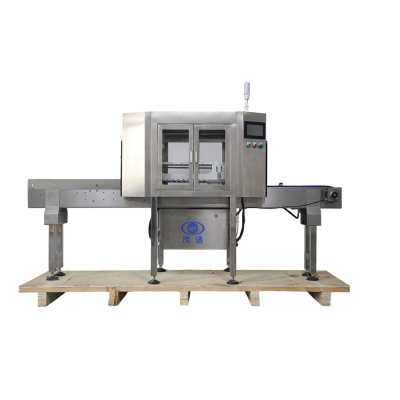
Visual Sealing Inspection Machine Keeps Can Lines Stable
High-speed canning lines demand seal inspection that keeps pace without direct product contact. The Visual Sealing Inspection Machine is specifically engineered for efficient, non-contact online inspection of sealing quality, automatically identifying and rejecting unqualified products. Tailored for 1L–2L cans, this advanced system integrates 360° cap inspection, visual grayscale analysis, a user-friendly color touchscreen HMI, and dual-side inspection for inkjet codes and QR codes directly on packaging.

Why Non-Contact Inline Seal Inspection Matters
A visible sealing abnormality can quickly pass through a high-speed production line if not caught at the inspection point. The Visual Sealing Inspection Machine tackles this risk by checking cans online without any mechanical contact, thus preserving product integrity while preventing inspection-induced damage. With a remarkable inspection speed of up to 72,000 cans/hour, it is perfectly suited for continuous can production environments where manual checks simply can't offer the same level of consistency and reliability.
Crucially, this system also helps detect sealing machine faults early, significantly reducing the chances of a large batch of defective products moving further downstream before the issue is addressed.
How the Visual Sealing Inspection Machine Works
The inspection principle relies on advanced image processing. A high-resolution camera, paired with a 360° sidewall optical lens, captures detailed images of the sealing area. The system precisely locates the cap, defines a circular inspection region along the sidewall edge, and then evaluates grayscale changes within that specific area. If the grayscale fluctuation exceeds a pre-configured threshold, the product is automatically flagged as defective and rejected.

It's important to realize that this Visual Sealing Inspection Machine performs visual seal inspection; it should not be confused with pressure testing or other physical leak-testing methodologies.
Operator Control and Code Verification
Effective inspection equipment needs to be straightforward to operate, shift after shift. This machine features a color touchscreen HMI (Human-Machine Interface) for intuitive operation, simplifying parameter settings and status reviews for production teams. Beyond just seal integrity checks, the equipment specification also includes dual-side inspection of inkjet printing and QR codes on packaging, providing comprehensive packaging quality control from a single inline station.
For buyers evaluating seal inspection solutions, this integrated approach—combining sealing inspection, code verification, and automatic rejection—can greatly simplify line planning by consolidating multiple critical quality checks into one cohesive system.
Modular System Design for Easier Maintenance
The equipment's mechanical structure is organized into three primary sections: the distribution cabinet, which supplies system power, processes images, and manages the rejection of defective products; the detection module, responsible for dynamic image capture; and the rejection device, which receives signals and efficiently removes failed products from the line.
This modular architecture not only provides multiple interfaces but also allows for future expansion or functional upgrades. The machine is engineered for high reliability, a low failure rate, and straightforward maintenance, all of which are crucial considerations for production lines that depend on stable, continuous operation. For similar seal-focused applications, the Can Body Seal Inspection Machine is also a key part of this inspection equipment category.
Installation Conditions to Confirm Before Commissioning
Stable imaging performance hinges on stable production conditions. Before installation, engineers must meticulously check the utilities, conveyor layout, and container stability around the inspection point.
| Installation Item | Specified Condition |
|---|---|
| Power Supply | AC 220V, 50Hz, single-phase |
| Power Consumption | Approx. 0.5 kW |
| Control Voltage | 24 VDC |
| Compressed Air | 4–12 bar |
| Ambient Temperature | 5–40°C |
| Relative Humidity | 50–65% RH |
| Altitude | 5–3000 m |
| Conveyor | 1.8 m single-row chain type |
| Conveyor Slope | ≤20° |
| Container Spacing | 3–5 mm |
The inspection area must remain clean and stable, especially around the bottle-neck or cap region. Factors like vibration and water droplets can negatively impact camera inspection accuracy. Should vibration be present at the inspection location, incorporating a 60–80 mm clamping device is recommended to enhance stability.
When This Machine Fits Your Line
The Visual Sealing Inspection Machine is particularly well-suited for producers requiring non-contact online seal inspection for 1L–2L cans, comprehensive 360-degree cap checking, reliable code verification, and automatic rejection within a modular system. Optimal performance always depends on matching the equipment to the specific container type, conveyor configuration, container spacing, and operating environment before full integration.
For in-depth project discussions and to review the Visual Sealing Inspection Machine product details, buyers are encouraged to contact Jinan Maotong Inspection Equipment Co., Ltd. at +8618612569280, via email at qibin@maotongtech.com, or through WhatsApp.
FAQs
What does the Visual Sealing Inspection Machine detect?
It visually assesses sealing quality by analyzing grayscale value changes within a circular inspection region around the sealing area. Products where this grayscale value exceeds a set threshold are automatically rejected.
Does the machine touch the cans during inspection?
No, the inspection process is entirely non-contact and performed online. This design helps preserve product integrity by preventing any inspection-related damage.
Can it inspect QR codes and inkjet codes?
Yes, the equipment is designed for dual-side inspection, capable of verifying both inkjet printing and QR codes on packaging.
What can sizes are specified for this machine?
The applicable can-size range for this machine is 1L–2L.
What site conditions are most important for optimal performance?
Key conditions include stable conveyor movement, consistent 3–5 mm container spacing, a clean inspection area free of water droplets, controlled vibration, an AC 220V power supply, and a compressed air supply of 4–12 bar.