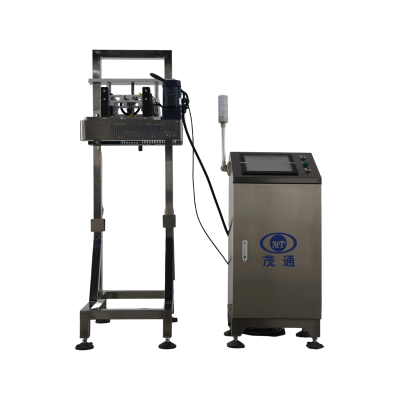
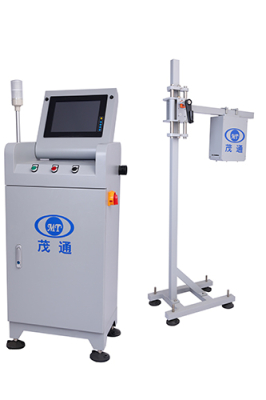
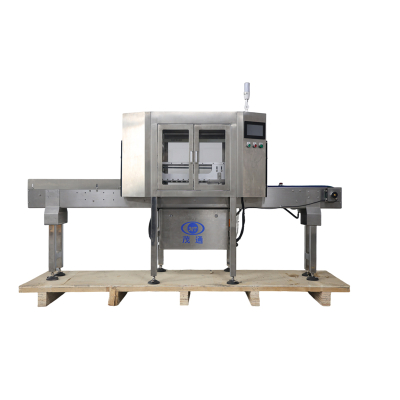
What is the Maotong Cap, Liquid Level & Coding Inspection Machine?
What is the Maotong Cap, Liquid Level & Coding Inspection Machine?
One-Sentence Definition
It is an online PET bottle vision inspection all-in-one machine independently developed by Jinan Maotong Inspection Equipment Co., Ltd. (Maotong Technology). Installed at the end of beverage, food, or pharmaceutical filling lines, it utilizes machine vision (CCD cameras + image processing) to automatically perform three types of inspections: cap integrity, liquid level accuracy, and coding quality, while automatically rejecting non-conforming products. It is also commonly referred to in the industry as a Vision Inspector or Cap/Liquid Level/Coding Integrated Detection System.
Inspection Scope (What it inspects)
This equipment primarily targets defects in PET bottles (and can be extended to cans/glass bottles) across the following categories:
Category | Specific Items |
|---|---|
Missing cap, tilted cap, high cap, loose cap, broken/missing tamper-evident band (security ring). | |
Low fill level, high fill level (under-filling or over-filling). | |
Coding Inspection | Missing code, incomplete characters, blurry printing, incorrect position/content of inkjet codes. |
If any defect is detected → The system automatically triggers the rejection mechanism (pneumatic pusher/sorting unit) to eject the product from the line.
Working Principle (How it works)
Taking a typical dual-station/multi-camera solution as an example:
Sensing & Positioning: Products pass a sensor; the system logs bottle ID and encoder signals for individual tracking.
Multi-Angle Imaging: Equipped with multiple GigE digital CCD cameras (e.g., Canadian brand cameras + Japanese lenses) and backlight/LED sources to capture the cap, liquid level, and coding areas from different angles.
Image Processing & Judgment:
Cap: Analyzes cap posture, height, and tamper band integrity via multi-angle images.
Liquid Level: Detects the grayscale difference between the liquid area (dark/opaque) and the empty bottle neck (light/transparent) to determine if the level is within tolerance (Accuracy up to ±1mm, with high-end models claiming ±0.5mm).
Coding: Uses OCR/template matching to verify presence, clarity, and correct positioning of codes.
Automatic Rejection: Rejection rate for defective products ≥ 99.99%, with integrated audible/visual alarms and data logging.
Key Performance Parameters (Typical Values)
Metric | Parameter |
|---|---|
Inspection Speed | Standard 60,000 bottles/hour; High-speed models up to 90,000 bottles/hour (model dependent). |
Liquid Level Accuracy | ±1mm (up to ±0.5mm). |
Container Range | Common 250mL–2L PET bottles, diameter approx. 20–100mm. |
Power/Structure | 220V, stainless steel enclosure, sealed anti-fog/drip design suitable for cold/hot filling environments. |
HMI/Software | Large touchscreen GUI (Chinese), 3-level user permissions, code character training function, MES/data traceability integration. |
Why Use It (vs. Manual Inspection)
Eliminates Human Fatigue & Leakage: Replaces error-prone manual visual inspection with stable, consistent automated detection.
Non-Contact & High-Speed: Does not disrupt production flow; speed-adaptive synchronization.
Compliance & Traceability: Coding/date inspection is critical for food & pharma regulatory compliance (incorrect batch codes = recall risk).
Space-Saving Integration: Combines three separate inspection functions into one compact unit, reducing footprint and integration complexity.