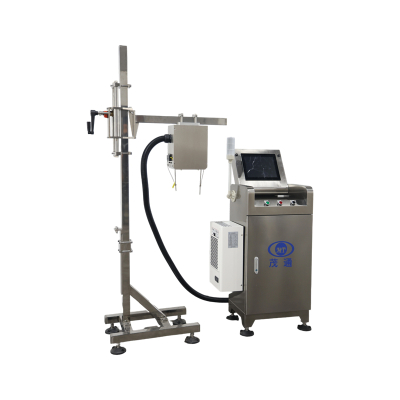
Giving Food Packaging a "Sharp Eye" for Inspection: How Modern Vision Inspection Technology Safeguards Food Safety
Food bags whiz by on the production line at a rate of 300 per minute, while an advanced vision-based inspection system captures every printing defect with 100% accuracy, minimizing food safety risks.
On high-speed food production lines, the production date, expiration date, and batch number on each packaging bag are crucial lines of defense for food safety. However, traditional manual inspection methods struggle to keep up with the high-speed production pace, inevitably leading to missed or incorrect inspections.
Machine vision-based printing inspection technology is fundamentally changing this situation. By mimicking and even surpassing the perceptual capabilities of the human eye, combined with artificial intelligence analysis and judgment, it builds a digital protective wall for food packaging safety.
1. The Severe Challenges of Food Packaging Printing Inspection
Food packaging printing inspection faces multiple technical challenges, mainly including complex packaging bag backgrounds, inconsistent printing quality, and variations in packaging bag shape.
Patterns, textures, or dark backgrounds on food packaging bags reduce the contrast between the printed code and the background, increasing the difficulty of recognition. At the same time, the printed code itself may have quality issues such as breaks, blurring, ink splattering, and uneven ink density.
Packaging bags on the production line may deform, wrinkle, or reflect light due to movement. These factors interfere with image acquisition quality, thus affecting the accuracy of the inspection results. Facing high-speed production lines with hundreds of packaging bags per minute, the inspection system must complete image acquisition, analysis, and judgment in a very short time, requiring extremely high real-time performance.
Traditional K3M sequential iterative algorithms, when extracting the skeleton of printed characters, are prone to deviating from the center for different shapes or irregular printed characters, affecting the accuracy of printing inspection. Manual inspection methods are not only inefficient but also prone to missed inspections due to fatigue, failing to meet the quality requirements of modern production.
2. Technical Principles and Innovations of Vision Inspection Systems
Modern food packaging printing vision inspection systems integrate various technologies such as optical imaging, image processing, and artificial intelligence, forming an efficient and reliable inspection solution.
Image Acquisition and Preprocessing
The system first uses industrial cameras to acquire images of the printed codes on the packaging bags, using specialized lighting to eliminate reflections and shadow interference. The system performs pre-processing operations such as median filtering, thresholding, and affine transformation on the acquired images to improve image quality and correct possible tilt.
A patented technology accurately judges the quality of inkjet printing by calculating the skeleton fitting degree and skeleton information density of pixels, constructing a distance field, and extracting skeleton extraction results. This method considers the distance between pixels and the similarity of normal vectors, enabling more accurate identification of character features.
Deep Learning and Lightweight Networks
In recent years, deep learning technology has been widely applied in the field of inkjet printing inspection. An improved algorithm based on YOLOv4, by designing a more reasonable feature pyramid size and incorporating angle regression information, allows the network to regress tighter prediction boxes, achieving an accuracy of 99.1%.
The introduction of denoising autoencoders effectively solves problems such as complex backgrounds and limited data in industrial inkjet printing scenarios. The improved MSDAnet network achieves an impressive inkjet printing detection rate of 99.81%, significantly outperforming traditional methods.
For real-time requirements, researchers proposed the Ghost-YOLO lightweight network. Based on YOLOv5, this network uses a phantom module to reduce the dimensionality of convolutional layers, reducing model parameters by 25%. Combined with position repetition suppression methods, this technology achieves high-precision real-time detection on embedded devices, with precision and recall rates reaching 100% and 99.99%, respectively.
Intelligent Closed-Loop Control System
Advanced vision inspection systems are no longer limited to single detection functions, but instead build a real-time closed-loop control system of "identification-detection-feedback-execution".
This system organically combines the laser inkjet printer with the vision inspection system. Once a printing defect is detected, a signal is immediately sent to the PLC, driving the rejection device to remove defective products from the production line, thus achieving fully automatic quality control.
3. Implementation Process of the Vision Inspection System
The implementation of a complete vision inspection system for food packaging bags involves multiple stages, each with clear technical requirements.
In terms of hardware deployment, industrial cameras, light sources, and trigger sensors need to be installed appropriately. The detection components are usually installed on the film pulling component. By detecting the distance of each translation of the film pulling component, image acquisition is precisely triggered, ensuring that each packaging bag is photographed in the correct position.
In the software algorithm development stage, image datasets need to be prepared and annotated. Researchers used industrial cameras to capture inkjet-printed images, then used annotation tools to label the inkjet samples, and augmented the data using image enhancement software to improve the algorithm's generalization ability.
During the system integration phase, the image acquisition, processing, judgment, and execution units are organically combined. When the system detects missing, incorrect, skewed, or misplaced characters in the inkjet printing on the packaging bags, it sends an NG signal to the rejection device, triggering rejection and an alarm.
4. Application Effectiveness and Future Development Trends
The application of the visual inspection system for inkjet printing on food packaging bags has shown significant results, playing a key role in improving quality, reducing costs, and enhancing traceability.
Taking a large food and beverage company as an example, after introducing a fully automated solution of "laser inkjet printer + visual inspection system," they achieved 100% zero-defect detection on a production line of 300 bottles per minute, completely eliminating customer complaints caused by labeling issues.
This system also brought considerable economic benefits, not only reducing the personnel required for quality inspection but also freeing personnel from repetitive and tedious inspection work. At the same time, the timely rejection of defective products avoided the waste of subsequent packaging materials, reducing overall production costs.
From a technological development perspective, food packaging inkjet printing detection is moving towards a more intelligent and efficient direction. The lightweighting of deep learning models will make detection systems easier to deploy on embedded devices, meeting the requirements of applications with higher real-time demands.
An end-to-end detection and recognition network framework is also an important development direction. This framework, by designing appropriate feature sampling layers, performs equally spaced sampling on the located inkjet printing area, allowing the features extracted in the object detection stage to be used as input for the character recognition branch, thereby improving detection and recognition speed and accuracy.
With the continuous advancement of algorithms and hardware, visual inspection systems will play an even more important role in food packaging quality control, providing technical support for enterprises to move towards "unmanned dark factories" and achieve intelligent manufacturing transformation and upgrading.
After a food company introduced the visual inspection system, the missed detection rate dropped from 1.5% with manual inspection to almost zero, resulting in direct economic benefits exceeding one million yuan annually due to reduced waste and rework. This system not only guaranteed the quality of outgoing products but also earned the company market credibility.
With the continuous advancement of artificial intelligence technology, future food packaging inkjet printing detection systems will be more intelligent and adaptive. They can not only identify defects but also predict equipment failures by analyzing data trends, achieving a leap from "treating existing problems" to "preventing potential problems," adding another intelligent layer of protection to food safety assurance.