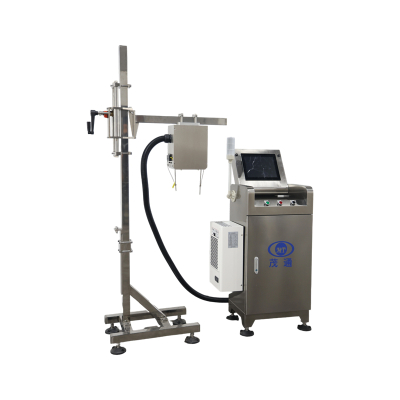
PET Label Inspection Machine Secures 60000 BPH Lines
For PET bottling lines, label defects are more than small cosmetic issues. A missing label, a label placed too high or too low, or an incorrect orientation can affect shelf presentation, downstream packaging, and final product release. Our PET Label Inspection Machine is designed as a PET Bottle Label Online Inspection System for fully automated, non-contact online inspection of PET bottle labels, with label presence and label height verification as core inspection items.

Project Design Basis
The project is defined as a PET Bottle Label Online Inspection System. It applies advanced machine vision technology to inspect PET bottle labels online without contacting the container. The designed throughput is 60,000 bottles per hour, and the applicable container type is PET bottles.
The PET Label Inspection Machine is installed on the single-row straight conveyor line behind the labeling machine. This position allows the system to inspect bottles immediately after labeling, so defective products can be identified and removed before they continue into later production stages.
Operating Conditions Buyers Should Confirm
Stable inspection with a PET Label Inspection Machine depends on both the machine and the production environment. The recommended operating altitude is 5–3000 meters above sea level, with an operating temperature of 5°C–40°C and relative humidity of 50%–65% RH. The workshop should meet relevant national standards for floor flatness and load-bearing capacity.
Key equipment conditions include:
| Item | Requirement |
|---|---|
| Noise | ≤85 dB, depending on container, machine power, and building acoustics |
| Voltage | 220V, 50Hz, single-phase |
| Total power | Approximately 1.0 kW |
| Control voltage | 24 VDC |
| Compressed air | 0.5 MPa, about 0.01 L per rejection cycle |
How the PET Label Inspection Machine Works
When a bottle reaches the positioning sensor, the system detects its presence and records the bottle ID together with the encoder value. The sensor then triggers the camera to capture the bottle label image. The image processor analyzes the result and sends inspection data to the Human-Machine Interface and the control unit.
If the bottle is judged defective, the control unit sends a signal to the rejector, which removes the corresponding defective bottle from the production line. In this way, the workflow supports real-time inspection and helps keep label quality control continuous rather than dependent on manual spot checks.
Image Acquisition and Inspection Content
The PET Label Inspection Machine uses an LED area light source with a service life of up to 50,000 hours. Foreground illumination helps present object details clearly, while a manual iris fixed-focus lens supports sharp imaging and brightness adjustment. The camera is an area-array CCD analog camera with 640 × 480 pixels resolution and image capture speed up to 60 frames per second.

The PET Label Inspection Machine supports 360-degree inspection, using multi-view stitching and color recognition technology. Its listed maximum inspection speed is up to 36,000 BPH, while the project design basis specifies a designed throughput of 60,000 bottles per hour.
Inspection items include:
| Inspection item | Detection basis | Rejection performance |
|---|---|---|
| No label | Label absence | 100% rejection rate |
| High label | Deviation ≥2 mm | ≥99.9% rejection rate |
| Low label | Deviation ≥2 mm | ≥99.9% rejection rate |
| Connection label | Requires color difference | ≥99.9% rejection rate |
The false rejection rate stated for the inspection group is ≤0.03%.
Structure and Line Integration
The equipment consists of multiple inspection units and an HMI, making it suitable for high-speed production lines. The detection unit uses an industrial control computer for data processing and communication with the control unit. The electronic control system integrates PLCs, program memory, photoelectric switches, inductive switches, and an HMI interface.
A rejection confirmation unit supports accurate removal of defective products, while the power distribution cabinet includes industrial air conditioning to help maintain an appropriate internal temperature. The compact design also helps reduce the footprint required on the production line.
For plants comparing inspection stations, related equipment such as the Skewed Label Inspection system and the Liquid Level Detection Machine may be evaluated according to the specific inspection scope required on the line.
FAQs
What does the PET Label Inspection Machine inspect?
It inspects PET bottle labels for no label, high label, low label, and incorrect orientation or connection-label conditions where color difference supports detection.
Where is the machine installed?
It is installed on the single-row straight conveyor line behind the labeling machine.
Is the inspection contact-based?
No. The system is designed for fully automated, non-contact online inspection.
What container type is supported?
The applicable container type specified for this system is PET bottles.
What is the designed throughput?
The project design basis lists a designed throughput of 60,000 bottles per hour.