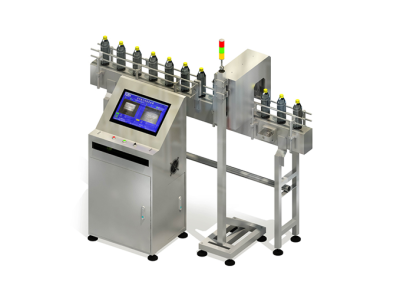
Use PET Label Inspection Machine for Cleaner Changeovers
A label defect may look small, but on a high-speed PET bottle line it can quickly become a packaging risk. The PET Label Inspection Machine is designed for fully automatic, non-contact online inspection of PET bottle labels, with a focus on label presence, label height, and orientation control. For beverage and packaged product manufacturers, the value is straightforward: detect visible label problems before bottles move further downstream.

Why Label Inspection Needs More Than Manual Checking
Manual spot checks struggle to keep pace when PET bottle production runs continuously. A PET Label Inspection Machine places inspection directly on the line, behind the labeling machine on a single-row straight conveyor. When each bottle passes the positioning sensor, the system records the bottle ID and encoder value, triggers image capture, analyzes the label image, and sends the result to the HMI and control unit.
If a bottle is judged unqualified, the control unit commands the rejector to remove it from the line. This workflow gives operators a clear way to manage label defects without relying only on visual sampling.
What the System Checks
The PET Label Inspection Machine focuses on practical label defects that affect packaging presentation and consistency:

| Inspection item | Detection condition | Rejection performance |
|---|---|---|
| No label | Label missing | 100% rejection rate |
| High label | Deviation ≥ 2 mm | ≥99.9% rejection rate |
| Low label | Deviation ≥ 2 mm | ≥99.9% rejection rate |
| Connection label | Requires color difference | ≥99.9% rejection rate |
The system also covers positive and negative label orientation, helping identify wrong label direction during online inspection. The specified false rejection rate is ≤0.03% for the listed inspection table.
Imaging Hardware and Dedicated Algorithms
The PET Label Inspection Machine uses an LED area light source with a service life of up to 50,000 hours. Foreground illumination helps present object details clearly, while a manual iris fixed-focus lens supports sharp imaging and brightness adjustment. The image acquisition setup includes an area scan CCD analog camera with 640 × 480 pixel resolution and image capture speed up to 60 frames per second.
For broader label coverage, the related 360° Label Inspection Machine page highlights 360-degree inspection, multi-view stitching, and color recognition technology. The image processing hardware uses imported components, while the software incorporates dedicated image-processing algorithms to support high-speed, high-accuracy, and high-reliability inspection tasks.
Built for High-Speed PET Bottle Lines
The project design basis identifies the system as a PET Bottle Label Online Inspection System for PET bottles, with designed throughput listed at 60,000 bottles per hour. Product feature information also lists a maximum inspection speed of up to 36,000 BPH. For buyers, these figures should be evaluated against the actual line layout, bottle type, label type, conveyor stability, and rejection requirements during project communication.
Key operating conditions include 220V, 50Hz, single-phase power, approximately 1.0 kW total power, 24VDC control voltage, compressed air at 0.5 MPa, and about 0.01 L air consumption per rejection cycle. Recommended ambient conditions include 5°C–40°C and 50%–65% RH.
One-Click Bottle Type Switching
A useful advantage of the PET Label Inspection Machine is recipe-based operation for different bottle shapes. Custom programs for various bottle types can be built in, allowing operators to switch bottle types through one-click operation. This matters on production lines where multiple PET bottle formats are handled, because repeatable parameter selection can reduce adjustment time and make changeovers more consistent.
The system structure includes multiple inspection modules, an industrial control computer, imported programmable logic controllers, photoelectric switches, inductive switches, and an HMI. Operating status and fault information are displayed graphically, giving operators a direct view of system conditions.
Closed-Loop Rejection Verification
Detection alone is not enough if defective bottles are not removed correctly. The PET Label Inspection Machine includes a rejection verification module for online monitoring. This module helps confirm that defective bottles are consistently rejected, supporting closed-loop quality control throughout the inspection process.
Its modular design also provides interfaces and reserved space for future expansion. The compact testing cabinet helps reduce footprint, while the power distribution cabinet uses industrial air conditioning to maintain suitable internal temperature and support service life.
Procurement Notes for Buyers
Before selecting a PET Label Inspection Machine, buyers should confirm bottle type, conveyor layout, label defect categories, production speed, compressed air supply, installation position, and environmental conditions. It is also worth reviewing how many bottle recipes will be needed and how operators will manage bottle type switching through the HMI.
For related line inspection needs, buyers may also review Skewed Label Inspection and other PET bottle inspection equipment depending on the production process.
FAQs
What does a PET Label Inspection Machine inspect?
It inspects PET bottle label issues such as no label, high label, low label, wrong orientation, and connection label conditions where color difference is required.
Where is the machine installed?
It is installed on a single-row straight conveyor line positioned behind the labeling machine.
Does the system support different bottle types?
Yes. Custom programs for various bottle shapes can be built in, supporting quick one-click bottle type switching.
What role does the rejection verification module play?
It monitors rejection online and helps ensure defective bottles are correctly removed from the production line.
What camera configuration is described for image acquisition?
The system uses an area scan CCD analog camera with 640 × 480 pixel resolution and up to 60 frames per second image capture speed.