Configure Pull Ring Cover Inspection Before Speed Becomes Risk
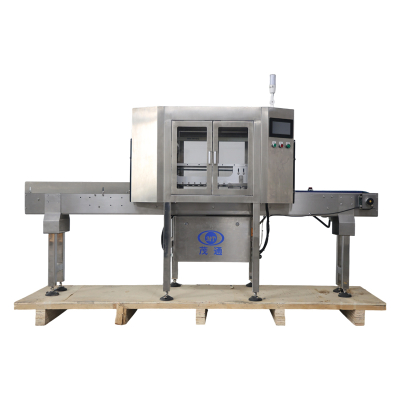
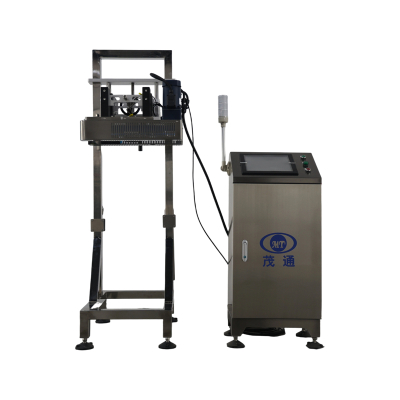
For high-speed canned beverage lines, cap quality is a critical checkpoint—a direct part of product integrity, line stability, and downstream packaging reliability. The Pull Ring Cover Inspection Machine Pull Ring Cover Inspection Machine is specifically designed for online cap inspection, integrating non-contact technology, 360° cap analysis, specialized lighting, a user-friendly HMI, automatic defect image storage, and real-time rejection into a continuous, streamlined workflow.

Equipment Configuration Details
The Pull Ring Cover Inspection Machine functions as a dedicated Can Cap Inspection Machine, built for continuous production environments rather than traditional offline sampling. Its design focuses squarely on cap inspection for high-volume canned beverage lines, where each can must be identified, thoroughly inspected, and either passed or rejected without disrupting the normal production flow. This Pull Ring Cover Inspection Machine ensures consistent quality at every stage.
| Parameter | Specification |
|---|---|
| Equipment name | Can Cap Inspection Machine |
| Model name | Pull Ring Cover Inspection Machine |
| Applicable production speed | Up to 60,000 cans/hour |
| Inspection area | Cap Inspection |
| Rejection method | Automatically rejects cans with defective caps detected by the inspection unit |
| Safety protection rating | IP65 |
Operating at speeds of up to 60,000 cans per hour, which translates to roughly 1,000 cans per minute, the performance of the Pull Ring Cover Inspection Machine heavily relies on conveyor stability, precise camera triggering, consistent lighting, and accurate reject timing. Beyond its core inspection capabilities, the Pull Ring Cover Inspection Machine Pull Ring Cover Inspection Machine also boasts a flexible human-machine interface (HMI) with multi-level user permissions for enhanced security and ease of use. Additionally, an industrial-grade cooling system is integrated to ensure stable, prolonged operation, even in challenging warmer conditions, minimizing potential malfunctions and downtime.
Detection Capabilities
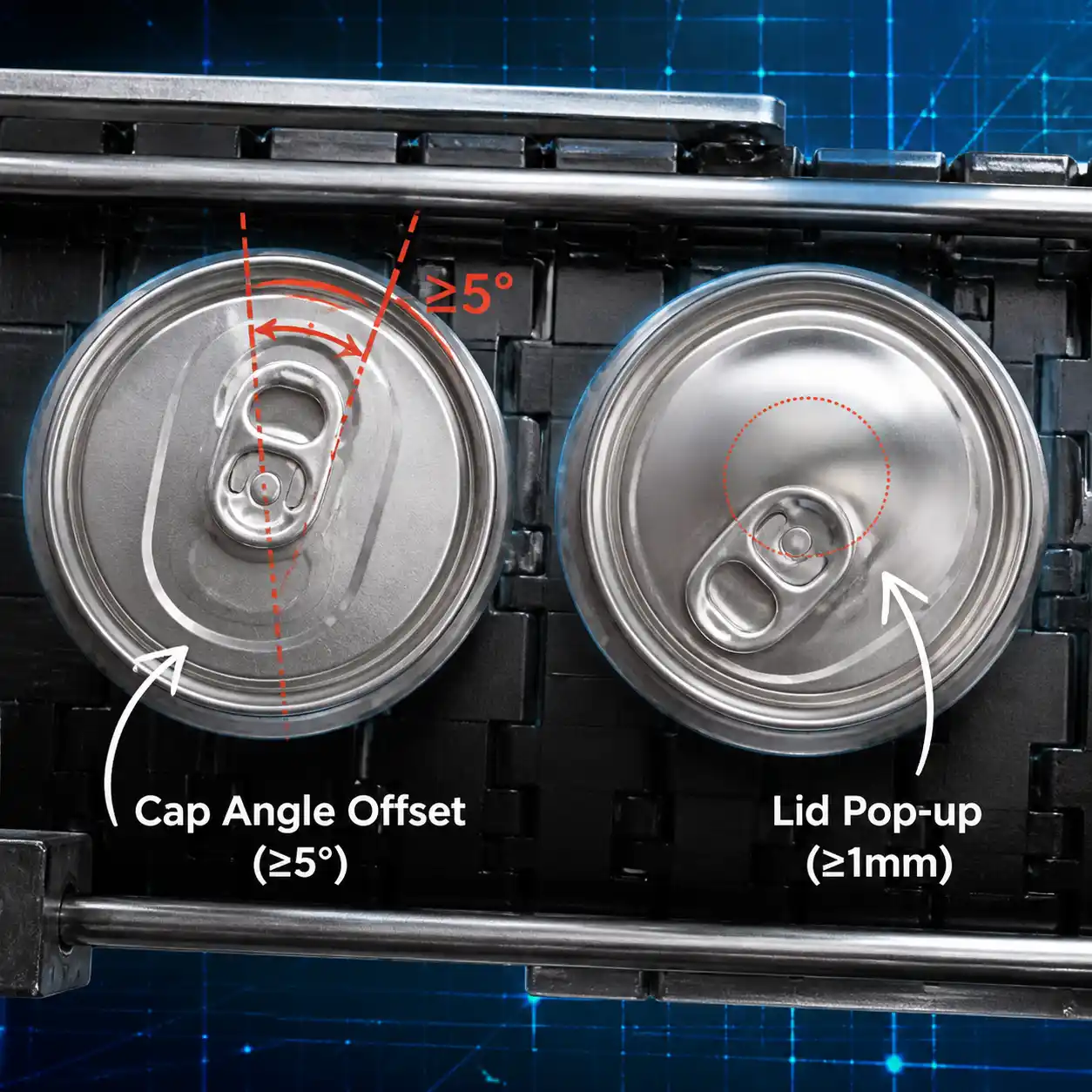
The Pull Ring Cover Inspection Machine excels at identifying three specific cap-related defects: missing caps, cap angle offset, and lid pop-up that can be caused by bulging cans or air leakage. These focused inspection targets are highly practical, addressing common cap conditions that significantly impact product appearance, seal integrity, and downstream handling efficiency.
| Inspection item | Detection content | Rejection rate | False detection rate |
|---|---|---|---|
| Bottle cap testing | No cap | ≥99.99% | ≤0.03% |
| Cap angle offset | Bottle cap deviation angle ≥5° | ≥99.9% | ≤0.03% |
| Lid pops up | Deviation value ≥1 mm | ≥99.9% | ≤0.03% |
These figures represent the standard accuracy values for the Pull Ring Cover Inspection Machine. However, actual settings might require fine-tuning based on the specific condition of the product cap and the degree of jitter present on the production line. For example, a rejection rate of “no cap” at ≥99.99% implies that, theoretically, only about one defective product out of 10,000 without caps might not be rejected. This level of precision is crucial for maintaining stringent quality control standards.
How 360° Inspection Works Online
During operation, the inspection sequence of the Pull Ring Cover Inspection Machine begins the moment a can passes its positioning sensor. The control unit promptly records the can’s unique identification number and its current encoder signal. This sensor then triggers a high-speed Gigabit digital camera to capture a detailed top-down image of the can cap, which is instantly transmitted over the network to the image processor.
The image processor then analyzes the cap image and sends the inspection results simultaneously to the HMI for dynamic display and to the control unit. For angle inspection, the system leverages advanced digital analysis and 360° template matching algorithms to precisely identify any caps that deviate from the required angle. When it comes to lid pop-up detection, the Pull Ring Cover Inspection Machine utilizes curved-surface scanning technology, continuously monitoring the top surface of each can cap for sudden surface changes that might indicate an abnormal seal or internal pressure issue.
Once an unqualified cap signal is confirmed, the control unit immediately instructs the rejector mechanism to remove the corresponding can from the production line. This real-time response prevents defective products from moving further down the line. Furthermore, the Pull Ring Cover Inspection Machine can store daily images of defective caps, with adjustable retention times, providing valuable data for later review and improving overall production management.
Installation Requirements Matter
The recommended installation position for the Pull Ring Cover Inspection Machine is a straight conveyor section measuring 1.5 to 2 meters, located directly downstream of the sealing machine. This strategic placement allows the system to inspect caps promptly after sealing, while also ensuring a stable product path crucial for accurate image capture and reliable rejection tracking.
Conveyor jitter is not a minor detail; it significantly impacts performance. Since the published detection accuracy of the Pull Ring Cover Inspection Machine may need adjustment based on line jitter and cap conditions, the commissioning process should always include practical observation of conveyor movement, cap presentation consistency, sensor timing, and the precision of the reject response. A stable installation enables the Pull Ring Cover Inspection Machine to align its inspection parameters with real production conditions, instead of just relying on nominal settings. This careful alignment ensures optimal and consistent performance.
Practical Value for Beverage Can Lines
For canned beverage manufacturers, the Pull Ring Cover Inspection Machine Pull Ring Cover Inspection Machine offers a highly structured and efficient solution for high-speed cap quality inspection. Its non-contact online inspection technology prevents any potential damage to products, while specialized light sources effectively reduce interference from various cover and pull-ring colors, enhancing detection accuracy. This advanced system also supports comprehensive 24-hour remote service, allowing for efficient troubleshooting and operational adjustments. It features continuous rejection capabilities and an automatic line stop function, which activates after a preset number of defective products have been rejected, preventing significant waste and ensuring consistent quality.
Ultimately, the Pull Ring Cover Inspection Machine is best seen as a complete inspection station where every component—the camera, lighting, image processor, HMI, encoder tracking, control unit, rejector, installation position, and overall line stability—works in concert to affect the final inspection result. This integrated approach ensures superior product integrity and operational efficiency for modern beverage production lines.
FAQs
What is the maximum production speed of the Pull Ring Cover Inspection Machine?
The specified applicable production speed is 60,000 cans/hour, which is equivalent to about 1,000 cans per minute.
Which defects can the Pull Ring Cover Inspection Machine detect?
It detects missing caps, cap angle deviation of ≥5°, and lid pop-up deviation of ≥1 mm caused by bulging cans or air leakage.
Where should the machine be installed?
We recommend reserving a 1.5–2 meter straight conveyor section immediately after the sealing machine for optimal performance.
Is the stated detection accuracy fixed in every factory?
No. The listed accuracy values are standard performance benchmarks. Specific settings may require adjustment based on the actual cap condition of the product and the degree of jitter on the production line.
Does the machine support automatic rejection?
Yes. When a defective cap is detected, the control unit promptly instructs the rejector to remove the corresponding can from the production line in real-time.