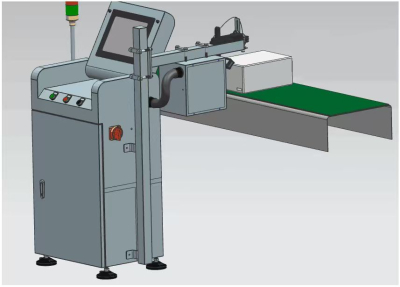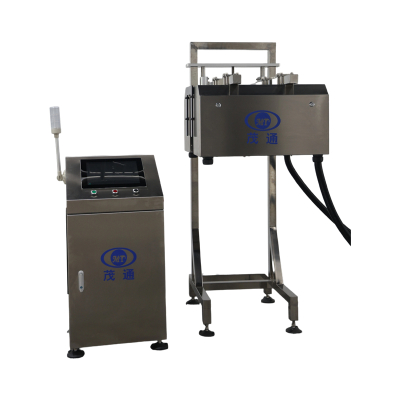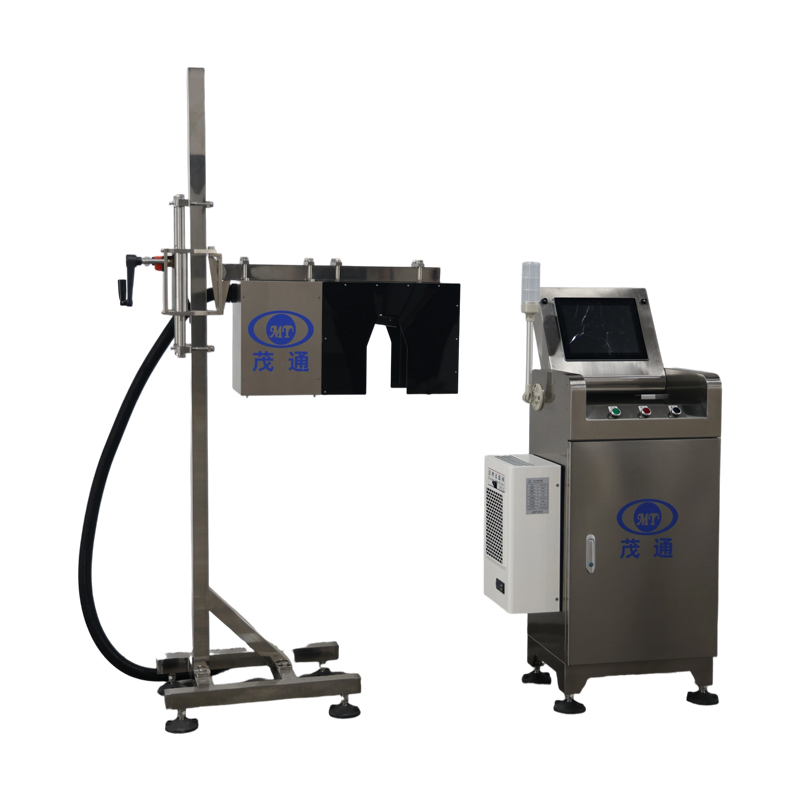
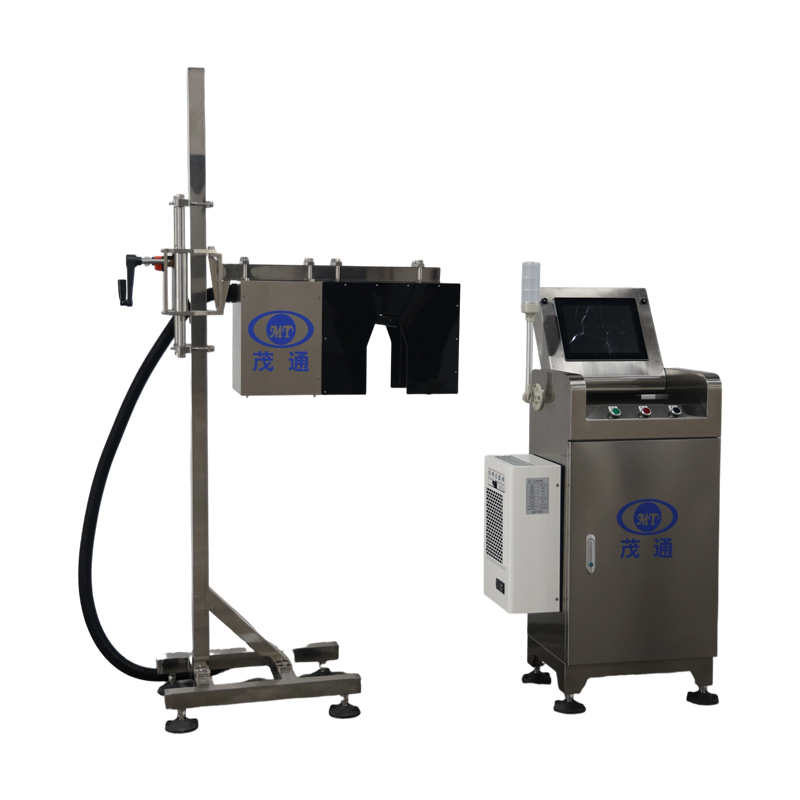
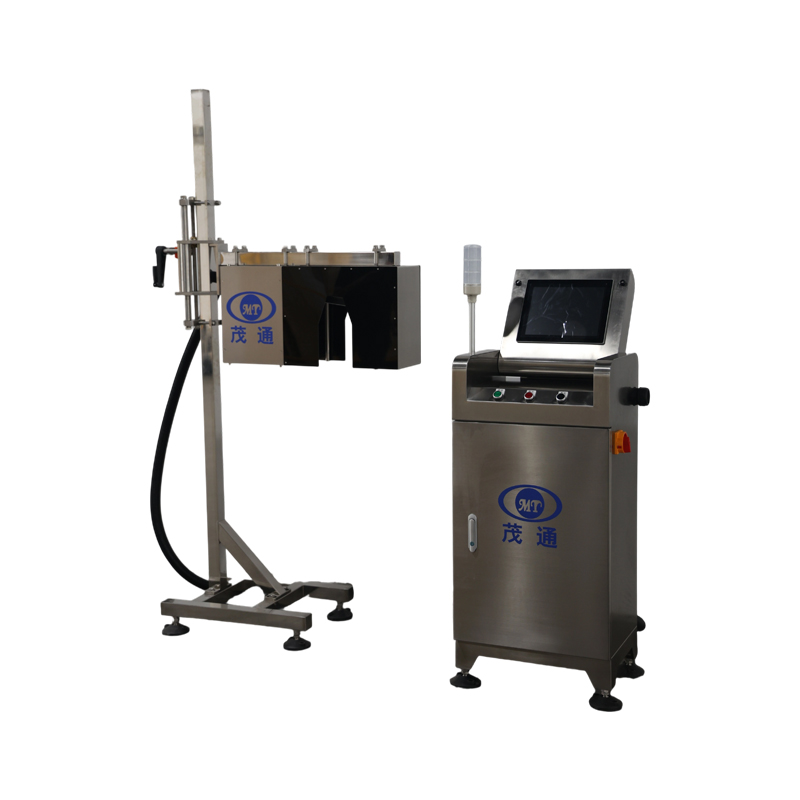
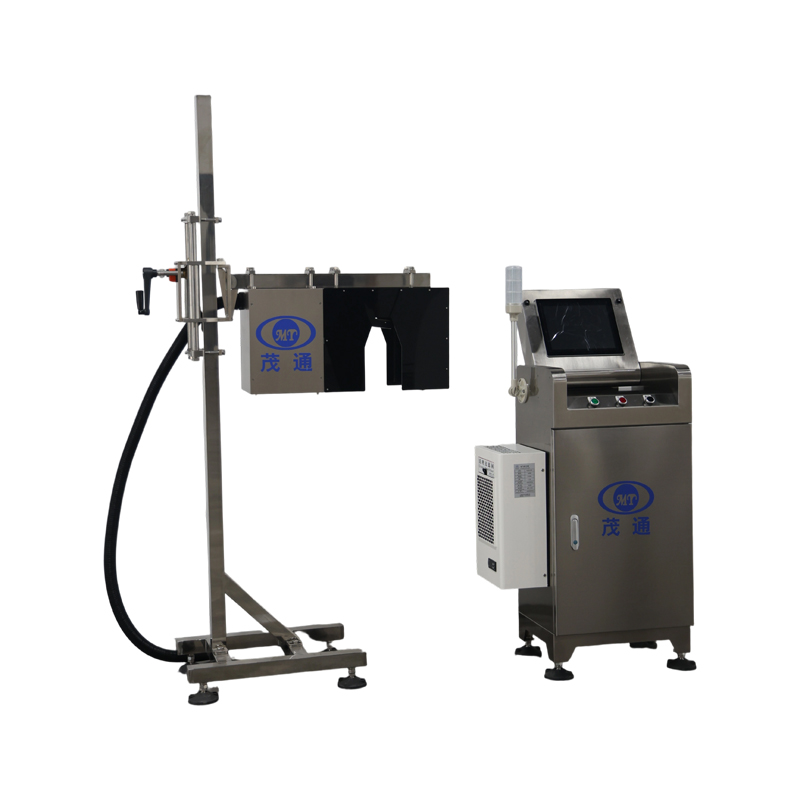
Inkjet Defect Detection Machine
1.The advanced algorithm is stable and has high detection accuracy
2.Detect different positions of code
3.The maximum speed is up to 72000 BPH
Inkjet Printing, Liquid Level & Tamper-Evident Ring Inspection System
I. Project Overview
1. Project Name
Inkjet Printing, Liquid Level, and Tamper-Evident Ring Inspection System
2. Project Description
The proposed inspection system is designed for the automated quality inspection of PET bottles. It detects defects related to cap integrity, tamper-evident ring condition, liquid level, and inkjet printing quality. Any bottle identified as non-conforming will be automatically rejected from the production line.
3. Maximum Production Speed
Up to 60,000 bottles per hour (BPH)
4. Applicable Container
PET bottles
5. Applicable Volume Range
200 mL – 2 L
II. Environmental and Site Conditions
1. Installation Altitude
5–3,000 m above sea level
2. Ambient Temperature
5°C–40°C
3. Relative Humidity
50%–65% RH
4. Factory Site Requirements
The installation site shall provide adequate floor flatness, structural load-bearing capacity, and other necessary site conditions in accordance with applicable national standards to ensure reliable and stable operation of the equipment.
5. Storage Requirements
After delivery, the equipment and its components shall be stored in an environment that complies with applicable national storage standards. Appropriate lubrication, corrosion protection, and preventive maintenance shall be carried out during storage to prevent surface damage, corrosion, deformation, or other conditions that may adversely affect subsequent installation, commissioning, and operation.
III. Utility and Operating Requirements
1. Electrical Power Supply
220 VAC, 50 Hz, single-phase
Any special or non-standard voltage requirements shall be confirmed prior to order placement. Changes to the specified power supply may result in corresponding adjustments to equipment configuration, manufacturing lead time, and project cost.
2. Total Power Consumption
Approx. 2.4 kW
3. Control Voltage
24 VDC
4. Compressed Air Supply
4–12 Pa
The customer shall provide the compressed-air pipeline from the air source to the main equipment unit.
Note: Please verify the compressed-air pressure unit. For industrial inspection equipment, 4–12 bar / 0.4–1.2 MPa may be intended rather than 4–12 Pa.
IV. Equipment Functions and Inspection Scope
1. Installation Position
The inspection system shall be installed at the designated position in accordance with the overall production line layout and process requirements.
2. Inspection Items
The system is capable of detecting the following defects:
Missing cap
Raised or improperly seated cap
Misaligned cap
Damaged or broken tamper-evident ring
Low liquid level
Missing inkjet code
Excessive ink coverage or abnormal inkjet printing
Incorrect or defective inkjet code
3. Inspection and Control Principle
Step 1 – Bottle Detection and Tracking
As each PET bottle enters the inspection area, the positioning sensor detects the bottle and sends a trigger signal to the control system.
The control system assigns a unique identification ID to each bottle and synchronizes the ID with the encoder's real-time position information. This enables accurate tracking of each bottle throughout the inspection and rejection process.
Step 2 – Image Acquisition and Defect Analysis
Based on the bottle's position and encoder information, the triggering system activates the camera units to capture images at three primary inspection areas:
Bottle cap
Liquid level
Inkjet marking
The inkjet inspection focuses on the printed code/marking itself, rather than the operation or condition of the inkjet printer.
The captured images are processed and analyzed by the vision processing system. Inspection results are displayed in real time on the HMI (Human-Machine Interface) and simultaneously transmitted to the PLC (Programmable Logic Controller) for further logic processing and defect determination.
Step 3 – Automatic Defect Rejection
When a defective bottle is identified, the PLC associates the inspection result with the corresponding bottle ID and tracks its real-time position using the encoder data.
When the defective bottle reaches the rejection station, the PLC sends a rejection command to the automatic reject mechanism, which removes the identified non-conforming bottle from the production line.
This closed-loop process ensures accurate bottle tracking, reliable defect identification, and automatic rejection of defective products without interrupting continuous production.
4. Equipment mechanical components
model
| Name | Components | Functional Description | Remark
|
1 | Distribution cabinet | Composed of an image processor, an interface processor, a strobe controller, and a PLC. | Provides power to the entire system, processes images, and controls the rejection of defective products. | |
2 | Detection module | LED light source, industrial CCD camera, and sensor. | Dynamically captures images of PET bottles. | |
3 | Rejection device | Main components include solenoid valves and mechanical components. | Receives signals and controls the rejection of defective products. |
5. Electrical composition of the equipment
model
| Name | Unit | Brand Notes | Quantity |
1 | Embedded imaging industrial computer (4 Ethernet ports) i5+4G+120G | Unit | Taiwan Chaoen, dust-proof, fast processing speed, and excellent stability | 1 |
2 | DAHUA high-speed gigabit digital camera | Unit | Resolution 680x480, imported from Canada, industry-leading brand | 4 |
3 | Camera I/O module | Set | Made-in-China | 4 |
4 | Lens | Piece | COMPUTAR 6MP, 12mm | 4 |
5 | Camera-50/30line cable | Piece | Made-in-China, 5m | 4 |
6 | MW.24v DC power supply 75/120W (DRP-75/120-24) | Piece | Taiwan Mean Well | 2 |
7 | PLC | Piece | Maotong independently developed | 1 |
8 | Touchscreen display | Piece | Taiwan IEI 15-inch | 1 |
9 | Light source controller | Unit | Customized in China, 4-way asynchronous triggering, screen flicker control technology, significantly extending light source life | 1 |
10 | Photo light source | Unit | Customized surface lighting, infrared, and blue | 4 |
11 | Power distribution cabinet | Piece | Made-in-China, 304 material, brushed, pickled, oxidized, and brushed finishes | 1 |
12 | Single-stage rejector Mono | Piece | Customized, air-push type, 304 material | 1 |
13 | Reject unit cylinder | Piece | Norgren high-speed cylinder, UK | 1 |
14 | Reject unit solenoid valve | Piece | MAC high-speed solenoid valve, US, 4.9ms response speed | 1 |
15 | Encoder | Piece | Made-in-China, Hode, incremental type | 1 |
16 | Low-voltage electrical components | Piece | Schneider, France | Several |
17 | Image processing system | Piece | Maotong independently developed, can develop V3.0 according to customer needs | 1 |
18 | Special equipment refrigeration unit - industrial air conditioner | Piece | Shanghai Highly Special, cooling capacity 320W | 1 |
19 | Terminal blocks | Piece | Honeywell, USA | Several |
20 | Photoelectric sensor | Piece | Leuze, Aurora PNP | 1 |
21 | Other electrical components | Piece | - | Several |
22 | Cabinet material and surface treatment | Piece | 304 material, igus® mechanical parts, brushed, pickled, oxidized, and brushed finishes. | 1 |
23 | Alarm light | - | Several | |
24 | Oil-water separator | - | Schneider tri-color tower light | Several |
25 | Relay | Piece | 1 | |
26 | Glass material | Piece | AirTac | 1 |
6. Testing cabinet structure diagram
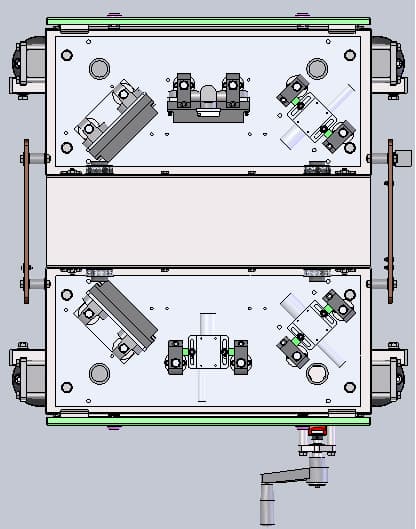
Capping liquid level detection (capping liquid level detection at stations one and three)
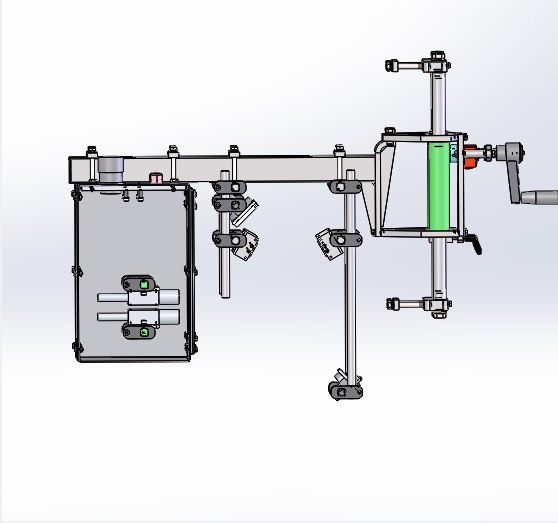
Inkjet printing inspection (station 2, single-camera inkjet printing inspection)
This module employs three CCD cameras positioned at different angles to capture images of each bottle, effectively minimizing blind spots. Equipped with specialized optical lenses, it filters light from multiple directions to enhance image clarity and acquisition efficiency. The system is designed to identify cap-related defects, including missing caps, raised caps, tilted caps, and damaged caps.
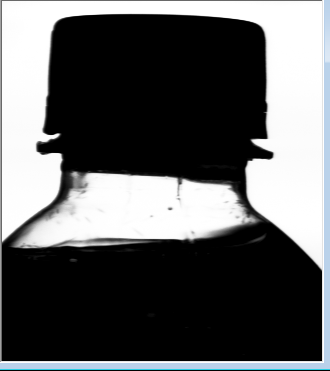
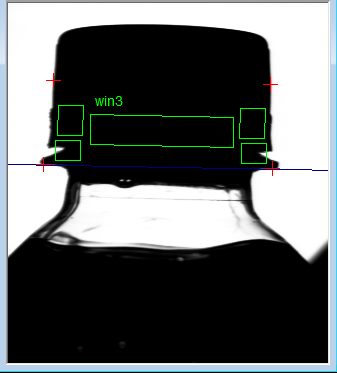
PET bottle capping images captured by CCD camera
8. Liquid Level Detection
This module uses a CCD camera to capture a frontal image of the bottle’s liquid level. It ensures that the liquid surface inside the container appears horizontally aligned when the bottle is at rest. Through image processing, the region below the liquid level is rendered black, while the upper portion representing the empty space of the bottle is shown in white. A specialized algorithm is then applied to distinguish whether the liquid level is above or below the preset threshold.
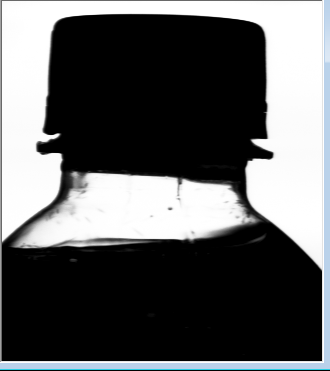
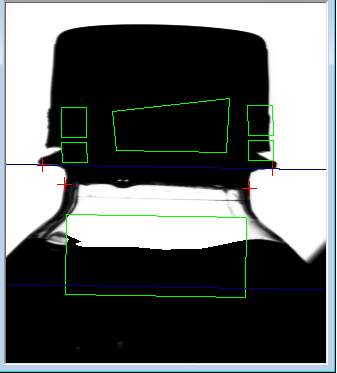
PET bottle image captured by the camera Processed liquid level detection image
9. Inkjet Printing Inspection
This module uses a CCD camera to capture images of the inkjet printing on bottles and caps from the front. It then digitally analyzes the captured images and automatically and accurately rejects bottles with unqualified inkjet printing. It is compatible with both yellow caps with black ink and black caps with white ink.
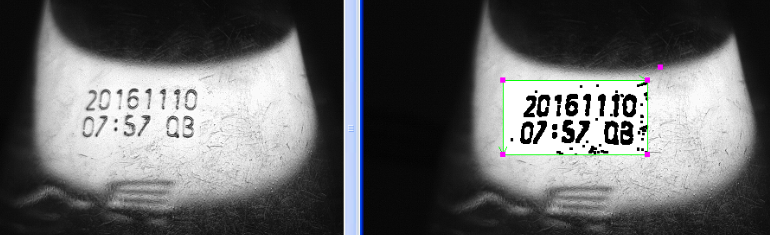
Sample image recognition processing effect
10. Detection accuracy
Inspection Items | Inspection Contents | Detection accuracy
| Rejection rate
|
| No cap | —— | ≥99.99% |
High cap | >0.8 mm | ≥99.98% | |
Crooked cap | >0.8 mm | ≥99.5% | |
Safety ring 100% disconnected | >1mm gap | ≥99.99% | |
Safety ring >70% broken | >1mm gap | ≥98.32% | |
Safety ring >50% broken | >1mm gap | ≥95.78% | |
Safety ring 100% missing | —— | ≥99.99% | |
Safety ring 70% missing | —— | ≥98.21% | |
Safety ring 50% missing | —— | ≥95.78% | |
Inspection Items | Liquid level detection (high and low) | 3mm below (or above) the standard
| ≥99.92% |
Bottle Cap Inspection | No inkjet print | ≥99.99% | |
Overall inkjet print 50% missing | ≥99.95% | ||
Overall inkjet print 30% missing | ≥99.9% | ||
Overall inkjet print 20% missing | ≥99.8% | ||
Inkjet print is blurred enough to remove the inkjet characters after processing | ≥99.99% |