X-ray Liquid Level Detection Technology for PET Bottles: Principles, Applications, and Prospects
In the beverage and pharmaceutical industries, the accuracy of liquid levels in PET plastic bottles is crucial for product quality and production costs. X-ray detection technology is becoming a key tool in ensuring this accuracy.
In the food and beverage and pharmaceutical industries, PET bottles are a common packaging form, and the accuracy of their filling level directly impacts product quality, production costs, and consumer rights. Traditional detection methods such as float methods, capacitance methods, or ultrasonic detection often prove inadequate when dealing with the opacity or special shapes of PET bottles.
X-ray liquid level detection technology, as a non-contact detection method, has become an important technological means for PET bottle liquid level detection due to its high precision and efficiency.
1. Principles of X-ray Liquid Level Detection Technology
X-ray liquid level detection technology is based on the physical principle of the interaction between radiation and matter. When X-rays penetrate matter, they interact with the matter, causing intensity attenuation, which follows the Beer-Lambert law.
The mathematical expression of this law is: I = I₀e^(-μρd), where I₀ is the incident radiation intensity, I is the radiation intensity after penetrating the object, μ is the mass attenuation coefficient, ρ is the density of the medium, and d is the penetration thickness.
In PET bottle liquid level detection, the X-rays emitted by the X-ray source penetrate the bottle and the liquid inside, and are then received by the detector. Changes in the liquid level height cause changes in the composition of the material along the X-ray penetration path, thus causing corresponding changes in the radiation intensity received by the detector.
In the area below the liquid level, the X-rays must penetrate the bottle wall and the liquid, resulting in greater attenuation; in the area above the liquid level, the X-rays only penetrate the bottle wall and air, resulting in less attenuation. By measuring this difference in attenuation, the liquid level position can be accurately determined.
Dual-energy X-ray technology further improves detection accuracy. This technology simultaneously utilizes two types of X-rays, high-energy and low-energy, and by analyzing the difference in attenuation between the two, it can effectively eliminate the interference of container wall material and thickness differences on the measurement results, achieving more accurate liquid level measurement. 2 Key Components of the PE Bottle X-ray Liquid Level Detection System
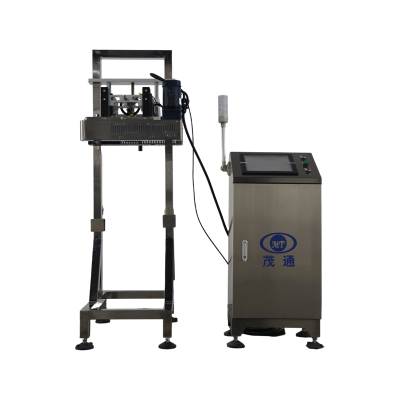
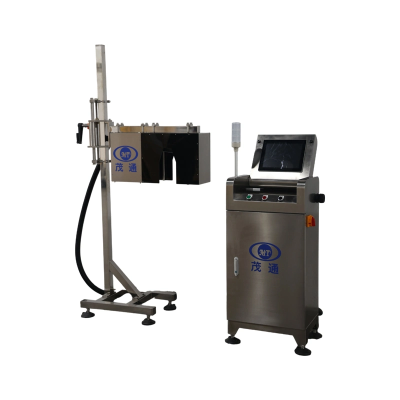
A complete PE bottle X-ray liquid level detection system typically consists of the following core modules:
2.1 X-ray Generation Module
The X-ray generation module is responsible for producing a stable X-ray beam. It usually consists of an X-ray controller and an X-ray generator, which can generate X-rays of specific energy and intensity under the control of the host computer.
To meet the needs of PE bottle detection, this system typically uses a point source combined with a collimator to produce a parallel X-ray beam, reducing scattering interference. The latest equipment is also equipped with an intelligent control system that can automatically adjust the X-ray parameters based on the bottle material and thickness to optimize the detection effect.
2.2 Detection Module
The detection module is responsible for receiving the X-rays that penetrate the bottle and converting them into electrical signals. Commonly used detectors include photodiode arrays and linear array detectors. Point or bar-shaped detectors can be selected according to detection requirements.
The sensitivity and stability of the detector directly determine the detection accuracy. New solid-state detectors use crystalline materials such as sodium iodide and cesium iodide, which have high efficiency and good stability, superior to traditional gas detectors.
2.3 Mechanical Transmission and Positioning Mechanism
To ensure detection accuracy, the system is usually equipped with straightening guides or conveyor belt mechanisms to precisely position and stably transport the PE bottles during the detection process. These mechanisms reduce measurement errors caused by bottle shaking and ensure that each bottle passes through the detection area in a consistent posture.
2.4 Signal Processing and Control System
The signal processing system is responsible for amplifying, filtering, and digitizing the weak signals output by the detector. Modern X-ray liquid level detection systems mostly use high-performance processors and advanced algorithms to achieve rapid signal processing and accurate liquid level calculation.
The host computer software is not only responsible for controlling the operation of the entire system but also provides functions such as data storage, statistical analysis, and defective product marking, providing comprehensive data support for production quality monitoring.
3 Unique Advantages of X-ray Liquid Level Detection in PE Bottle Applications
3.1 Non-contact Detection
The biggest advantage of X-ray liquid level detection is its non-contact nature. The detection equipment does not directly contact the PE bottle or the liquid inside, avoiding the risk of cross-contamination, which is especially important in the pharmaceutical and food industries.
At the same time, non-contact detection also means no wear and tear on parts, reducing equipment maintenance requirements and lowering long-term operating costs. 3.2 Powerful Penetration Capability
X-rays have excellent penetration capabilities for a variety of materials, easily penetrating PE bottle walls and other common packaging materials (such as glass, metal, composite materials, etc.). This characteristic makes X-ray detection technology independent of bottle color, transparency, or shape, enabling accurate liquid level detection even for completely opaque dark-colored PE bottles.
3.3 High Precision and High Efficiency
Modern X-ray liquid level detection systems can achieve detection accuracy of up to ±1mm, with a maximum detection speed of up to 72,000 bottles/hour, fully meeting the needs of high-speed production lines.
By employing advanced image processing algorithms (such as edge detection, contour analysis, and fast convolution integration), the system can accurately identify the liquid level position, maintaining high recognition accuracy even in complex situations involving foam and bubbles.
3.4 Multi-Parameter Detection Capability
In addition to basic liquid level detection, the X-ray system can simultaneously perform multiple quality inspection tasks, such as bottle cap sealing integrity, impurity detection, and volume calculation. This "one-time detection, multiple results" feature further improves the efficiency and cost-effectiveness of production quality control.
4 Technical Challenges and Solutions
4.1 Container Wall Interference
Uneven wall thickness or complex shapes of PE bottles can pose challenges to liquid level detection. To address this issue, the latest technical solutions employ a container wall separation model, using a differential method of X-ray penetration path differences at different angles within the same scanning plane to effectively eliminate the interference of container wall thickness and material on attenuation data.
Dual-energy X-ray technology, through the difference in attenuation characteristics of high and low-energy X-rays, can better distinguish between container material and liquid, improving detection accuracy.
4.2 Radiation Safety Considerations
Although the radiation dose of X-ray detection systems is controlled within safe limits, radiation protection remains an important consideration in system design. Modern equipment typically employs multiple protection designs, including lead shielding layers and grating protection, to ensure operator safety.
Relevant international and domestic standards (such as GB/T 25845-2010) provide clear specifications for the safe production and use of radioactive liquid level gauges. Users should select equipment that complies with these standards and establish strict operating procedures.
4.3 Algorithm Processing Speed
High-speed production lines require extremely high real-time performance from the detection system. Currently, advanced detection systems utilize edge computing devices and dedicated acceleration engines (such as TensorRT) to control overall processing time within 50 milliseconds, meeting real-time detection requirements.
5 Application Scenarios and Benefits Analysis
X-ray PE bottle liquid level detection technology has been widely applied in multiple industries:
In the beverage industry, it is used to detect the filling volume of bottled water, carbonated drinks, fruit juices, and other products, ensuring that products meet the nominal capacity and reducing cost losses due to underfilling or overfilling.
In the pharmaceutical industry, it is used for liquid level detection of medical packaging such as injections and infusion bottles, ensuring accurate drug administration and avoiding drug waste due to inaccurate liquid levels.
In the daily chemical industry, it is used for liquid level detection of PE bottle packaging products such as shampoos and shower gels, maintaining brand image and protecting consumer rights.
According to statistics, the use of X-ray liquid level detection systems can improve production line filling accuracy by more than 30%, reduce the rate of undetected defective products to below 3%, and significantly improve overall production efficiency.
6 Future Development Trends
With technological advancements, X-ray liquid level detection technology for PE bottles is developing towards a more intelligent and efficient direction:
The deep integration of artificial intelligence and machine learning will enable the detection system to have self-learning and adaptive capabilities, continuously optimizing detection algorithms and improving adaptability to different products and production conditions.
The integration of Internet of Things (IoT) technology will enable data interconnection between devices, making the detection system an important part of the intelligent manufacturing system, providing real-time and comprehensive data support for production management.
The continuous improvement of detection speed and accuracy will remain the core direction of technological development. With advancements in detector technology and processing algorithms, future systems are expected to achieve higher detection speeds while maintaining high accuracy.
With the continuous progress of X-ray technology, we have reason to believe that future PE bottle liquid level detection will become more precise and efficient. As researchers have stated, new algorithms can improve the accuracy of identifying hazardous liquids to over 97%, while reducing the false positive rate to below 3%.
For companies pursuing high-quality production, investing in advanced X-ray liquid level detection technology is not only a guarantee of quality control but also a strategic choice to enhance market competitiveness. In the context of intelligent manufacturing, this technology will continue to evolve, providing more comprehensive solutions for various industries.