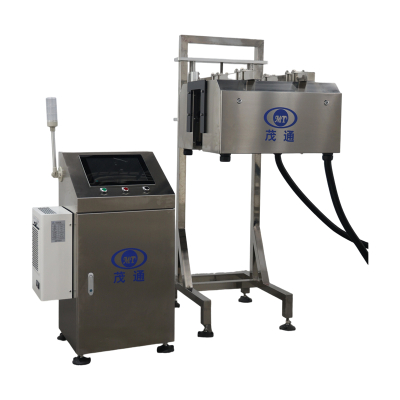
PET Empty Bottle Inspection Technology: A Critical Link in Safeguarding Packaging Quality
What seems like a simple plastic bottle is backed by a sophisticated inspection system.
PET empty bottles, as a primary packaging form for the food, pharmaceutical, and cosmetics industries, have a quality that directly impacts the safety and shelf life of their contents. During production, PET empty bottles inevitably develop defects such as damaged necks, cracks, and deformed bottoms. These defects can lead to product leakage, contamination, or spoilage. PET empty bottle inspection equipment, through automated inspection technology, can efficiently identify and remove defective bottles, reducing raw material waste and lowering production costs.
1. The Importance of PET Empty Bottle Inspection
During the production process, PET empty bottles can develop various defects from blow molding to the filling stage. Damaged or cracked bottle necks can lead to poor sealing, causing leakage or spoilage of the contents; deformed bottoms affect bottle stability and can lead to collapse during transportation and stacking.
These defects not only affect product appearance but can also trigger food safety issues, resulting in both economic and reputational losses for the company.
Online inspection equipment can promptly remove defective empty bottles before filling, preventing substandard products from entering subsequent processes. This not only reduces raw material waste but also avoids production losses caused by packaging problems, meeting the dual requirements of quality control and cost management in modern manufacturing.
2. Main Technical Indicators of Inspection
PET empty bottle inspection covers multiple technical indicators, mainly divided into three categories: appearance defect detection, sealing performance detection, and dimensional accuracy detection. Visual Defect Detection
• Bottle Mouth Integrity: Detects whether the bottle mouth is damaged, cracked, or deformed.
• Bottle Bottom Defects: Identifies whether the bottle bottom is deformed or has other defects.
• Bottle Body Appearance: Checks the bottle body for stains, bubbles, or scratches.
Sealing Performance Testing
• Gas Barrier Properties: Measures the barrier properties of PET bottles against gases such as oxygen and carbon dioxide.
• Water Vapor Transmission Rate: Detects the amount of water vapor transmission to assess moisture resistance.
• Sealing Reliability: Tests the bottle's sealing performance using vacuum decay or pressure difference methods.
Dimensional Accuracy Testing
• Vertical Axis Deviation: Measures the vertical deviation between the center of the bottle mouth and the center of the bottle bottom.
• Bottle Mouth Dimensions: Precisely measures key dimensions such as bottle mouth diameter and thread specifications.
• Outer Contour Dimensions: Checks whether the overall contour of the bottle body meets specifications.
3. Mainstream Detection Technologies and Equipment
Three main detection methods have emerged in the field of PET empty bottle inspection: manual inspection, sensor-based inspection, and computer vision inspection. Manual inspection is a traditional industrial inspection method, mainly involving inspectors visually observing each PET bottle for defects. However, it suffers from low detection rates, slow speed, difficulties in data collection and analysis, and high costs.
Modern automated inspection systems mainly employ the following technologies:
Machine Vision Inspection System
Machine vision inspection systems use high-resolution cameras and specialized light sources to comprehensively photograph the bottle mouth, body, and bottom, and analyze defects using image processing algorithms.
The bottle mouth inspection component typically includes a high-brightness light source, a semi-reflective glass plate, and a bottle mouth inspection camera, capable of accurately identifying bottle mouth defects. The bottle bottom inspection component uses a backlight and a bottle bottom inspection camera for transmission inspection, effectively identifying defects such as deformation or cracks.
These systems offer high detection accuracy, with an accuracy rate of over 99%, and a detection speed of up to 36,000 bottles/hour, suitable for high-speed production lines.
Sealing Performance Testing Equipment
Sealing performance testing equipment mainly includes gas transmission rate testers, water vapor transmission rate testers, and sealing testers. Differential pressure gas permeation testers can test the barrier properties of PET bottles against gases such as oxygen and carbon dioxide; water vapor transmission rate testers are specifically used to measure the water vapor transmission rate of materials; and sealing testers use a vacuum principle to detect the sealing reliability of bottles.
Precision Leak Tester
The precision leak tester uses differential pressure analysis for leak detection. When the inflation valve opens to inflate the empty bottle, the sensor monitors the pressure change inside the bottle in real time. When the reference pressure is greater than the pressure inside the bottle, a negative differential pressure (-DP) is generated. Bottles with leaks will have abnormal differential pressure values, and the equipment will automatically reject defective products based on this.
This type of equipment can utilize a new American detection system, with dual independent leak detection channels per station, offering high precision and reliability, with an accuracy of up to 0.01mm, suitable for various specifications of PET bottles from 5ML to 10L.
4. Detection Workflow and Principles
A typical PET empty bottle detection system includes a bottle neck defect detection component, a bottle bottom defect detection component, and a defective product rejection component. These components work together to achieve comprehensive detection of empty bottles.
The detection process begins with the sensor component detecting the position of the PET empty bottle. When the empty bottle rotates with the star wheel of the production line to the detection station, the infrared sensor triggers the detection system to start working.
Next, the bottle neck defect detection component begins to work. A high-brightness light source illuminates the bottle neck through a semi-reflective glass plate. The bottle neck detection camera captures the bottle neck image, and image processing algorithms analyze whether there are defects such as damage or cracks.
In the simultaneous bottle bottom detection, a backlight illuminates from below the bottle bottom, and the bottle bottom detection camera captures the bottle bottom image from above, identifying whether there is deformation or other defects in the bottle bottom.
When the system identifies a defective bottle, the defective product rejection component starts to operate. A cylinder pushes the rejection plate, removing the defective bottle from the production line, ensuring that unqualified products do not enter the filling process.
For larger PET empty bottles, an innovative solution is to use a mirror system to shorten the detection distance. This solution uses two reflections from the lower and upper mirrors, allowing the CCD camera to capture a complete image of the entire large-sized bottle at a relatively short distance, significantly saving equipment space. 05 Industry Development Trends and Innovations
PET empty bottle inspection technology is developing towards greater efficiency, accuracy, and intelligence. With advancements in computer vision technology and artificial intelligence algorithms, modern inspection systems can achieve more complex defect identification and classification functions.
One important innovation is the application of dynamic rotating inspection systems. This system uses a rotating rod-driven component to rotate the empty bottle, and a CCD camera, in conjunction with a mirror system, captures images of the bottle from multiple angles, enabling precise measurement of the bottle's outer contour and neck dimensions.
Inspection algorithms are also continuously being optimized, including operations such as maximum value dilation and minimum value erosion on images, followed by gradient image generation and contour boundary extraction, significantly improving detection accuracy and reliability.
With the deepening of the Industry 4.0 concept, PET empty bottle inspection equipment is being deeply integrated with other systems on the production line, enabling data sharing and intelligent control. Modern inspection systems can record the total number of bottles inspected and the number of defective bottles, providing data support for production process optimization.
Future PET empty bottle inspection technology will focus more on multi-functional integration. A single device may simultaneously perform multiple tasks such as appearance inspection, dimensional measurement, and leak testing, significantly improving inspection efficiency and cost-effectiveness.
Advances in inspection technology are directly related to product quality and safety. With the continuous development of machine vision, artificial intelligence, and other technologies, PET empty bottle inspection will evolve towards a more intelligent and efficient direction, providing more reliable quality assurance for the packaging industry.
In the future, with further improvements in detection accuracy and continuous breakthroughs in detection speed, PET empty bottle inspection technology will play an even more important role in the food, pharmaceutical, and cosmetics industries, providing strong support for companies to reduce production costs and improve product quality.